What I’d Like to Say to . . .

This is what I’d like to say to . . .

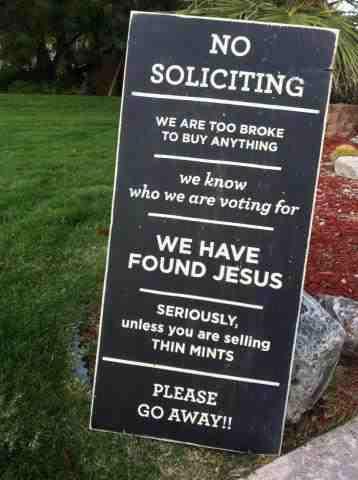
People on both sides who remove political signs from people’s yards:  Stop it.  What is wrong with you people?

Indiana Republican Senate candidate Richard Mourdock  who made that comment about it being part of God’s plan when someone gets pregnant because of rape:  This is terrible theology.  Not only is it  unorthodox, but it repels people from the God we worship.  God has given human beings free will which means that God’s finger is not on every trigger, every steering wheel, and every hand on the proverbial apple.  Stop it.  Read your Bible, sir.  God can use even evil for good.  But God is not responsible for all the evil

Seminary Curriculum Administrators:  Please teach our seminarians how to serve the 21st Century Church, even if it means messing with tenured professors’ lesson plans.  We don’t need any more seminary graduates trained in serving churches that no longer exist.  Please hire leaders who have actually been engaged in Missional Ministry, Making Disciples, Third Place Ministry, and Entrepreneurial Community-Building.  I can get you a list of people who know how to do this.  Please.

The Makers of Delsym Night Time Cough & Cold Medicine:  The worst is over.  We’re almost through this  cold.  Not sure if you were more helpful than soup and tea, but thank you for not tasting awful and doing your part.

Hoping to get back to the office today.

New Habits for “Nones”

The downfall of the institutional church, in my humble opinion, has been the fact that we church people spend most of our time with other church people.    Big mistake.  We need some new habits if we hope to connect with “the nones.”

Easum & Brittain’s new book is about how we must staff churches in a world where one in five people self-identify as having no religious affiliation. The facts show that fewer and fewer church members are “coming to church” so how can we expect never-churched people to come through our doors?

And because I’m sick and don’t have the energy to do much more than quote people, consider this from Easum & Brittain:

Because people no longer come to church on their own, the church must spend most of its time, energy, and money filtering people out into the community.  The measurement of effectiveness shifts from ‘how many in worship?’ to ‘how much difference is the church making in its efforts to transform the city?’

The question ‘What is God doing in our community that we can be a part of?‘ is replacing, ‘How can we get more people to come to church?’

Easum and Brittain would also say that the smaller a church, the more time the pastor must spend in the community – not in the church office.  Take note Personnel Committees!

We need to develop new work and staffing habits if we hope to reach out to “the nones.”  And before we reach out to them, we need to know why we are reaching out.  Clue:  it’s not to get them to join our church.

Excellent conversation starter, if you are hanging out with your church friends:  watch the most recent episode of The New Normal (The Godparent Trap, aired 10-23-12.)  How would your church relate to Bryan?

Image from the London Nun Run in 2009.

What a Courageous Pastor Looks Like

The most courageous pastors are prophets.  But most congregations don’t want their spiritual leaders to be prophets.   When people gather together for worship after a busy, stressful week, most of us would prefer to be comforted, cheered, and congratulated, not nudged, challenged, and held accountable.

Nevertheless God has called those of us in professional ministry to be brave – even if it ticks people off and threatens our personal and professional lives.

It’s not easy being a courageous pastor especially if:

  1. We are dependent on the paycheck we receive from the very congregation we risk offending when we proclaim the Word of God in love.
  2. We serve a church that does not respect our authority or trust our vision.

What does a courageous pastor look like?

  • A courageous pastor is more afraid of God than his/her congregation.
  • A courageous pastor is an equal opportunity offender.  (We don’t always side with the Republicans, the Democrats, the new members, the long-standing members, the rich, the poor, the most active members, the least active members, etc. etc.)
  • A courageous pastor preaches the Word of God, even if it confounds and offends everybody.
  • A courageous pastor stands up to bullies, even if the bullies are the biggest contributors,  hold the historical power, and will do ungodly things that we – as the pastors – cannot and will no do ourselves in retaliation.

Every single pastor will deal with bullies if she/he stays in professional ministry long enough, and this experience is excellent for our prayer lives.

My own personal experience with bullies a few years ago is what made me more fearless because I learned that, even when people believed the worst about me after some serious defamation, God was faithful.   We follow a Prophet – and Savior – who was rejected to the point of death.  And – still –  love won.

Being courageous is dangerous.  But courageous congregations are lead by courageous leaders, and they are the ones who will actually transform the world in the name of Jesus.

Image of the prophet Jeremiah by Chagall.  (Notice how haggard he looks.)

The Courageous Church

I would love to say that most of our institutional spiritual communities are very brave, but I’m not sure I believe that.  (That’s Southern Speak for I don’t believe that.)  It’s understandable that most of our congregations – especially those under a membership of 150 –  find themselves in survival/scared mode.

God makes us brave.  A sure awareness of the Holy Spirit fills us, not only with a peace that passes all understanding, but also with a confidence beyond all understanding.  And these are the perfect days to call on God to make our congregations courageous.

This is what a courageous church looks like:

  • They call the Pastor that the Holy Spirit tells them to call, even if she/he doesn’t look like a) the typical pastor and/or b) the kind of pastor who has always served their congregation.  In other words:  No More Pulpit Candy.
  • They have The Conversation about doing something drastic about their worship space:  remove pews?  shift seating arrangement?  sell the @&!x# building?
  • They encourage/implore/require their pastor to spend more time in the community than in the church building.
  • They come together ready to learn how to be deployed to serve a broken community, rather than gathering to be taken care of   themselves.
  • They stick their lives into other people’s crazy.  They are willing to sit with the chemo patient, eat lunch with the homeless person, listen to the illiterate child learn to read, go with the arrested kid to the police station.
  • The last things on their minds are:  I need a nice venue for my funeral/my daughter’s wedding/my grandchild’s baptism.

What else would you add to this list on a lovely Monday morning?

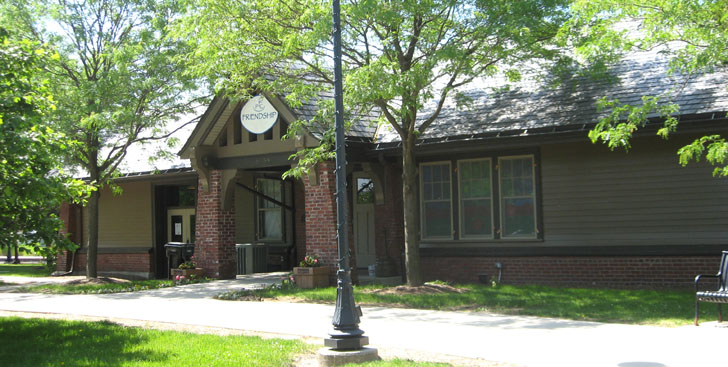
Image is of the building where one of the most courageous churches I know gathers for worship in Chicago.

Hallmark and The Missional Church

Let’s talk about greeting cards.

Every church has at least one lady who sends greeting cards to church members.  Birthday cards. Get well cards. I’m-praying-for-you cards.  We sometimes call this a card ministry.  But I wonder how effective this is as pastoral care for a 21st Century Church. As I leave a conference about offering pastoral care to caregivers, some of us were talking yesterday about the dear ladies who send the cards.  For a certain generation, sending a card is one of the most thoughtful gestures of affection.  To other generations, it’s not at all meaningful, especially when it comes with a platitudinous blurb or just a signature. My grandmother always sent me a birthday letter about the day I was born and I have dozens of them.  They are almost identical as she sent the same tale every year. Those are precious letters, written thoughtfully and with some effort especially in her older years. SBC used to get a card from a church lady for his birthday, but she didn’t have his name right. Ever. I’m sure she meant for the cards to be a meaningful gesture, but they struck SBC as a inauthentic.  She didn’t even know his actual name. One older lady I know was hurt when her daughter didn’t send a birthday card to her.  The daughter had taken her mother out to dinner and given her flowers.  But there was no card.  Fail. A guy told me yesterday that people under the age of 40 find greeting cards to be a fake form of showing real care – unless the card contains a personal note or a check.  This seems to be a generational preference.  What seems thoughtful to some seems inauthentic to others. Having said this, we all need to send Thank You notes – real, handwritten, heartfelt thank you notes. Do it for your grandmother.

Toast

I thought the Disaster Alert Phone App would be good for my prayer life.

Just one click and I’d have access to all kinds of prayer-worthy crises from floods to earthquakes to tropic storms to fires.  As I write this, there are three earthquake watches, five tropical storm alerts and two hurricane warnings in The Top Ten Disaster Alerts.

Actually, this App stresses me out instead of moving me to prayer.  I already have enough disasters on my prayer list.  In fact, I am a magnet for disaster news . . .

which is why I’m at this Conference on Compassion Fatigue Prevention & Resiliency – for personal as well as professional reasons.  We hope to upgrade the Pastoral Care to Pastors in our Presbytery.  But I also need to learn these skills personally.

Before I left my last congregation in Virginia to join HH, who’d been called to serve a church in Chicagoland, a parishioner asked me what I’d be doing next and these words almost burst out of my mouth:

“I am exhausted.  I just need a break.”

I didn’t mean to shock her but she appeared a little shocked as if she was thinking, “What does she have to be so exhausted about?”  It’s not like I was a pastor in Katrina-ravaged New Orleans or earthquake-destroyed Port Au Prince.

The truth is that the unrelenting nature of professional ministry is what makes the profession hard.  It’s like being the pinball in a spiritual arcade, and even we pastors are disciplined in taking a Sabbath, it’s just one day off with a different set of demands. Compassion fatigue is a real issue for pastors – and others – especially when we are not inoculated against it.

Pastors are among the most isolated people in the world, according to the Presbyterian Disaster Relief trainers meeting with us this week.  In the 1950s, professional ministry was considered the healthiest profession in the U.S. and now it’s considered among the least healthy.  Clergy have an extremely high incidence of obesity, depression, alcoholism, and high blood pressure.  All empathetic people – whether we are teachers, doctors, social workers, or fire fighters – tend to be good at pastoral care, but we are also more at risk for Compassion Fatigue which – if left unattended – can lead to all manner of inappropriate behavior.

A friend of mine tells me that her family has a motto:  Don’t put your hand in the crazy.  Clergy people  have intentionally chosen to put our whole selves in the crazy.  It’s called incarnational ministry.

But if we don’t build resilience or strengthen our refueling tools, we will feel like toast.

Who Needs Pastoral Care?

I’m writing from Epworth By the Sea in Georgia at the Presbyterian Pastoral Care Network, and feeling a bit like a Pharisee.  The point of this conference is to discuss the pastoral care of our pastors and their families and I’m  a big fan of pastoral care for pastors and their families.

On the one hand:

We were asked last night to share an example of a pastor we know who has received stellar pastoral care and one woman could not think of a single example.  She has personally never been honored for her service (almost 30 years) by the churches she’s served.  She has never had a colleague reach out to her in times of stress.  My hope is that she would initiate her own circles of care.  But –  honestly people –  we need to appreciate our pastors and support their families.

On the other hand:

As I hear conversations about the stresses of pastors – and believe me I know about those stresses – I’m cognizant  that everybody seems to have this kind of anxiety these days.  Forgive me, pastors, but who doesn’t have overwhelming stress today?  Is it true that many are receiving every drop of attention from us and there’s nothing left for our own self-care?  Or are only a handful of people getting the spiritual support they need?

I’ve witnessed many congregations doing a terrible job of thanking their pastors.  This is Pastor Appreciation Month – a recognition initiated by the Focus on the Family people – but worthwhile in terms of appreciating those who offer spiritual leadership.

But in a healthy church, the pastors are training others to be spiritual leaders.  Is the issue that we fail as pastors to equip others to serve as ministers?

There’s a lot of talk at this conference about “ministers” and “lay people” and this is the basic problem.  We are all called to be ministers.  The lay people are those with no training and no call to serve the offices of ministry (elders and deacons in the PCUSA tradition.)

There are whole congregations that do not give helpful pastoral care to its people.  A community is transformed when everyone is trained how to care for the lonely, the overwhelmed, the sick.  Yes, there are those without the capacity to care for others.  But most of us can learn the basics.

We all need pastoral care.  And everyone can be taught to offer it.


What I’ve Learned

Between Chicago Ideas Week – which ended today – and my whirlwind visit to the NC State Fair and my Introduction to the New Beginnings program of the PCUSA, I’ve learned a couple things in the past several days.  As I head down to St. Simon’s Island, GA to learn about pastoral care networks, here are several  nuggets to consider.

What I learned from:

  • Lauren Drain – It’s important to allow questions in our faith communities, and if our church doesn’t allow questions, look out.  TAKE AWAY FOR CHURCH: Church should be the one community in which it is always good to ask questions.  There are no stupid questions.  There are no faithless questions.  If our kids are not asking hard questions they aren’t paying attention.
  • Leah Libresco – Even the most committed atheists can change their minds.   TAKE AWAY FOR CHURCH:  Answer those questions honestly and love lavishly and you never know what God will do.
  • Julia Sweeney – Even a religious upbringing doesn’t guarantee lifelong faith in God. TAKE AWAY FOR CHURCH:  Love people even when they let go of God.
  • Kiel Murray – Collaboration & brutally honest feedback sparks the best from us.  TAKE AWAY FOR CHURCH:  We need to trust each other enough to be held and to hold others accountable.  We need to be able to say, “Your sermons are not growing disciples, this Peach Festival is not reaching the neighbors, our Bible Studies have become gossip sessions.”
  • Karen Tenkhoff – Research is essential.  If they are making a movie about scuba diving, for example, everyone from the screenwriters to the editors to the gaffers go scuba diving.  TAKE AWAY FOR CHURCH:  Everyone needs to be on the same page working towards the same goal – from the music director to the sexton to the clerk of session to the pastor.  If the goal is disciple-making, then everything each individual does should be about disciple-making.
  • Brian Bowen Smith – “I don’t just look at the subject of my photographs; Context is everything.”  Are we in a studio?  At the beach? In an airplane hangar?  TAKE AWAY FOR CHURCH: The way we work is impacted by our context (aka missional or incarnational church.)  If we serve in a biker community, it’s different from serving in a country club community.
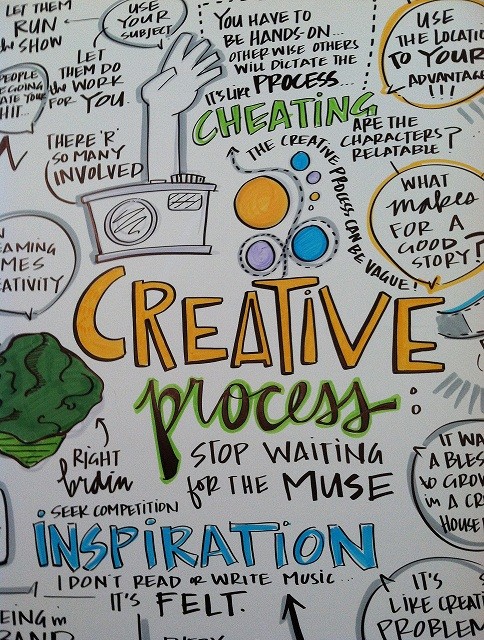
  • Brandon Boyd – “Art is creative problem solving.”  TAKE AWAY FOR CHURCH: Instead of bemoaning the issues we face, why not approach them creatively?  Parking problems?  Partner with the Tattoo Parlor with plenty of parking.  Huge building with too many pews?  How about taking out the back 30 pews and create a space for an art gallery or children’s play area or an expanded hospitality center.
  • Scott Belsky – Creativity x Organization = Impact.  TAKE AWAY FOR CHURCH.  We need both 1) creative leaders (those with great ideas) and 2) organized leaders (those who make the trains run on time) to have an impact in our community.  Dreamers need doers.  Doers need dreamers.
  • Susan Meier, Our New Beginnings Consultant – We used to believe that Trying Harder would move churches ahead.  Now we know that Doing More doesn’t necessarily help.  What’s needed involves doing a Completely New Thing.  TAKE AWAY FOR CHURCH:  Amen.
  • NC State Fair – An experience is enhanced by sensory treats.  The Smells (Fried Dough, Bar-B-Que, Caramel Apples, Chickens, Donkeys), the Sights (Pig Races, Tractors, Mega-sized Pumpkins), the Textures (Cotton Candy, Straw, Pottery),the  Sounds (Carnies Calling Us to Play Whack-a-Mole, Screaming Roller Coaster Riders, Cows Mooing), and the Tastes (ham biscuits, fried Snickers Bars.) TAKE AWAY FOR CHURCH:  God has created too many sensory experiences for us to bore people with bland worship.

May you learn amazing things this week.

Ideas Week: The Gamification of the World

It’s Ideas Week in Chicago!

When I was a parish pastor, some volunteer leaders came up with fun names for ordinary jobs to keep things interesting: Flower Czarina (the person in charge of Sunday morning flower arrangements) and Coffee Queens (those serving refreshments after worship) were among my favorites.

When we toured the Tribeca Flashpoint Academy for Chicago Ideas Week on Tuesday, I noticed they did the same things with the naming of their rooms.  The  library is called the Info Commons.

Howard Tullman spoke of the gamification of the world.  Get this:

  • More middle aged women play digital games now than teenage boys. (Hello Farmville.)
  • It’s more lucrative to sell virtual t-shirts than real t-shirts.
  • Building up one’s Klout score  = the game of life?

Again, there are consequences for church.  Just as secular educators have long used games to teach students, church educators have also used games – from Bible Jeopardy to What Would Jesus Do? – The Board Game to make Sunday School more fun.  We prefer to play.

But church is for losers.  We are the screw ups of the world who realize the need for a savior.  The first Christians included some rich and successful souls, but most of them were “sinners and prostitutes.”  Remember this song?  (One of my personal favorites.)

The world might increasingly become “gamified” but we who seek to follow Jesus find ourselves living counter culturally – even though we get sucked into the game more easily than we’d like to admit.  Eventually we get tired of games.

Ideas Week: Going Mocial

It’s Chicago Ideas Week.

Light Bulb Wreath from Howard Tullman’s private collection

Touring Howard Tullman’s Tribeca Flashpoint Academy yesterday – a for-profit two-year college in the heart of Chicago – felt like what I imagine it feels like to tour the USC Film School in LA.  The tour guides were very cool and said things like, “When Tyra Banks was here . . .”

The result is that I felt fairly dorky in my black pea coat and sweater tights.  (Imagine Velma from  Scooby Doo touring the set of Minority Report and you get the idea.)

Howard Tullman has made millions doing entrepreneurial things, and he shared his insights yesterday on what he’s learning.  I could write several weeks worth of blog posts on his commentary.  But for today:  Mocial Networking (Mobile Social Networking)

If you connect with people on the run, you already do this, of course, but imagine these activities – all possible right now –  via your smart phone:

  • Filtering of Data so that we can see what our friends and colleagues are doing as often as they want to tell us.  Imagine Ticketmaster connecting with our Facebook friends so that we can see exactly where our friends are sitting at a concert or ball game.
  • Smart Reach between people and objects.  “It if computes, it connects.”  We can measure when our laundry is dry, how far along our moving van has traveled, or how many people have gathered for a protest via phone apps that send us progress, locations, and data via texts.  Measuring on the go.
  • Real Time Sharing via eavesdrop apps that allow information (e.g. music) to be shared between two friends without those Old School headphone splitters.  In fact you can be in different states and share music or videos.
  • Fully Interactive Engagement in crowds.  In a stadium, everyone can vote on the encore song or voice their opinion on a ref’s call.
  • Fan Solicitation that negates the need for Ticketmaster to promote sales.  For example, if 19 million people are following Taylor Swift on Twitter, you can tell her followers about the new tour dates and they can buy tickets directly from her.  And then your phone can tell you which of your FB friends will be there.
  • Wiki Work makes good use of random time.  For example, after people randomly watched the video of a school bus monitor being bullied, they contributed over $700,000 to fight bullying during the course of two months.

So, as Howard Tullman was flying through double-screened slides of interesting data and analysis, I was probably the only person in the room wondering how this all impacts institutional faith communities.  Off the top of my head, these are my first thoughts about what this means for Church People:

  • Measuring is everything:  Our Klout scores – and similar tools – will determine what we pay for items online.  For example, Tyra Banks will – ironically – pay less for cute shoes because it’s believed that if she loves her new Louboutins, she will tweet about them and millions of others will want to buy their own pair.  If I buy them (which I won’t), it will cost me more because I don’t have her reach mocially.  The church will need to be a community – and perhaps the  only community – that doesn’t care what your real-world influence might be.  We will love you if no one knows your name.  We will welcome you even – even – if you don’t own a smart phone.
  • All this stuff eventually makes our brains hurt.  It’s very cool and yet we need to turn it off occasionally.  (Insert Sabbath in the Suburbs pitch here.)  Church might soon be the one “place” where people are encouraged to take a Sabbath, teach Sabbath skills, and remind people that there is a Creator who is mightier than Zuckerberg.

As I was reading about Howard Tullman after the lab talk yesterday, I came across this quote from the 9-11-12 issue of INC magazine, written by Tullman:

“Too many businesses run into serious problems because they waste time trying to make their circumstances fit their plan rather than changing their plan to fit their circumstances. The longer you benchmark or measure your progress to an irrelevant or outdated standard, the more time you waste and the more ground you give up to the competition.”

I would shift this to say that too many churches waste their time trying to make their circumstances fit their customs rather than changing their customs to fit their circumstances.  The longer we benchmark or measure our progress to an irrelevant or outdated standard (church attendance, church building, church budgets), the more time we waste and the more ground we give up to the competition – i.e. a secular world view.

And that’s what I learned on Tuesday.