The Elect & The Elected

The political world is abuzz with who will be elected today. In the spiritual world, we speak of ourselves as The Elect.  The Christian Doctrine of Election is about God electing us. 

Being among those elected by God for special ministry (and I believe we are universally elected, by the way) is not cause for feeling like we are All That.  I heard Richard Mouw explain it this way:

Once someone has been “elected” (either politically or spiritually) the work has just begun.  Nobody wants to elect a president or other government official and then have her/him do nothing.  The election is not the end; it’s the beginning.

  • It takes work to be elected if you are a political figure. 
  • It takes grace to be elected for regular human beings. 

But both of us have work to do to make the world look more like heaven, especially for the least of these.  Prayers today that our politics won’t get in the way of our faithfulness.

Read This Book: The Cross in the Closet

“Being gay for a year saved my faith.“

The Cross in the Closet feels especially timely in these days of vicious election conversations – if we have conversations with “the other side” at all.  Tim Kurek is not gay.  But he decided to plunge into the life of The Other for one year, living as a gay man as a  sort of personal spiritual discipline.

Tim grew up in a conservative Christian home within a conservative Christian culture in which gay people were demonized and feared.   When he told his own mother that he was gay, she said she would have preferred he had terminal cancer.

I loved this book for the story of Tim’s commitment to meet and care for people whom he had always been taught were beneath him spiritually.  I loved watching his own journey to discover what it means to be gay.  (It’s not about clothes or gait, by the way.)

What felt discomfiting, though, was that – in order to live as a gay man for a year – Tim had to deceive people, because he was not in fact gay.  He even had a pretend boyfriend so that he would not be put in a position of having a real physical encounter with another man.  Unlike the spiritual discipline of living for a year as a Biblical Woman (Rachel Held Evans) or taking her family through a year of intentional Sabbath (MaryAnn McKibben Dana), Tim had to pretend to be something he’s not.

I remember a friend finally telling me he was gay after watching the funeral scene in Three Weddings and a Funeral.  He didn’t want me and others to find out at his or his partner’s funeral that they were a couple.   But it hurt a bit that he’d pretended to be straight – replete with a “girlfriend” at one point.

Trying to imagine how Tim’s new GBLTQ friends felt about the eventual revelation that he was not actually gay made me uncomfortable.  That, and the fact that gay Christians – and non-believers alike – have been trying to tell this story for years but have not received the attention Tim has received for pretending.

Nevertheless, this is a great read which – in my mind – is more about connecting with The Other than gay-straight relationships.  We who follow Jesus believe that God became the ultimate “other” to connect with us.  God gave up supreme privilege to become one of us.  Tim Kurek’s personal journey to become one with the GBLTQ community offers some important insights, especially for Christians who have vilified people for being different.  Read it.

Generation Wars in Church

I am 56 years old.  My retirement date is closer than my ordination date.  I could no more serve as a youth group leader than I could wear a leather mini-skirt in public.  Even if I could pull off the mini skirt, it would look ridiculous and be wholly inappropriate, just as it would be for me to start a church in a trendy bar.

And yet, I still remember being the 30-something pregnant pastor.  I remember always being the youngest pastor – and often the only woman –  in interfaith leader gatherings.  I remember what it was like to work part-time in a church while raising three kids under the age of four.  I have tried to stay fresh, read current books, keep informed through conferences and conversations, learn from seminarians.

But I see a trend  that older pastors (meaning every pastor older than 50 and especially those over 70) and younger pastors (the 20-40 somethings) are clearly engaged in a huge mutual disconnect.  I see this especially here:

  • In yesterday’s news my denomination’s Board of Pensions proposed
    a new health care dues structure that makes health care much more expensive for pastors with children starting in 2014 while continuing to give incentives for postponing retirement.
  • In Boundary Training events when older pastors and younger pastors clearly hold different understandings of who is vulnerable in clergy-parishioner relationships and why.  Say “boundary issues” in a room full of pastors and individuals have a much different idea of what this means, depending on generation.  (Example:  For the older generations of pastors, it was perfectly normal to marry a parishioner.  For younger generations, this would be considered misconduct.)
  • In preaching that finds many older pastors still proclaiming the Word with three points and a poem while younger pastors experiment with new forms of proclaiming the Good News, often involving dialogue, art, and group spiritual direction.
  • In what it means to be a pastor in general.  Older pastors are more likely to spend their time at their desks preparing sermons and classes, doing pastoral care, and moderating meetings while younger pastors are more likely to focus on missional outreach and equipping others to do ministry.

There are older pastors – mostly men – who have given their lives and energies to serve the institutional church during the glory days of the mainline denominations.  They were respected in the community and they have been doing ministry for a long time.

There are younger pastors who are serving – or trying to serve –  a church that, for many in our postmodern culture, is obsolete,  flailing, and shifting.  Many young pastors have school loans, and there are few possibilities in terms of available calls, especially calls that are open to creative ministry for a new season of Church.

I remember in serving my last church that it was very much like serving two different congregations.  There was the church that expected ministry from me like the ministry they had experienced for the majority of their lives.  And there was the church for people who had been hurt by the church, had never been part of the church, and who would never walk through the door of a traditional church.  Today serving in a Middle Judicatory (in my case a Presbytery), I serve two sets of pastors and two sets of churches.  There are the churches who want a pastor who preaches, teaches, baptizes, buries, and visits the sick.  And there are pastors who know how to do this, both with and without enthusiasm.

And then there are the (rare) churches who want a pastor to lead them into the 21st Century, to equip them to be ministers, to teach them not so that they are smarter but so their faith is deeper, who train others to do pastoral care, and who spend more time out in the community than in their church buildings.  There are especially younger pastors who long to do this usually with great passion.

So here we are.

I believe that both kinds of pastors are faithful and good.  But our church has got to focus on the future.  What do we imagine for our churches over the next ten to twenty years?  And how might the older generations make way for the younger generations to lead?

Mosaic includes images of some of the generational rock stars of the Christian Church.  (And there are countless others.)

Saints Wear Aprons (not bibs)

My genius friend AD was telling me that she hopes to one day have church business cards that say something about the responsibility of church members to wear aprons, not bibs – but she had a much more poetic way of putting this.

She heard about the idea in a class, and then we found this post which spells out the details.  Amen Mountain Wings.

“Bibs are for people who only want to be fed.  Bibs are for those who are not yet ready or willing to feed themselves.  Bibs are for those who are more interested in being served than in serving. Bibs are for those who insist that the church exists for them and their needs. Bibs are for babes in the faith, those who haven’t  caught God’s vision for the church, or those who are not yet of the faith.”

“Aprons are for those who have a heart to serve others in Jesus’ name.  Aprons are for those who know they are the church.  Aprons are for those who don’t mind getting their hands dirty.  Aprons are for those who take the time daily to feed their spiritual hunger.  Aprons are for those who are growing in faith, and hunger to help others grow.”

It occurs to me that an apron would be the perfect “Welcome to This Church” gift for new members.  If new members receive “welcome gifts” at all, it’s often a coffee mug or a key chain or a Church Cook Book.  But what if we required a commitment to service – in the image of Christ – before asking people to join.    “Membership” would become less about receiving ecclesiastical benefits and more about committing to serve others in Jesus’ name.

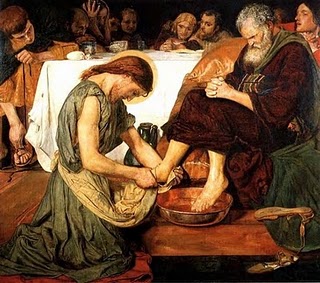
Even Jesus wore an apron when he served others according to scripture.  If true saints are those in the church who follow in the likeness of Jesus, shouldn’t we all be wearing one?  Something to think about on All Saints’ Day.

Image by Ford Madox Brown is Jesus Washing the Feet of Peter (1852-56)

The Four Scariest Words in Church

“Thy will be done” are the four scariest words in the Bible.  

I am fairly enamored with my own way of doing things, and yet, faith involves trust.  Even when things look hopeless, I believe love will always win because of this and other things.  But trusting in God’s will and not my own is essential – at least for a person of faith.

But what about the scariest words we might hear or repeat in church?

My nominations:

  • Actually, that’s my pew.
  • Our table is closed.
  • We can’t afford it.
  • You are not invited.
  • God really hates you.
  • But our policy says . . .
  • God doesn’t call women.

And your nominations?

Happy Halloween to all!

If I Could Be Queen of the World

My favorite #sandy tweet from yesterday was this one from Cory Booker:

Just spoke with Gov Christie. His team has been a tremendous support in this emergency & I appreciate his personally reaching out (again).

Cory Booker is the (Democratic) Mayor of Newark, NJ.  Chris Christie is the (Republican) Governor of New Jersey.  Doesn’t it feel good when bi-partisanship happens?

Previously in the day, Gov. Christie mentioned how helpful President Obama had been in terms of offering federal support.  All this goodwill made me feel safe and proud of my country.

I sometimes ask people looking for a new calling or a general life change:  If you were King/Queen of the World, what would you do?  

Today, it’s my turn.

If I were the Queen of the World, I would decree the following five things.  They would be non-negotiable, because I would be a bossy monarch.

1.  All Americans have to listen to this conversation between Alice Rivlin (the Democratic economist) and Pete Domenici (the former Republican senator) regarding the United States economy and the importance of bipartisanship in a democracy.

2.  The Electoral College would be abolished.  It’s obsolete and makes a vote in Ohio worth more than a vote in Montana.

3.  Citizens’ United would be overturned.  Our leaders should be chosen by independent citizens, not by corporations or unions.

4- Whoever loses the elections next Tuesday must announce that he/she will wholeheartedly support the winner for the sake of our nation’s future and well-being.

5- Once elected, all members of Congress are required to partner with a member of her/his opposing party for regular meals, outings, and – if they are praying people – prayer.  The only agenda for these meetings would be to get to know and care for that colleague and her/his family.  It’s harder to demonize someone on the other side when your kids have played soccer together and your spouses have exchanged recipes.

After a terrible storm, people come together in selfless care.  Coming together after an election is the least we can do for our country.


Image of the crown made for Caroline of Baden, Queen of Bavaria in 1806.  She liked pearls.

First Say “Hi”

It’s annoying and perhaps offensive when someone tries to tell us something we 1) already know and 2) have known a long time.

For example, I once worked with a seminarian who was constantly explaining things to me like “There’s this amazing scholar named Walter Brueggemann“) as if I not been quoting Brueggemann for 20 years in my sermons.  It was a sign to me that she hadn’t noticed who I already was and what I already knew.

In relationships, though, we often need to teach our beloveds how to care for us – even though we wish they could read our minds and just know.  Early on in marriage, HH and I had this exchange at the end of a long work day:

Me:  What a crappy day.  Ugh – traffic, mean people, no break for lunch.

HH:  You need to (fill in the blank with a litany of helpful things)

Me:  No.  This is the moment when you are supposed to say, “Everything’s going to be alright.”

HH:  Everything’s going to be alright.

Me:  You are the Best HH Ever.

So, here’s the deal:

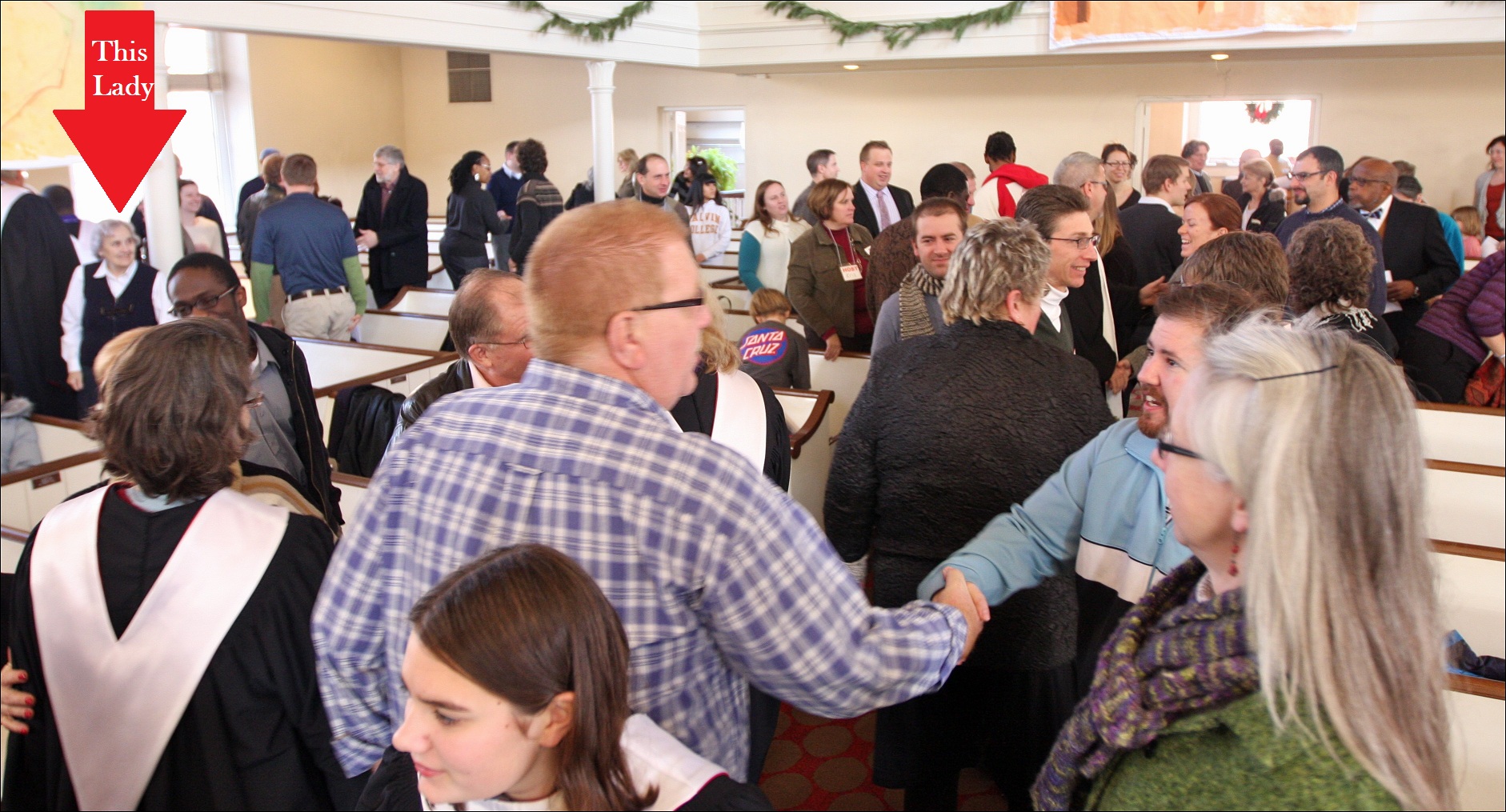
At the risk of offending all our “friendly congregations” we need to teach people what they are supposed to say when they see another human being at a church event – especially a person they don’t already know.

First you say, “Hi.”  You could say, “Hi, my name is ___.”  Or you could say, “I’m not sure we’ve met before, but my name is _____.”  And then . . .

  • Remember their name and introduce them to one of your friends (not to ditch this person, but to genuinely connect him/her to another)
  • Ask a real question or make a real comment (“I love your sweater” – if you do; “Have you been part of this church for a long time?”)
  • Walk. With. The. Person. To. Coffee. Hour.
  • Find out three things about this person.   Look the person in the eye and remember.
  • (If you are really interested in connecting) Invite the person to join you for something to eat.  Maybe a few of you already have plans.  But especially if you are going out for brunch, pizza, more coffee, invite this new person.

Our Presbytery Staff is reading Jim & Casper Go To Church which tells the story of Jim Henderson (a Christian) and Matt Casper (an atheist) visiting ten churches during which Matt gives his take on what that congregation seems to be about.  One of their top observances is that almost nobody talks to them.

For churches that universally consider themselves to be both “friendly” and “interested in growth” this is a totally strange phenomenon.  And I can’t help but agree.

In the past three weeks, I have worshiped with five church communities – most of which I’d never visited before.  My communication with most of those I met involved mime:

  • Someone silently handed me a bulletin.
  • Someone pointed to where I could sit.
  • Someone opened an interior door and looked annoyed that I was late.

Nice but no cigar.  I am a Myers Briggs Introvert, but I can put myself out there and talk to people.  I’m happy to do this, but honestly, it would be great for all our congregations to learn how to greet someone they don’t know.  All our congregations need some in-service training on this.  Really.  “First, look the person in the eye and say, ‘Hi.'”

Four Churches Re-form Today!

Portrait of Martin Luther (1529) by Lucas Cranach the Elder

There is so much to be reformed in the church.  I’m reading this book – more about that later this week – but Henderson & Casper (“The Friendly Atheist”) point to enough opportunities for institutional church change to exhaust a person.

Nevertheless there is reason to rejoice:  four communities in my life are making brave steps that will transform their neighborhoods:

Church-Beside-the-School is voting to call a new pastor who looks nothing like any pastor they’ve called before.  She prepared for one of her interviews by researching how many students at the school next door were on free/reduced lunch.

Ghanaian-Church-in-the-City will commission their new Pastor today.*  He will continue to do his day job in finance, but because he speaks Twi, loves Jesus, and can lead a people, he will also be commissioned to administer the sacraments and preach among this particular congregation of people who hail from Ghana and now live in Chicagoland.

Famousish-Emerging-Church will celebrate their new home in West Rogers Park with music, pumpkin-carving, and Poetry Vespers.  They will be sharing a pastor with another, more traditional congregation in the same worship space.  Centered, Generous, Dynamic Faith will continue to flourish in a new neighborhood, later partnering with a community in yet another neighborhood as well.

Ebenezer-New-Church-Plant will formally launch the ministry of my friend and former colleague, Matt Pritchard, as he’s licensed to preach in the Mennonite denomination, planting a new congregation called Ebenezer in the Oaklands neighborhood of Pittsburgh.

Reformation Day Challenge:  Can you name one thing your spiritual community has done in the past year to reform its ministry?  Not a rhetorical question.  I’d love to hear what you have to say.

Happy Reformation Sunday.

*The PCUSA – my denomination – allows for churches to be served by what they call CREs – Commissioned Ruling Elders.  Previously these servants were called CLPs – Commissioned Lay Pastors.  The Presbytery of Chicago is still calling them CLPs but it stands for Commissioned Local Pastor.  WHY do we need our own acronym?  Here’s why:  All Ruling Elders are commissioned.  All of them.  And “lay pastor” is a misnomer in that all Ruling Elders and Deacons are no longer “lay” anything.  If you are ordained to serve in any way, you are no longer a lay person.  Please stop referring to Ruling Elders and Deacons as “lay people.”  Remember the priesthood of all believers?  It’s not just for Reformation Sunday anymore!

Politics and Parenting Reprise

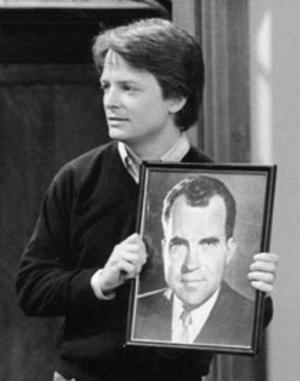
There was a popular TV show in the 1980s called Family Ties about Boomer Parents and their Gen X firstborn.  Elyse and Steven are Democrats (Dad works for Public Television, for Pete’s sake) and their son – Alex P. Keaton – is a conservative Republican.  Sitcom hilarity subsequently ensued.

According to this recent article, from information first published in Psychological Science, researchers have determined that authoritarian parents tend to raise politically conservative children and egalitarian parents tend to raise politically liberal children.  In other words, Alex P. Keaton would be an anomaly.

We adults define “good children” in different ways.  Some of us define “good children” as being compliant and obedient.  Others of us define “good children” as being fearless and inquisitive.  Which temperament would you prefer to have in your real or imaginary children?

Conservative families tend to have more fearful children, according to this article.  Their children are more afraid of breaking the rules, getting into trouble, and being excluded if they go a different way.   Have you found this to be true in your family or in other families you know?

Liberal families tend to have more fearless children.  Their children are temperamentally more restless and focused on activities.  Have you found this to be true?

As I’ve shared before, there seem to be two basic parenting styles.  And while it’s really easy to peg people and their their children, I am amazed when parents raise children who see the world in a diametrically different way than they do.

Republican parents tend to raise Republican children.  Democratic parents tend to raise Democratic children.  Or do we?

Cosmic Sabbath

For the past 20-some years, I have experienced what can only be called a Cosmic Sabbath, twice a year.  This is my way of explaining how I sometimes get sick during the busiest weeks of my working life.  It often happens Holy Week.

It happened this past week, just after I finished reading the exquisitely written Sabbath in the Suburbs.  Actually, I read it twice.  The second reading was especially inspirational in my role as a wife and mother, not to mention a person who is supposed to be professionally spiritual.

This is what I learned from a week of coughing, gargling, napping, and sultry whispers during which I missed several Very Important Meetings, Phone Calls, and Emails.  In hopes of surviving a week of the cruds, I channeled the amazing MAMD and others who reminded me that:

  • I am not indispensable as much as I’d like to think I am.
  • Floating Sabbaths (a Tuesday afternoon here, a Wednesday morning there) don’t work.
  • Sabbath is not the same as “Family Time.”
  • Doing things “Sabbathly” is such a good idea.
  • Vick’s Vaporub is a miracle ointment.

At the risk of sounding Mourdockian, God has a way of slowing me down when I consciously or unconsciously act as if I’m All That.  But what makes this different from believing that overworking is “something God intended,” I realize that this is my choice.  A poor choice.

Why do we believe that not keeping the Sabbath is an okay commandment to ditch?