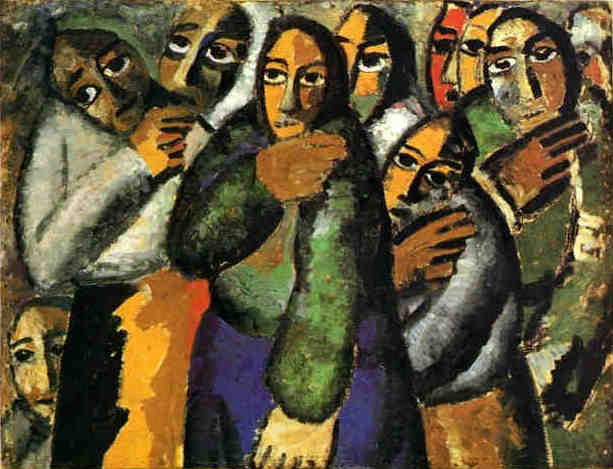
Postmodern Ordination Exams

Today is Ord Day in the PCUSA which means that many students and candidates for professional ministry in my denomination are being examined in one or more of the following required exams:

  • Bible Content
  • Biblical Exegesis
  • Theological Compentence
  • Worship & Sacraments
  • Church Polity

Today is the first time all standard exams will be given online.  Very 21st Century of us.

Some believe the exams are nit-picky and discourage creativity.  They are right.  These exams are about specifics and basics.  Just as Picasso proved himself as a classical painter before introducing cubism, we want our future pastors to know the most basic foundations of the Bible, Reformed Theology and the Constitution of our denomination before creating new ways to serve, worship, and understand God. 

Having said this, I have a couple ideas for ordination questions that I’d love to see included in these Postmodern Ords.  Except for the Bible Content Exam, the questions tend to be essay questions, and in keeping with that . . .

Question 1:

A couple in your church has just lost their newborn after two days in the Intensive Care Nursery.  The child died an hour ago and you’ve been called to come be with the family.  During the visit, they ask you to baptize the baby.  What is you response based upon:

  • Reformed Theology
  • The Directory for Worship
  • Biblical References
  • Pastoral Considerations

Question 2:

A young woman has been worshipping with your community for several weeks and she wants to join the church officially.  However, she cannot say that Jesus Christ is her Lord and Savior.  She would like to believe that she lives a way of life that conveys that Jesus to be her Lord and Savior but – if she’s honest – she tells you that she’s unclear about the Trinity, she fails at following Jesus most of the time, and she doesn’t trust Jesus as much as she would like.  She is trying to be authentic in what she says she believes.  What is your response to her based upon:

  • Reformed Theology
  • The Form of Government
  • Biblical References
  • Pastoral Considerations

Question 3:

A ruling elder has broken her ordination vows.  She has spread gossip about the pastor and sabotaged the committee work surrounding church redevelopment.  What is your response as her pastor based upon:

  • Reformed Theology
  • The Form of Government
  • The Directory for Worship
  • The Rules of Discipline
  • Biblical References
  • Pastoral Concerns

These would be open book questions.  And they would look at church issues in a  wholistic and multi-layered way. 

What questions – or topics for questions – would you like to see asked in 21st Century Ords?

Image is Factory by Pablo Picasso.

The Nuance-Savvy Pastor

Remember that scene in Philadelphia when the Denzel Washington character said to the Tom Hanks character, “Will you explain this to me like I’m a six-year-old, Mr. Wheeler, because I just don’t get it.”  ?

I need someone to teach me things like I’m six years old sometimes.  As the first anniversary of my current ministry rolls around, I realize how much I haven’t understood, known, or picked up on things over the course of 12 months.  I may not automatically intuit every sacred assumption, relationship triangle, or rivalry.  Please feel free to explain things to me like I’m six.

Excellent pastors are savvy when it comes to nuance.  At any age, in any season of professional ministry a nuance-savvy pastor is healthier than the clueless pastor.  Perhaps this is obvious or perhaps it’s not.

As some of the posts this week have been about relationships between former pastors and churches, let’s talk “nuance.”

The Clueless-ish Pastor

Former Parishioner:  Would you come back and baptize my baby next spring?

Former Pastor:  I can only baptize your baby if you ask the new pastor.

The Nuance-Savvy Pastor

Former Parishioner:  Would you come back and baptize my baby next spring?

Former Pastor:  No.  I really can’t.

Note the difference?  The Clueless-ish Pastor doesn’t realize it, perhaps, but he’s put the new pastor in a difficult situation.  If New Pastor says, “No” re: inviting Former Pastor back, NP is a jerk.  If New Pastor says, “Yes” it’s often because NP has no choice.

Our goal is to have healthy churches with healthy relationships, so that the way is cleared to Do Ministry.  The needs of the community are so great and we don’t have time to spend our days dealing with personnel drama and explaining things to the clueless by dancing around issues, afraid we will hurt someone’s feelings.  We need to be able to talk to each other plainly and authentically (like we are six years old) and realize that ministry is not about us.  It’s about expanding the reign of God here and now.

PS  Thank you J.

Image Source.

When Life Is Not Pretty . . . with Mr. Akin, My Brother in Christ

Todd Akin and I each have a Master of Divinity degree.  His is from Covenant Theological Seminary in St. Louis.  We both call ourselves Presbyterians but our denominations are different and we have different perspectives about the world.  He is a PCA Christian and I am a PCUSA Christian.

In light of the week’s political events, I’ve been thinking about a couple of influential books we all need to read or re-read:

Texts of Terror by Phyllis Trible reminds us of several Biblical stories we will never hear about in a Sunday sermon.  Remember the unnamed concubine who is given to a man by her father against her will, then gang-raped by a band of townsmen, and finally gets chopped into pieces by the husband who ships her body parts throughout Israel?  Most of us don’t like to think about the fact that such a thing could happen, especially in the Bible.

In Against Our Will  Susan Brownmiller,  reminds us that relationships between men and women changed forever, historically, when men realized they could rape women.

I feel for Todd Akin who seems to be from a church tradition that believes that ugly things don’t usually happen – especially for innocent people.  Someone taught him that a woman’s body has a natural deterrent to pregnancy if she is  raped.

Wouldn’t that be a wonderful thing?  But it’s not true.  Hundreds of women in Bosnia and the Democratic Republic of Congo can testify to this.

[Note: Mr. Akin’s denomination does not allow the ordination of women and in some PCA congregations, women are not allowed to teach boys over the age of 13.  The Church of the Redeemer in Manhattan, led by the great Tim Keller, is a PCA congregation uses this document about the role of women in leadership.  It says that women are called to do everything men can do except serve as elders and deacons.]

There are many good church people out there who are sequestered from the ugliness of this world.  Maybe we live in gated communities or maybe we just avoid things like poverty and mental illness and violence.  Many of us seek “success” so that we can separate ourselves from all that’s dirty and depressing. We don’t want to be reminded of ugliness.

But this is the antithesis of what Jesus did.  Jesus reached out to the dirty and depressing.  He subjected himself to ugliness up close and personal.

I think my brother in Christ, Todd Akin, would like to pretty-up life’s ugliness and I get that.  But there is more than one way to do this.  God can redeem even the experience of a rape victim and that is part of our calling – to help make this happen.  But we are missing the point when we try to pretty-up the horrors of life by blaming victims or expressing outlandish wishful thinking about ugly realities.

I would love the upcoming political election to include conversations about this, about world views rather than half-truths declared in ads funded by the most powerful.  What do you think’s going on in terms of spiritual reflection and the current nature of politics?

Image Source.

Pastor as Platonic Girlfriend

Yesterday’s blog post comments stirred some memories:

  • The times one parishioner called me for Girl Talk on random nights past 11 pm.  When I suggested that I needed to get some sleep, she said, “But you’re my pastor.  You have to talk with me anytime I want to talk.”  Uh, no.  (If she had an emergency at 4 am, she could call me – because I was her pastor.  If she wanted to talk about the cute co-worker who hangs out at her desk – because she saw me as her friend – she’d need to wait until coffee hour next Sunday.
  • The times people would say they’d like to meet for coffee next Friday, and when I’d say, “Friday is my day off” they’d say, “Great!  It’s my day off too, so we can meet at 10?”  Nope.  If it’s my day off, I don’t have church meetings, even for coffee.  (What’s painful is when a friend realizes that being with her/him is a ‘church meeting’ and not just a friendly date.)
  • The times women, in particular, would share intimate details about their fertility cycles, hot flashes, sex problems, relationship woes, marriage crises, affairs, and various addiction disorders and assume that we were best friends.  I might disclose a much less intimate detail about my life like “I have a doctor’s appointment Tuesday” or “I’m going to the beach for vacation” or “I once dated a guy named Ricardo” and my friend didn’t notice that my details were not comparable to her details.

When I married my husband, after four years being The Single Pastor, one or two young women in the congregation were resentful that this guy had taken their best friend away.  I remember one woman saying, “We used to go out to lunch all the time before you got married and now you don’t have time for me.”  In truth, we had met for lunch once to discuss VBS curriculum.

Obviously I needed stronger boundaries. 

As the first woman pastor in my first and second calls, there were no models for clergywomen relationships with female parishioners.  For generations the male pastor had been a father figure or even somebody to crush on from the pews.  (another boundary problem)  But when they shared intimate things with me, I seemed to be The Holy Girlfriend who could hear about failed birth control and then pray about it over a cup of coffee. 

I honestly had good friends in the congregations I served.  But I never shared specifics about most things in my life, especially my marriage, my sex life, my personal health issues, my legal worries, or my financial situation – which are common topics with many parishioners.  I was occasionally told that I’m so easy to talk with “it’s like talking with a girlfriend.”  But I’m the girlfriend who is your spiritual leader, who will marry you and bury you, who will sit with you before the mastectomy and after the liver biopsy.  I’m the one who is trying to equip you to be a spiritual leader too. 

And we might be very close, but I can’t be your best friend.  It would be a boundary problem.

So, clergywomen friends:  share your experiences and how you’ve learned to keep good boundaries.  Have you found girlfriends in the parish?

And female parishioners: please share your friendship experiences with women pastors.  Have your female pastors been like platonic girlfriends?

The image is Two Women in Dublin.  See more here.

Cutting Ties with Former Parishioners

As I mentioned last week, I find myself questioning some of the standard practices of professional pastors – or in this case, the practices of churches and the higher judicatories that guide them.  Today’s pondering:

To what extent do former pastors need to cut ties with former parishioners?

After Brian McLaren left Cedar Ridge Community Church – the church he and Grace McLaren founded –  I was surprised to see Brian in worship with Cedar Ridge shortly after the arrival of the new pastor.  This was a shock to my Presbyterian/Good Boundaries sensibilities.  Doesn’t it hinder the relationship of the congregation to the new pastor for the former pastor to be there?  Apparently not in this case.

In my current ministry, I am also aware of a retired pastor  from a different church who has been “honorably retired” from that church for over three years but he has officiated at every wedding and funeral in that congregation since he “left.”  The new called pastor has literally not officiated at a single wedding or funeral.  Needless to say, the new pastor has been an “unintentional interim” pastor.

My hunch is that pastors who’ve retired or moved to another call have a different perspective than the pastors who have replaced them.  Off the top of my head, I’d put it this way:

Pastors Who’ve Retired/Moved On Might say:

  • Why can’t we still be friends with former parishioners if we agree not to discuss church business?  
  • These people are our long-time community.  Our children grew up with those people.  Our spouses’ closest friends include those people.
  • They were our social network and supporters.  We shared the deepest life experiences together.

The Interim Pastors or New Installed Pastors Who’ve Come After Them Might Say:  

  • It’s important to cut all ties – even social ties – to make it possible for the new pastor to establish strong relationships.
  • It’s good policy to force the congregation to rely on the interim pastor or the newly installed pastor.
  • It’s not healthy for the former pastor to be seen as “our pastor” in perpetuity.

I would love to hear about your experiences – whether you are a parishioner, a former pastor, or a new pastor.

I ask these questions as a “former pastor” who regularly invited those pastors who came before me to participate in special services, funerals, and weddings.  My husband- who is also a pastor –  regularly invited former pastors to participate in worship when he served as an interim pastor.  We didn’t feel threatened by including the colleagues who used to lead our churches,  but those former pastors were also very healthy and had excellent boundaries.

I guess my basic issue is that we have rules based on the worst possible scenario in terms of dealing with intrusive and unhealthy former pastors.  What if we were all grown-ups and remained friends with former parishioners while keeping our distance from church business?

This is what I ponder after a weekend celebrating the retirement of a friend after 40 years of professional ministry in 8 congregations.  People from all those congregations joined us for the celebration and they tell me that they remained friends with him and his family long after he left those positions.

I would like these ongoing relationships too, but it’s seriously frowned upon.  Thoughts?

Image Source.

The End of the Career Clergyperson

Hart Edmonds’ comments in yesterday’s post were provocative and true:

. . . the day of ministry as a career is over, and we delude seminarians if we don’t share that with them. 

I’m at Mo-Ranch this weekend celebrating the retirement of a good friend.  After being ordained to the Ministry of the Word and Sacrament at age 24, he has served as an associate pastor fresh out of seminary, a solo pastor in a changing neighborhood, the founding pastor of a still-thriving congregation, a seminary staffer, and an interim pastor at the end of these 40 years.  He has served on committees and boards and, by all accounts, he has been a very successful and beloved pastor.

He said yesterday that his whole ministry career occurred during the last gasps of Christendom in the United States.  He recognizes the shifts in the culture and in the church, and it doesn’t scare him as a Christian – God will always have a church –  but he acknowledges that we are now in a season of Post-Christendom.

Easy for him to say that he isn’t scared.  Many of us cannot count on full-time work and a pension at the end of a long and satisfying clergy career.

I think about young seminarians who assume they’ll be serving congregations for the next 40 years themselves, with full time work and full benefits.  But this is not realistic for most young pastors.  They are entering churches in which their call to ministry may not look anything like the calls and careers of their own pastors, mentors, and professors.  This is not news, of course.  But it’s an especially stark reality as I celebrate this retirement tonight.

Our friend is expecting friends from all the churches he’s served tonight.  Literally dozens of people will gather to share stories and fond memories of a ministry well done.  I honestly doubt this will be the case for me one day, but I really don’t think it will be the case for my 20-something and 30-something friends in professional ministry.

There will always be the need for a traditional institutional church, perhaps, but most followers of Jesus will not be connected in that way.

Image is from Mo-Ranch.

Being Uprooted Sucks

I find myself questioning some of the standard practices of professional pastors.  Today:  length of service in a particular congregation.

When I was in seminary, we were told that ten years was the preferred term of service for pastors.  I did not comply:

First Call – 5 years

Second Call – 22 years

My United Methodist friends don’t seem to move as much as they used to.  As a child, my friend A’s family moved every five years until her father became an official in the denomination, and the family could plant themselves in one place for longer than the time it takes to get through elementary school.

I observe pastors who stay too long which damages their churches, sometimes to irreparable points.  This happens, especially, in a tight economy when available pastors outnumber open churches dramatically.  Pastors also stay too long when they “can’t afford to move” financially or they are too close to retirement to seek a new call or they don’t want to disrupt their children’s or spouse’s school and work lives.

I’m hyper-aware of the boundary problems involved with staying too long in a single congregation to the point that it becomes “your church” in an unhealthy way.  After 22 years in one congregation, this especially troubles me.  Did I stay too long?  Maybe.  Maybe not.

Context is everything.

All I know is that being uprooted sucks.  I considered it an enormous gift from my parents to grow up in a one town all my life.  They could have moved when I was in junior high but chose not to “for the kids.”  To be honest, they didn’t really want to move either.  They had roots after decades in Chapel Hill.

In this particular Presbytery where I now live,  many pastors move from church to church within the Chicagoland area.  This allows families to plant themselves in one neighborhood for the entirety of a child’s life and develop deep roots.  The biggest problem, though, is that pastors don’t live in the particular neighborhood where they serve which makes ministry a bit more difficult.  It’s optimal, I believe, to live in the neighborhood where your church lives.  This is how missional church happens more readily.

So, what’s been your experience as a pastor or a parishioner in terms of length of pastorate?  Are there any standard guidelines anymore?


Can You Be a Muslim Follower of Jesus?

Jesus said, ‘I am the way, and the truth, and the life. No one comes to the Father except through me.” John 14:6

Sunday Worship Usher:  Have you met the Muslim woman from Turkey who was visiting today?

Me:  You don’t mean the Rumi Forum guys?

SWU:  No, this was a woman.  You need to meet her.

I was planning to travel to Turkey at the time and the usher was more interested in the fact that Z. was from Turkey than the fact that she was Muslim.  Z and I became friends – more because she was Muslim than because she was from Turkey.  One day over brunch she said, “I think I want to be baptized.”

Would you say that Jesus Christ is your Lord and Savior?” I asked and she said, “Not yet. I will always be Muslim culturally.  But I want to live my life like Jesus.”

Herein lies the very interesting issue of personal spiritual identity.  I just read a very brief novel (a novela?) by Brian McLaren called The Girl With the Dove Tattoo which is a prelude of sorts to his new book  Why Did Jesus, Moses, The Buddha, and Mohammed Cross the Road?, due out – very intentionally – on September 11, 2012.  And the tattooed title character – like so many young adults I know – is grappling with what she believes.  Her basic identity, however, is Christian – whether she toys with Buddhism, Judaism, Islam, or even atheism.

Can my friend Z. be a Muslim follower of Jesus?  Can Islam be her cultural identity while she seeks to follow the way of Jesus?

What do we mean when we say Jesus is the only way to the Father?  Does this mean that I pray the Jesus prayer?  Does it mean I profess my faith in front of a congregation of Christians?  Does it mean I alter my life in a radical way to live my life as Jesus lived his life? 

There was a scene in the Gandhi movie where Om Puri plays a Hindu who has killed a Muslim child because Muslims killed his child. When he repents and confesses it to Gandhi, Gandhi tells him to adopt an orphan Muslim child and raise him as a Muslim.  This confused me as a Christian (and probably would be confusing to a Hindu person as well.)  What if we encouraged people of other faiths to be the most faithful Hindu/Muslim/Buddhist/Sikh/Jew they could possibly be while modeling to them what a faithful Christian looks like in hopes of sharing what love really looks like through Jesus?  What if we really loved “the other” in the likeness of Christ who clearly loved (but didn’t overtly preach to) the Syro-Phoenician woman, who saw Jesus as a prophet and healer but was identified as a Canaanite? 

This is the stuff of interesting conversation. 

A dear friend of mine who grew up Roman Catholic and now considers herself Buddhist (although she is still pretty Catholic whether she likes it or not) often says, “All religions are the same.”  I totally disagree with her.  Each faith has its own identity and culture.  But God uses all faiths – when practiced truthfully – to point to the Truth that is Jesus, in my humble opinion.  My identity is Christian.  I believe following Jesus is absolutely the best way to live – and none of us does it very well.  But sometimes people who self-identify as Jewish, Muslim, Buddhist, Sikh (and no faith) seem to do it better than I.

Thoughts?

Mothering Young Adult Christians

Things that make me feel older:

  • Photographs of myself (Do I really look that old?  Actually, yes, I do.)
  • Being called a crone (I know it’s supposed to be a compliment, but it doesn’t feel that great.)
  • Having young adult kids.

Things that make me feel younger:

  • Having young adult kids.
  • Being asked by people my age and older “Can you tell me why my young adult kids don’t join a church?” (Apparently I look like I have this information.)
  • Eating quinoa

I’ve asked my young adult kids recently what they loved about growing up in the church.  (I already know what they didn’t love.)  They are double PKs who were often the first to arrive and the last to leave the building on Sundays.  Church members often talked to them in a way that they didn’t talk to other kids, for better or for worse.  They were watched, talked about, and basically better known than other church kids.  And today, they rarely cross the threshold of a church building. And yet they still self-identify as Christian.

Me:  So, what did you like about growing up in the church?

Them:  The community.  

Really, all three of them say this.   Because of the church, they know people they never would have known otherwise (people of different generations, political proclivities, cultures, faiths, and family types.)  Because of the church, they witnessed random people (often people they didn’t know very well) bring casseroles to our house when we needed them.  Because of the church, they watched me take food to other people’s homes, visit them, drive them places.  And sometimes they were given the opportunity to do the same for people they barely knew.  (Fun family memory:  The fender bender in which the boys “lost the cobbler.”)

One of my kids told me he has every intention of raising his own family in the church.  But for now, our kids’connections range from zilch to occasional.  Their identity, though, remains with Jesus.  (And more about that tomorrow.)

Image Source.

Is the Emerging Church Dead?

I don’t think so.

But as one such church I love “closed”  and others have closed or teeter on the brink of closing, I wonder what we are doing wrong.  Or are emerging congregations simply more provisional than other churches?

Characteristics of these congregations seem to be:

  • Location in urban/suburban neighborhoods with extraordinary transience (i.e. the neighborhoods people move into temporarily because they are fresh out of college or just starting out professionally)
  • Predominantly comprised of people who like multiple options for everything – including spiritual nourishment (i.e. they have more than one spiritual community)
  • Predominantly comprised of overtly broken people (i.e. addicts, church refugees, etc.) who readily share their brokenness, although they are broken in different ways
  • Predominantly comprised of young professionals, non-profit workers, artists, and dreamers (although my former church also included people with higher education degrees in medicine, engineering, national security, etc.)

Many Emerging Churches struggle financially.  They cannot afford to call a FT pastor in the traditional sense:  someone with a seminary degree, a FT base salary with housing allowance, health insurance, and retirement benefits – although that’s the model most churches have used.  And traditional sponsoring churches do not always consider Emerging Communities to be “real church” anyway.

The kinds of churches that will be planted in future years will be more varied than we’ve ever seen before.  Many will have bi-vocational pastors, as we’ve predicted.  But there will also be missional communities that need and will pay for FT spiritual leaders.  And still, those communities will be very different from traditional churches.

I thank God today for Holy Grounds, Neighbors Abbey, The Portico in Charlotte, and all the others communities that have tried to be something new.  We are still learning how to do this.

Breaking News!