Is It a Sin to be Ignorant?

The past couple of days, I’ve been driving – slowly and alone – across the country to get to my TBC.  There was no time to check out books on CD.  There was no time to find good music.  I just tossed things in the car and left.

So I listened to the radio.  Between Illinois and Virginia, there are huge swaths of real estate with only Christian Talk Radio on the airwaves.

I like radio.  I like Christians.  But this is a sample of what I heard on a show called “Ask the Pastor”:

Guy Calling In:  So where in the Bible is Muhammad mentioned?  Because if he’s not in the Bible, why do we even allow Muslims to congregate in this country?

Radio Pastor:  You are absolutely right.  Muhummad is NOT mentioned in the Bible.  Good point sir.

God help us all.*

The problem with ignorance is not merely that we don’t have the facts; it’s that the absence of the facts impacts the way we relate to others.  If I know even a little something about the history of Islam, I will better understand Muslim neighbors.  But if I cling to false information or have no hunger for factual  – as well as spiritual – truth, thus choosing to be ignorant and being separated from The Other (other faiths, other political parties, other races, other sexual orientations, etc.) then Am I Committing a Sin?

Jesus connected with all kinds of people.  As far as I can tell, Jesus connected with every kind of person.  If we are to Be Like Jesus, aren’t we supposed to connect with The Other too?  And we have to know them and know about them to connect, right?

I asked a remarkable Roman Catholic-ish/Buddhist-ish friend the other day: Is it a sin to be ignorant?  And she said, “No.”  But I wonder.

*The More We Know Moment:  The books of the Greek (New) Testament were written between the 50s and the 90s AD.  Note that Jesus was ascended into heaven after the resurrection in the 30s.  Muhammad was not even born until ~570.
 

If You Could Change 3 Things About Your Church . . .

We had a long Presbytery Assembly meeting last night.

For you non-Presbyterians, our occasional Presbytery Assembly meeting is for business and announcements.  Ours meets five times a year, but other Presbyteries meet more or fewer times depending on their own desires and rules.

I staff our Presbytery but my responsibilities don’t involve planning these meetings, really.  But I have some ideas – especially after such a long meeting last night and many other long meetings I’ve attended in my 25+ years of attending these things.

If I could change just 3 things about Presbytery Assembly meetings, I would do this:

  1. Have Pre-Presbytery events that looked more like TED Talks than church workshops.  10-20 Minute Talks About Ideas.  Just imagine: Sculpted Space, Within and Without;  The Global Food Waste Scandal; Photos That Bear Witness to Human Slavery – all real TED talks that members and friends of our Presbytery could also conceivably share from their own experience and expertise.
  2. (From the exceptional Shawna Bowman) Experience the examination of candidates for professional ministry to be a teaching moment during which they teach us.
  3. Show a stream of slides throughout the meeting showing images of what’s going on in our churches, photos of new pastors with their names and the names of their church/hospital/educational institution/etc., photos of pastors, educators, musicians, etc. with significant anniversaries which include their names and occasion (e.g. Susie Smith, Ordained 15 years on September 19. Joe Jones the organist of St. Nicholas became a dad on September 1 – with requisite image of cute baby)  This would help us with names and faces, and the recognition of what’s going on for us corporately and personally.  Also this would add interest for those of us who have attention deficit issues.

So, what would you change if you could change 3 things about your church, your presbytery, or (this could get interesting) your pastor?


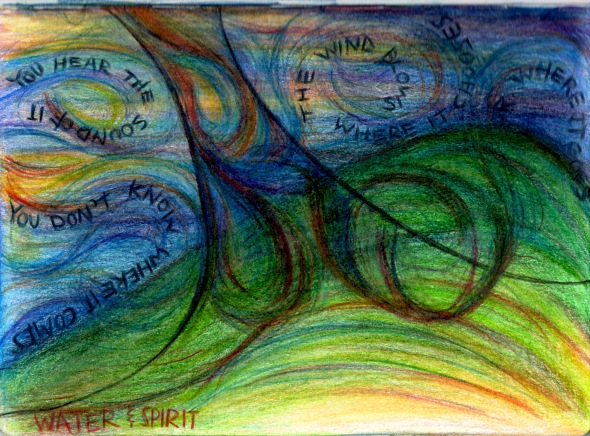
Image is Water and Spirit by Shawna Bowman.  See more here.

Teenagers are Crazy: The Religion Edition

The Daily Show is kind of brilliant, and last night’s Special Report by John Oliver  sparked some interesting ideas.  Phyllis Tickle and others talk of the Religious Rummage Sale that happens every 500 years – more or less:

~4 BCE – The Birth of Jesus the Messiah

and about 500 years later . . .   476 – The Fall of Rome

and about 500 years later . . .  1054 – The Great Schism

and about 500 years later . . . 1517 – The Great Reformation

and about 500 years later . . . The Great Emergence?

Last night John Oliver “reported” that Islam – at the age of  1400 or so years –  is “a teenager” in Religion Years, and he asked the audience to remember what Christians were doing in our “Teenage Years.”  Think of teenagers and some of the nutty things they do.  And then look at what the Christian Church did when they were “teenagers”:

In 1415, the church burned John Hus – the Czech priest accused of heresy – at the stake.

In 1536, William Tyndale, the Bible translator was burned at the stake for opposing King Henry’s divorce.

In 1572, Huguenot Christians were massacred on St. Bartholomew’s Day by Roman Catholics.

And then there were The Crusades.  Those out of control “teenagers” in the 13th Century.  No, it’s not exactly every 500 years or exactly the same time table as Islam, but you get my point.

Crazy things are happening in the world over misunderstandings, a ridiculous video in this age when anyone can film and post a crazy video, and an election in the United States.

What I’m saying is that history is really interesting.  And we need to mature.

Most of us don’t want to be teenagers any more.  But God guide those who are.

Image is from this.


What Are We Willing to Do?

Desperate people do desperate things.

  • Parents illegally cross borders to find a better life for their children.
  • Teachers strike to get better benefits for themselves, better facilities for their schools, better resources for their students.
  • Oppressed people throw rocks and homemade bombs at their enemies across fences to protest for their cause.

Some of us find these practices understandable and some of us are outraged.  As people of faith, we are called to trust in God when we are oppressed or insecure or losing ourselves.  But then Jesus also calls us to be act boldly against what is unjust.

Martin Luther put it this way:  Pecca fortiter, sed fortius fide et gaude in Christo. “Sin boldly, but believe and rejoice in Christ more boldly still.”

It’s a lifelong journey trying to figure all this out.  What are we willing to do to live out our faith?  What is right and what is wrong?  I wish we could have civil conversations about these things.

Image is from an art gallery for the works of undocumented students.

Strange Ways to Love God

For the sake of argument, I’m going to assume that

  • Sam Bacile 
  • The Muslim militants who stormed into the Benghazi Consulate and killed our diplomatic staff
  • You and I

are all people of faith.  We don’t believe the same things, but we each believe our faith involves pleasing God – whomever God is for us. 

I’m imagining – again for the sake of argument – that Sam Bacile is a devout Jew, that the men who attacked the consulate are devout Muslims, and that you and I are devout practitioners of our own faith. 

Let’s say that – out of love for the God of Moses – Sam Bacile (or whatever his name is) wanted to teach “truths” about Islam – a faith he disagrees with.  And because some Muslims were outraged at what they considered blasphemy against Muhammed – out of love for the God they call Allah– they defended Muhammed in an act of retributive violence. 

Remember Diana Butler Bass’ book Broken We Kneel written after 9-11-01? Diana tells the story about her young daughter who asked why a neighbor was wearing a head scarf and Diana responded by saying, “That’s how she loves God“?

So, how do we love God? 

Do we practice spiritual disciplines like prayer and Bible study?  Do we practice acts of mercy like taking food to the sick and hungry?  Do we defame other faiths?  Do we physically or verbally harm people who criticize or disparage our religion?

One of the tasks of the 21st Century Church – and the 21st Century Mosque and the 21st Century Synagogue – is to develop skills in diversity competence.  Most of us are incompetent in connecting with people of other faiths. 

You might remember that after  9-11-01 it was discovered that most members of Congress did not know the difference between a Sunni and a Shiite Muslim (much less the Kharijites, Sufis, etc.)  And sadly, I doubt that most members of Congress can explain the differences eleven years later. 

I am convinced that the most pressing requirement for living in a pluralistic world involves learning about other faiths and connecting with people personally who practice them. 

Jesus himself did this.  For those of us who try to follow Jesus, maybe we need to remember that our multilingual Savior connected with Gentiles without threatening them or mocking them or hurting them.   We can even express our love for God by loving those who don’t know God the same way we do.

We can love God by connecting with organizations like the Interfaith Youth Corps or starting a Daughters of Abraham book group.  Or we can create incendiary media that mocks people of other faiths and strike out at those who understand God differently than we do.  But that is a very strange way to love God if you ask me.

What’s Normal for Families (especially in Church World) ?

HH and I watched The New Normal  last night and liked it, although it’s a bit of a fairy tale. (e.g. Rich gay couple gave the  surrogate mom a really nice house.) 

But not everybody likes this TV show. 

The One Million Moms organization – which has called on citizens to complain about a Skittles ad which involves a teenager making out with a walrus (I haven’t seen it)  is very concerned about  attempts to “desensitize America and our children.”  An ongoing conversation about popular media is this:  Does television promote a certain culture or does it reflect a certain culture?

The same question has been asked of The Church for generations:  Are we a thermostat or a thermometer?

The One Million Moms organization has every right to 1) ask networks not to show programs they find offensive and 2) boycott companies that advertise on these programs.  Also, they do not have to watch those shows.

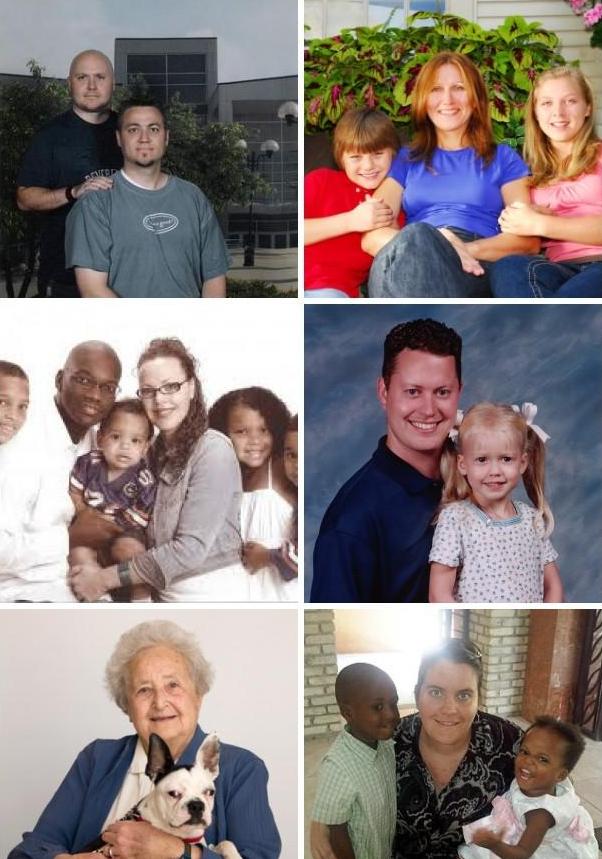
But here’s my question:  What is the New Normal?  Especially in our churches, what family types have you found?  The stereotypical church family looks like this.  But actually, real church families are more varied.  I have not served wild and crazy congregations at all, but the communities I’ve served have included:

  • Interracial couples
  • Single moms who’ve adopted infants
  • Single moms who’ve adopted older kids
  • Gay couples with no kids
  • Gay couples in the process of adopting kids
  • Gay couples with kids from former relationships
  • Lesbian couples with one mom giving birth to their kids
  • Single moms who’ve undergone IVF
  • Married couples who’ve undergone IVF
  • Married couples who’ve adopted babies
  • GBLTQ teens without parents
  • Single people of every age and sexual orientation
  • Couples (married and unmarried) who have been together for 60+ years

The New Normal TV show involves fertility issues, and all families are fertile in their own way.  And churches are fertile with spiritual richness while often looking like the Land of Misfit Toys. 

What does normal look like for your congregation?

Days When Life Changes Forever

Every time I was pregnant, I would look at the upcoming calendar and remember that there was a day coming – then unknown to me – that would become special for the rest of my life.

September 11 is one of those days for many people.

It’s corny and dramatic to say that 9-11-01 changed us all forever.  To me, being “changed forever” implies that every single day is different because of what happened on a particular day in the past. These are the days we didn’t see coming except as routine dates on the calendar.  But then something unexpected happened to shift your world into A New Normal.

If you lost a parent, spouse, best friend, sibling, or child on 9-11, your life changed forever.  If you suffered a chronic malady – either physical or mental – on 9-11 then every day is now different.

Some of my Life-Changed-Forever Days are:

  • July 8, 1956
  • April 8, 1984
  • September 17, 1986
  • September 16, 1988
  • May 1, 2010

What about you?

I remember 9-11-01 very well.   It changed my life in that my heart still feels knotted up when I hear the old news accounts of that day.  But my trauma is nothing compared to others.

Today, let’s remember the survivors, the still-grieving, the Iraq and Afghanistan war veterans and their families, the families of Saddam Hussein and Osama bin Laden, and all for whom this day is very personal.  Praying for peace with all of you today.  And may we treasure our special days – even the very hard ones.

What Does It Take for a First-Time Pastor to be Called to a Church Today?

I was reading Thomas Friedman’s article here about “working hard and playing by the rules” or –  what it takes to land a good job today.  It moved me to think about what it takes to get a call to a church today.  Believe me, it takes more than working hard and playing by the rules.

It’s – first of all – of course, about God’s call.

God moves us and God moves search committees towards each other.  But there are many good candidates for ordination to professional ministry who work hard and play by the (seemingly countless) rules.

It used to be true that seminarians had a call waiting for them upon graduation, but those were the days when churches were large enough to have associate pastors or even “assistant pastors.”  Some of us will remember those days.

Today it takes an average of 2-3 years to find that first call out of seminary.  Why?

  • Sometimes it’s because the candidate still has required preparation to complete: Clinical Pastoral Education or an internship or more time to take/pass ordination exams.
  • Sometimes it’s because there are simply not enough positions for first-time calls.  As I write this, there are 327 people seeking their first call and there are 140 openings.
  • Sometimes it’s because we have second career pastors who already have FT careers and they can take their time looking for a first pastoral call, waiting for just the right one.
  • Sometimes those deemed ready to be ordained to their first call have spouses or other family members to accommodate.  Finding two positions in a certain geographic area is at least twice as hard as finding one.

So what about working hard and playing by the rules?  Those things are basic.

And it’s true that some Search Committees are looking for a certain age demographic that does not describe you.  But honestly, I’m finding that there are  committees looking pastors of every age group, depending upon the job description.

For the 21st Century Church (and maybe this was true for previous centuries to a point) churches seem to be looking for:

  • An authentic pastor leader – someone who can articulate a vision based on the leading of the Spirit that matches the real context of that congregation.  (Example:  don’t call someone who says he can draw in lots of new members who look just like them when the neighborhood no longer looks like them.)
  • Someone who will love you enough to tell you the difficult truth (“Our church is not a big deal in town any longer.”)
  • Someone who will love you even when you freak out over cultural changes.  (e.g. You just noticed that even Church Culture needs to change and this is both Biblical and faithful.)
  • Someone you will follow.  One phenomenon I’ve seen is the “older member” church who calls a young pastor with the intention of controlling her/him.  Don’t do this.
  • Someone who is teachable.  Don’t call the woman/man who doesn’t care to learn who you are, what you are about, what new things God is pointing out.  Beware of wise fools.
  • Someone who knows how to interpret the Word of God in live action.  Every academic person can do a book report.  But it takes a pastor to interpret how Scripture relates to our real life – and not only from the pulpit.  [Note: Loved reading this morning that my friend MK’s church in Chicago opened their doors to striking Chicago teachers who needed to use the facilities.  A small but teachable moment.]

New pastors will need to do more than work hard and follow the rules.  The unique thing about seminary training as opposed to other professional training is that you can jump through all the hoops, take all professional exams, and complete all academic requirements and STILL not be called to professional ministry.  It doesn’t mean you aren’t called to ministry.  It means you aren’t called to this particular ministry.  This is Good News if you understand that God does the calling and speaks to us through a variety of human beings and life circumstances.

I Can’t Read the Bible for You

[Note: My colleague E is a genius .]

Bill Hybels writes in Move, “I can’t read the Bible for you.”  As Willow Creek has assessed its model for membership, it’s become clear that Scripture reading is a non-negotiable requirement for those who want to 1) join and 2) grow in faith.

Being a disciple of Jesus does not involve:

  • Busying ourselves with church activities – even noble ones (choir, Stephen Ministries, Session, Deacons, etc.)
  • Having our names on church membership roles
  • Attending worship services

When we read Scripture, we gather insights on who God is and who we are.  The brilliant thing about the Bible is that we gather different insights depending on how we read it, what’s going on in our lives when we read it, and any number of other influences.  Today I might read the parable of the Prodigal Son and identify with the older brother.  Tomorrow I might read the same parable and identify with the younger brother.  The Spirit hits us between the eyes sometimes and other times we read a passage and think “Huh?”

As a pastor, I regularly study Scripture and let it steep, simmer, and percolate for days before writing down my reflections for sermons or studies.  Preachers put a lot of effort into sermons, but we can’t be the only ones pondering the mysteries of Scripture.  Like Hybels, I can’t read the Bible for my parishioners whether those parishioners are in a single congregation I serve or in the many congregations I visit as a Presbytery staffer.  We have got to do the theological work of disciples – studying, grappling, praying over, and talking about What The Bible Is Saying.  And then we live accordingly.

Being a follower of Jesus involves ongoing transformation.

I’m convinced that people crave good teaching and solid spiritual direction.  But the strongest spiritual communities grow in maturity because they take Scripture seriously.

You might be reading this and think, “Well, duh.”  But honestly, folks, many people in our congregations haven’t picked up a Bible in decades, if ever.  Too many are happy for their pastors to be the lone Bible expert while they sit on pews or sofas and passively learn something or find something interesting or experience an inspirational pep talk.

When was the last time we grappled with a passage of scripture with people in our community?  (I hope it was yesterday.)  This is essential if we are serious about moving deeper spiritually.  And our faith communities cannot thrive without this.

Image Source

Exceptional Whispers

I have a childhood memory of making “a party” with my Great Aunt, and as we were placing cookies on the tray to serve our Sunday afternoon guests, my Aunt G.  whispered into my ear, “Remember, the Edmistons are better than everybody else.” 

This confused me.

One, it was a random comment that had nothing to do with sugar cookies.  And two, it seemed to be in direct conflict with what I’d learned in Sunday School (i.e. I am a miserable offender).

I believe that my children are exceptional.  They are brilliant, kind, and creative.  I might even say I have the Best Kids in the World.  I call my extraordinary sister the BSE (Best Sister Ever) and  my husband is simply The Best.  I am profoundly grateful to be connected to these people.

Maybe you believe your kids/spouses/siblings are The Best as well.  I hope so.

Another random whisper came from a parishioner years ago as she was lying in a hospital bed which happened to be in one of the Top Hospitals in the U.S. according to a recent news magazine article.  We talked and prayed and considered her recovery.  And then she leaned over and whispered into my ear, “The United States doesn’t have the best health care in the world.”  She was originially from Asia and she went on to share how some of the care she’d received in that Top Hospital would be considered unacceptable in South Korea.  And yet, especially during these political conventions, we often hear that the U.S. is the greatest country in the world, the U.S. has the best health care in the world.  And the Olympics in London reminded us that our athletes are the world’s best.   Remember the U.S. is better than everybody else.

There is a difference between cheerleading on behalf of our families, our communities, our nation – Nobody does it better!  – and genuinely believing that we are better than other families, communities, and nations.  Considering ourselves to be exceptional can mess with our heads. 

Consider the church:  A gifted pastor I know, serving an Important Church, was equipping his leaders to share their faith in more hands-on ways with their neighbors.  One of the elders challenged this exercise saying, “We’re Big-Deal-Church-On-The-Hill.  We don’t have to do this.  People already know who we are and what we stand for.” 

The pastor responded in a way that would eventually cost him his job:  “Actually, nobody knows who we are and what we stand for.  No one really cares that we are the Big-Deal-Church-On-The-Hill anymore.”

There is a fine line (or maybe a not-so-fine-line) between knowing we are exceptionally loved, fortunate, and graced and believing we are better, bigger, and more powerful.  One evokes a response of gratitude in that we want to make it possible for others to be so blessed.  Another evokes hierarchy and a superiority that Jesus never espoused.  The unique thing about the Christian faith is this.  Our blessings are not to be exploited; they are given that we might serve others.

Are we the best nation in the world?  We should aspire to be.

Are our families the greatest?  Yes.  (I would love for everyone to be able to say this.)

Are we better than everyone else?  Not only ‘no‘ but if we believe this,  it’s – ironically –  proof that we are not better; we are simply prideful and confused.

Image Source.