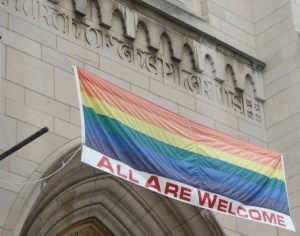
 About a year ago, I heard Richard Mouw speak at the Fellowship of Presbyterians gathering in Minneapolis where he made an excellent statement about Christians with whom he disagrees. He said that if his friends could back up their beliefs Biblically, he could respect them and simply agree to disagree. The subject was the ordination of GLBT Christians and he cited friends like John Buchanan and Barbara Wheeler among those he respected who came down on a different side than his own.
Ross Douthat’s op ed in yesterday’s New York Times referred to the (liberal) actions of The Episcopal Church over the last weeks. Among other things, the House of Bishops voted to approve a rite to bless same-sex unions and Mr. Douthat claims that this is yet another example of the reason why Sunday attendance has diminished over the last several decades in most of our churches. The reason denominations are dying? According to Douthat (and many others) it’s because of liberal activism.
Actually, Diana Butler Bass’s book gives a more reliable and academic reasoning for these decreases, but blaming liberals is standard practice. If Mr. Douthat were to talk with the good people at our conservative churches – at least if they told the truth – he would find that their attendance is down as well. Catholic Bishops are not allowed to discuss such things in public, but their numbers are down too.
The bottom line is that following Jesus involves a commitment that many do not wish to make.
Gone are the days when church was a club with membership perks (a wedding venue, a funeral venue, status in the community.) Huffington Post just reported new Gallup studies over the weekend that stated that only 44% of Americans have confidence in organized religion.* That’s an all-time low.
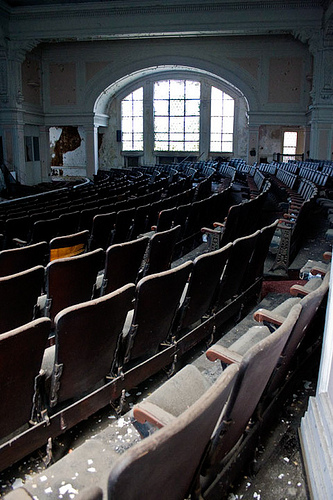
This has to do with what I wrote about in my two previous posts here and here. We have too many dying churches who are threatened with closure. They have lost their purpose (to make disciples of all nations, to equip the saints for ministry, to teach the way of Jesus) and focus only on survival. And the sorting of Christians into “liberal” and “conservative” congregations is part of the problem.
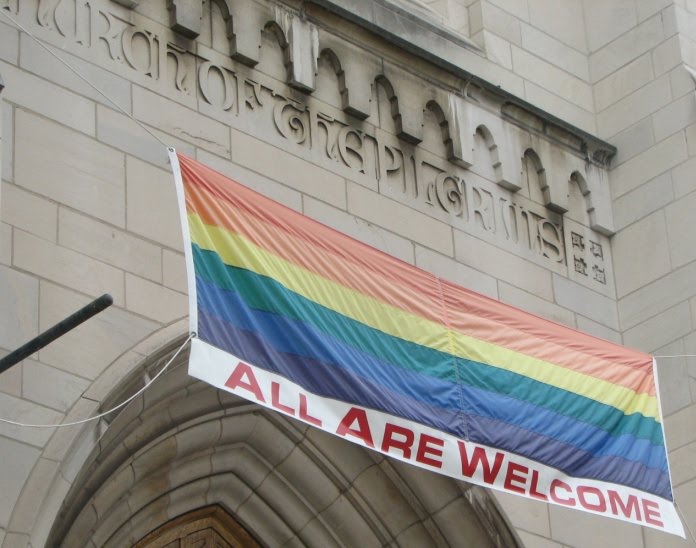
The church is supposed to look something like the Kingdom of God which includes friends and enemies, rich and poor, men and women, locals and foreigners, lepers and bleeding people, and all manner of others who fit in or didn’t. Anybody can read through the Gospels and note the wide assortment of people Jesus included in the fold. And the epistles highlight the conflicts between A) those who believed you had to become Jewish before you could belong to the Way of Jesus and B) those who believed you did not have to be circumcised or follow Jewish food laws to follow Jesus’ Way. These issues were as huge as the issues we’ve grappled with involving divorce, the leadership of women, the leadership of GLBT Christians, and marriage equality.
Both “liberal” and “conservative” churches are grappling with these issues. There are “conservative” Christian colleges who admit to having unofficial gay and lesbian groups on campus: Biola and Baylor, for example, and several Christian colleges – Wheaton College in Illinois, Bob Jones University, Messiah College and Westmont College – now have gay alumni groups.
I believe this is less about political activism than a matter of faithful interpretation of scripture for many of these students and alums. There is more than one way to interpret God’s Word. That’s the beauty of it, really. Some of us believe that God is still speaking. And those who want to follow Jesus – the whole broken band of misfits that we are – may find that what we share in common is so much bigger than what separates us.
*I erroneously said in my sermon yesterday that it was 33%. But the correct percentage is 44%.

 institutional malaise, in soul-sucking jobs.