A Word or Two About Bad Behavior in Church

Still floating after a wonderful ordination experience last weekend, I was talking with colleagues today about why such an experience is so rare.  I’m not talking about the rarity of a moving worship service.  I’m talking about the phenomenon of a person who has been wholly and truly nourished by the congregation of her birth through childhood and teen years and into her young adulthood.
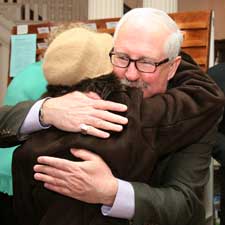
People wonder why there are so few young adults in church.  There are many reasons.  But the bottom line is that few young adults have experienced authentic hospitality and unconditional love, not to mention spiritual meaning.

If we have experienced lavish love in a spiritual community, we will stay with that community.

Too many of us have experienced these kinds of scenarios:

  • First time guests come into worship trying to figure out where to sit and how to find the bathroom.  And a church officer greets them in the lobby with, “Welcome!  We’ve never had anyone with a pierced lip here before.“
  • During the Passing of the Peace, a teenager wearing her soccer uniform is greeted by a church leader with, “I see you didn’t have time to dress appropriately this morning.”  During the Passing of the Peace.
  • A middle-aged single woman – new in town –  sits in the pews by herself and not one person says “Hello” much less, “Can I get you a cup of coffee?” or “Would you like to join me and my sister for brunch after worship?“

I wonder sometimes if we have failed – as a church – in teaching basic Christian behavior.  So many broken people come through our doors and we fail in showing what wholeness looks like.

In fact, we tend to excuse bad behavior – afraid that difficult people will leave.  We fail to hold each other accountable.

I remember calling out an elder on her bad behavior – she was sending incendiary emails out randomly to church members – and after telling her that it was unacceptable, not to mention a violation of her ordination vows, to behave in that way, she said, “So are you asking me to leave the church?”

I said, “I’m not asking you to leave the church.  I’m asking you to stop being so mean.”  She was stunned – in a good way.  Because of her own “stuff” she tended to misbehave so that she would be kicked out of a community.  She was used to being asked to leave every organization or job or friendship she’d ever had.

We don’t want mean/rude/inhospitable/gossipy people to leave our churches.  We just want them to stop it and start making an honest effort to follow Jesus.

How does your community deal with bad behavior?

The Way (Church) Life Should Be

In spite of the message of Diana Butler Bass’ new book – Christianity After Religion – in which Diana correctly notes many ways in which the institutional church no longer works for people in terms of nurturing their Christian faith, I experienced something profound yesterday:

A young woman was ordained to the Ministry of Word and Sacrament in the church where she had been baptized as an infant, confirmed as a teenager, and nourished as a young adult.  And clearly the institutional church was at the core of her Christian journey.  Amazing.

The miracle of this day included the fact that:

  • Vows made by parents on the day of their infant’s baptism had been kept.  (They really did pray with and for her and raise her in the faith.)
  • Vows made by a congregation on that same baptism day had been kept.  (The congregation really did know, love, and nurture this infant throughout her childhood, teenage years, and young adulthood – through kindergarten, middle school, high school, college, seminary, and beyond.)
  • Vows made by a young woman on the day of her confirmation had been kept.  (She actually grappled with her faith and allowed herself to be mentored by adults, and led by God.)
  • The institutional Christian community worked.  (An individual and her extended family were loved, inspired, held accountable, set free, and launched for ministry through a church family for the entirety of one young woman’s life.)

Sadly, we don’t see this much.

Most of our ordained pastors, much less, those called to serve apart from formally ordained ministry – have experienced their journey a more difficult way:

  • They have been hurt by the church, even after baptism and confirmation, or  – at best – their home churches have been indifferent towards their spiritual growth.
  • They have wandered from the faith and nobody noticed.
  • They were raised with no spiritual community at all.
  • They crave spiritual nourishment now but still can’t find it in the church.

God has a mysterious way of calling us even when we wander, even when the community around us has failed.  But yesterday I witnessed with my own eyes an   institutional church that got it right.  Congratulations L. and welcome to this ministry.


My Personal Relationship with Stress

I live with stress.  This week my stress has been exacerbated by:

  • Pastors in trouble (although there are ways out)
  • Churches in trouble (although there is still hope)
  • Committees in trouble (although they could be healthier with just a few tweaks)
  • Tuition bills (although paying them means my kids get to go to college)
  • Out of town guests (although it’s more fun than stressful)
  • Commuting (although I’m grateful to have slept on the train this morning)

I actually get more done when things are stressful. Heart-racing, shoulder-aching, tear-inducing stress is not so great.  But I like having work to do, schedules to keep, deadlines to make. 

There is a good article here about workaholics.  Sometimes we throw ourselves in the vortex of stress to avoid bigger issues.  And sometimes we just like stress.

What’s your relationship with stress?  Is it killing you?  Energizing you?

Happy Week: Re-Wiring Our Brains

Happy churches tend to have happy pastors.  Happy pastors tend to be creative human beings who crave fresh ways of doing ministry.

There, I said it.

I increasingly see ineffective pastors who haven’t learned or done anything new in years.  Interestingly enough, some of them think they are learning something new when they read books or attend workshops, but the books they read or the events they attend only make them “smarter.”  The information doesn’t translate into fresh ways of doing ministry.

According to Shawn Achor human happiness is less determined by genetics, environment, or a combination of the two than by the commitment to develop new habits.   Exercising our brains makes us better – and happier – people.  When we develop new habits, our brains literally re-wire themselves.

The Church needs more re-wired pastors.

I serve a denomination with many talented pastors.  They are smart, well-spoken, creative, and compassionate.  But they are also – sometimes – lame.  Some of us haven’t allowed our spiritual practices to evolve since seminary.  Some of us haven’t preached a fresh sermon – or delivered that sermon in a fresh way – for decades.  Recently heard in a sermon:  “Maybe you’ve heard of the new play Cats . . .”

The brains of  digital natives who have never known life apart from computers are wired differently from those of us who went to high school equipped only with typewriters.   We can become digital immigrants, but we have to be willing to go there.  Immigrate.

A truly great conference or a truly excellent book moves us to a new place.  Before spiritual communities can move closer towards the Kingdom of God, spiritual leaders have to be willing to move first.

I still believe that the meaning of life is To Glorify God and Enjoy God Forever.  This involves some re-wiring.

Happy Week: Who’s With You?


The Preaching Roundtable

Bad things happen.

In my first 5 years of marriage, both my parents and my only grandparents died.   We moved.  We changed jobs.  We had a couple miscarriages.  And we also had three healthy kids – which was good – but not easy.  But we were blessed with a sense of okay-ness, if not joy, in those first five years.  We were happy.

HH and I  are still happy after many more years together, but this is not a post about married life.  It’s about life.  My hope is that I’d also be happy (okay if not joyful) even if I’d remained single.  I know life would be different but I suspect it would still be good.

One characteristic that increases happiness is resilience.  There have been studies, in particular on the resilience of clergywomen which say we can learn how to be more resilient which makes us happier.  One tool:  community.

Much of what adds to our happiness involves the support systems we have around us.  Daniel Gilbert, who teaches psychology at Harvard,  wrote this:

If I had to summarize all the scientific literature on the causes of human happiness in one word, that word would be “social.” If I wanted to predict your happiness, and I could know only one thing about you, I wouldn’t want to know your gender, religion, health, or income.  I’d want to know about your social network – about your friends and family and the strength of your bonds with them.

Whatever you do for work and life, what communities have made it better?

Happy Week Day 2: Happy Things People Say About Love

“My wedding day will be the happiest day of my life.”

“He/she always makes me happy.”

“If only I was with someone, I would be happy.”

Get these good people a (pre-marital, marital, individual) counselor.

I, for one, love Valentine’s Day.  But love can be hard.

Happy Week: The Harvard Business Review

I’m back from a church event in Sterling, VA and – when I’m doing a work trip with lots of ideas swirling around – I usually buy the current issue of The Harvard Business Review.  It’s not the kind of journal I read regularly, but there’s something about stepping away from my usual context that inspires me to read something apart from my usual context as well.  The January-February 2012 issue features several articles about Happiness.

I absorbed and highlighted chunks of this issue like I was reading the latest Rob Bell book.  And there’s probably more in this HBR issue for church leaders than even Rob Bell might offer in one of his books.  And I’m not at all talking about treat-your-church-like-a-business articles – which I usually disagree with.

So on this Valentines week of many (eye-rolling) Happily Ever After stories, I’d like to have some conversations on Happiness.  Reading the Harvard Business Review on a plane makes me happy.

What kind of reading (and where) makes you happy?

Conferences! Conferences!

Please share:  which spiritual/Christian/worship/churchy conferences or events are you attending this year?  (See yesterday’s post.)

I especially want to know if you are registered for this Mime Conference.

Everyone:  please share what conferences you might be attending related to your field in the secular world too.


Cool Event Envy

I’m in Sterling, VA this week for a Cool Event even though not many folks have signed up.  It’s about shifting meetings (which have become the business equivalent of breathing) from deadly wastes of time to spiritually energizing gatherings.  That’s not the official name of the event, but that’s what I’m calling it.

I could spend my life attending events:

Next Church 2012

Wild Goose 2012

Festival of Homiletics 2012

Church Planters Academy

Heck, I’d like to go to Burning Man once in my life although my family frowns upon this idea.

Many of these spiritual/church events feature the usual talented leaders.  You know who they are.  The energy among participants is contagious.  The FB and Twitter feeds buzz with comments.  People leave refreshed and dizzy with cool ideas.

Of course I have limited time to do these things.  There are events I pretty much have to attend (Board of Pensions Benefits) and those I really want to attend (Q1012).

Like meetings that go nowhere, I hesitate to attend events that I fear will go nowhere in terms of solid tools for change in the church.  Yes, some events are meant to enliven us and offer sabbath, but events that promise to point us to A New Way actually point us to not so new ways.

What conferences/events are you attending in 2012?  And why?

Image source.

Are the Rich Better Church People?

I almost drove off the highway on the way home from work Monday while listening to this interview with Libertarian author Charles Murray about his new book – Coming Apart: The State of White America 1960-2010.  

He casually said  that The Rich Are Better Church People Than The Poor.  Really?

Don’t get me wrong.  There are very faithful wealthy people who often serve as patrons supporting 21st Century evangelists, apostles, teachers, etc. much like Paul and others were supported in the 1st Century Church.

But Charles Murray seems to ratchet this up a bit.  He says that wealthy Americans are more likely to be good church people than their less educated, poorer fellow citizens.

First this made me angry.  And then I think I got it.

Wealthy, established people benefit the most from institutions:  schools, clubs, churches, etc.  They are better at being institutional because they have benefited from institutions: universities, fraternal organizations, social clubs, and so on.

It used to be true, he said, that civic institutions attracted people from a variety of socio-economic groups.  The Moose Club, The Elks Lodge, the Kiwanis Club enjoyed memberships that included rich, poor, and everyone in the middle.  But today, Murray asserts that the Upper Class and the Lower Class have segregated themselves.  (This sounds a lot like The Big Sort.)

Upper Class Whites generally watch the same TV shows, eat the same foods, and rear their children the same way as other Upper Class Whites.  Lower Class Whites basically watch the same TV shows, eat the same foods, and rear their children the same way as other Lower Class Whites.

Among the activities that Rich People Life is church.  Or synagogue.  Or mosque – again, according to Charles Murray.  He would argue that this means that the wealthy are more committed to religious institutions.  

But this doesn’t mean that The Rich are most committed to Jesus.  Two different things.

Again, there are both rich and poor who are Good Church People and there are both rich and poor who try to follow Jesus.  These groups are not necessarily the same but sometimes they are the same.

(Side note:  when HH and I saw The Book of Mormon in January, I was struck by how much more church talk there was compared to God talk.  The missionaries were most concerned with bringing people into the church, building the church, obeying the church.)  In my theology, the church is a body that brings people to God, builds God’s kingdom, tries to obey God.

Are the Rich better Church People?  Maybe.  Are they better disciples of Jesus?  Maybe.  But the poor in our world and all who hunger for purpose and relief are more likely to call God’s name in the night.  Those who’ve experienced the living God, who’ve known resurrection in this life, who’ve acknowledged God’s grace are the ones more likely to be disciples.   They could be financially rich and serving within institutions.  Or they could be financially poor and connected by less formal relationships.

What have you seen concerning wealth and faith?

Image source.