Cultivating a Culture of Counterintuitiveness

Jesus was a counterintuitive genius: 

  • The last will be first and the first will be last.
  • Blessed are the meek for they shall inherit the earth.
  • Love your enemies and pray for those who persecute you.
  • On the sabbath his disciples were hungry and they plucked heads of grain to eat.
  • Jesus stretched out his hand and touched the leper.

We, on the other hand, are somewhat addicted to the habitual, the sensible, the standard operating procedure.  This is why we continue to staff governing boards with Church Pillars and plan the same events every season.  While – in this season – typical congregations will hang the greens and Christmas carol and organize children’s pageants, some counterintuitive congregations will forgo the usual worship service on Sunday, December 25th and ask people to stay home with their loved ones praying with personalized home liturgies.  Others will suggest that – instead of gathering for Christmas Eve in the sanctuary – they gather in livingrooms with non-Christian neighbors for prayer and singing.

My New Year’s Resolution (it’s never too early): To cultivate a culture of counterintuitiveness in the church. 

The Presbytery I serve owes a scary amount of money.  THE DEBT.  I heard about THE DEBT prior to moving here and I’ve noticed that many people see everything that happens in the church through the lens of THE DEBT. 

I’m done with this – after only 3 months on the job.  Yes, there is debt but has anybody noticed WHY we have debt?  This particular Presbytery chose to Do The Right Thing some years ago, which involved taking on a debt for the redemptive purposes.  It was a matter of justice and holiness.  It was an effort made to heal what was broken.  Debt was accepted for the sake of the weak and hurt.  And we probably would have taken on even more debt if anybody thought it might help.

Here’s another counterintuitive idea:  I would love to see the angriest pastor on “the right” and the angriest pastor on “the left” covenant with each other to hang out once a week in 2011 to pray for each other, to hear about each others’ pets and hobbies and loved ones. 

Here’s another counterintuitive idea:  Sell your church building – especially if it’s a drain on your financial resources.  Meet in a comfortable Third Place (more about Third Place Ministry tomorrow) and set up a church incubator space for multiple church staffs and other non-profits to use through the week for screen time, study, conversation.

Other counterintuitive ideas?

Spiritual Osmosis (& Why It Doesn’t Work)

Continue reading

Happy Thanksgiving

Tomorrow morning, I set out to drive over several rivers (Calumet, Kankakee, St. Joseph, Ohio, Allegheny, Monongahela, Potomac) and through many woods to spend Thanksgiving in Virginia.  I’m bringing five pies and a sweet potato casserole (for Thursday) plus two containers of frozen soup, a spinach lasagna, and pumpkin-walnut muffins (for before Thursday.)  Can’t wait.

I am enormously thankful.

Happy Thanksgiving everyone.  No more fresh posts this week.

They Said “Yes”

Have you ever been in a large meeting – church or secular – and the group is approving an institutional policy and your eyes start to glaze over as you read it?

A person or committee has written it, there is often a first reading, tweaks are made, details are discussed, questions are asked, and then the community finally votes it up or down.  At least this is how it’s supposed to work. 

Often, it actually goes like this:  the policy is written, nobody really reads it a first or a second time, nobody asks questions, people vote without really knowing what they are voting for. 

We might seriously want a Safe Boundaries in the Church Policy or an Administrative Leave Policy, or even a Bringing Our Pets to Work Policy.  But either the details bore us or we basically trust that what’s in there is good stuff.

And then, perhaps, we are surprised about the repercussions down the road.  Because we didn’t really know what we were saying “yes” to. 

I don’t think this happened last Saturday.

On November 19, an institution near to my heart approved a policy that Changes Everything – at least in terms of ecclesiology – in our particular midst.

The Presbytery of Chicago said “yes” to the new Policy Guidelines for Worshipping Fellowships, Pre-NCD Worshipping Fellowships, ad New Congregation Developments.  (I’ll include a link when the approved version is available digitally.)  It’s 16+ page permission-giving document which  acknowledges that traditional membership doesn’t work for all new communities, that some congregations are born organically, and that the leader might be called something other than pastor.  He/she might be called an evangelist, a convener, a mission worker.  It’s not that there are no rules about starting new churches.  It’s just that the rules are flexible enough to work in a 21st Century culture.

I’m so thankful.

The Psychology of Pews

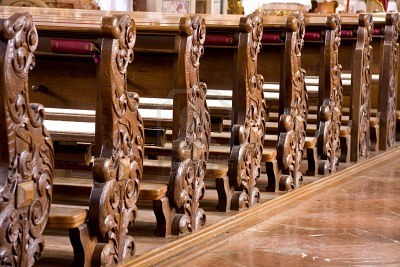
A colleague was telling me that – since their sanctuary exchanged their wooden pews for moveable chairs –  there’s more moving around in worship.  It’s almost as if people felt invisibly chained to the straight-backed, sturdy benches of a traditional worship space.  Maybe we are thinking that because the pews are immovable, we are too.

A well-know Emerging Church leader tells the story of talking with a church lady about the possibly of moving the pews in her church sanctuary and she said, “Unfortunately, the pews can’t move.”  He immediately took a screwdriver out of his pocket, unscrewed the pew from the floor, and said, “Sure they can.”

Some people worship sitting on pews.  Others worship sitting in chairs.  And still others worship sitting on sofas.  (We can also worship walking around, bending over a child or a garden, lying beside a loved one but that’s for a different post.)

I’m convinced that one of the most soul-sucking misconceptions of the formerly mainline church in the U.S. is the notion that there is only one way to worship.  For example, I filled in one Christmas Eve for a church whose pastor was away and – as I officiated over communion – the communion servers looked terrified.  Their backs were to the congregation during The Words of Institution and so I could see their pained facial expressions.  After worship, I asked if they were okay, and they told me that they’d been afraid I would be angry with them for not standing where they usual stood for communion in that sanctuary.  They had accomodated me and where I was standing, which was not where their pastor always stood for communion. 

I was the one unfamiliar with their customs.  I was the one “standing in the wrong place.”  I was the one who was a guest for Christmas Eve.  But they were afraid I would be angry – as if there was one and only one way to do communion.

How in the world did we get this way?  Is it really more worshipful to sit in rows, facing forward staring at the backs of people’s heads,  and not moving until the final “Amen”?  In other (growing) churches throughout the world, people come and go during worship, folks move around.  They might even dance.  Our issues involve more than being the infamous “frozen chosen.”  We have a way of being the worshipping church that shuts down spontaneity – even if that spontaneity involves getting up to check on a crying child or getting a cup of water. 

As a person who grew up sitting in church pews and rather enjoying it, we need to remember that the first gathering places for followers of Jesus had no pews.  It will be interesting to see how long it takes for us to evolve away from them for good.

Can Pastors Be Friends with Former Parishioners?

Most institutional churches have policies about how much a pastor can be in relationship with former parishioners.  In my new job, I’ve seen several of these policies.  They range from “the former pastor can send a Christmas card” (and that’s about it) to “the former pastor can worship in his/her former church with the permission of the current pastor.”

I’ve known relationships between former pastors and parishes being very connected and healthy.  And I’ve witnessed former pastors sabotaging the ministry of the current church leader.

Facebook has altered the issue of maintaining friendships after a pastor moves along or retires.  Do we de-friend all our FB friends when we leave?  Or do we continue to be friends who refrain from talking about the particulars of the congregation. 

Appropriate:  Pictures of the kids, Shared news stories, Weather, Life milestones

Not appropriate:  Sermon critiques, Church gossip, Pastoral care, Promises to come back even years later to officiate at weddings and funerals.

So, here are my questions:

Is it okay to be friends with church members who left the congregation even before I left (i.e. people who moved to the Midwest years before  I left with whom I’ve remained friends.)?  I’d say yes.

Is it okay to wish former members Happy Birthday on Facebook?  I think so.

Is it okay – when a parishioner asks me to come back to baptize their baby – to say, ‘I’d love to, but we have to ask the new pastor.’?   Nope.  This forces the new pastor either to be a bad guy or to rubber stamp what’s been decided.

Is it okay to drop in for worship unannounced, ask if I could co-lead worship the Sunday I’ll be back for the holidays, make pastoral care phone calls, or ask parishioners to share church gossip with me?  Never, never, never, and never.

The bottom line in terms of these relationships seems to be:  what’s best for the congregation.  It’s not about me and what I want. 

What’s tricky is the pastor’s family.  My kids have grown up in one church.  They have friends and mentors there.  Should they not get to stay in touch with those friends?  Should they stop worshipping with that congregation even though they still live in the neighborhood? 

I’ve watched pastors’ wives sit on the third pew with their arms crossed and their faces pained.  I knew one spouse who sat on the Nominating Committee to choose her husband’s successor.  It’s a weird dynamic.  Why should she leave “her church” filled with all her friends?  Maybe she shouldn’t.  Or maybe she really should. 

All these scenarios and possibilities require healthy pastors who don’t make it about them.  The bottom line:  Are we most concerned with nourishing and building up the reign of God?   Or are we most concerned with maintaining our personal power or need for attention?

What’s your wisdom on this?

Can Your Pastor Be Your Friend?

Maybe this is a girl thing.

When I was a single twenty-something pastor, living only with a black lab in the manse, a church friend phoned after 11 pm to tell me about a movie she’d watched on TV.   

After doing this several times, I asked her not to call after 10 because I needed to sleep, and her response shocked me:

But you’re my pastor and you have to talk with me anytime I need you.”

I responded that if she had a pastoral emergency, she could call anytime.  But if she was calling to talk “as a friend” I needed her to let me get my sleep.  I was the first clergywoman in that town and I probably looked more like a girlfriend than a pastor.

Female physicians and attorneys have told me that their female patients/clients sometimes see them as girlfriends.  These women sometimes share personal information and don’t notice that comparable information isn’t being shared by the professional they’ve gone to visit for medical or legal services. 

More than once in my parish ministry, someone would ask if we could meet for coffee on a Friday to talk and when I said, “Friday is my day off,” she would invariably say, “Great!  It’s my day off too.”  And when I would awkwardly explain that I tried not to do church work on my day off, it hurt her feelings.  I never meant to hurt feelings, and I considered church people to be friends, but I’ve found that there are “friends” and there are “friends.”

Eugene Peterson believes that clergy and parishioners can be friends, and I agree.  But most pastors cannot share their deepest, darkest issues with most parishioners.  When I’ve disclosed a personal sadness or worry, many church friends have not wanted to hear it.  They have come to me in hopes of disclosing their own sadnesses or worries.  That’s what they pay me for.

Other church friends totally get that we clergy are human beings and not holy pillars of perfection.  We go on dates, struggle with temptations, have bad hair, and get tired and cranky.  We make mistakes and sometimes we make big mistakes.  The mistakes of a pastor are bigger than the comparable mistakes of parishioners – for better or for worse.  But it’s true.

Can clergy be friends with parishioners? Yes.  But keeping those boundaries can be tricky. 

Tomorrow:  Can Pastors Be Friends with Former Parishioners?

If Our Religion is Football . . .

I grew up in Chapel Hill, North Carolina and believe me, I know what it’s like to worship college sports.  It’s my heritage and my history.

But as I’ve pondered the Penn State situation and those who have grown up loving the Nittany Lions, I’ve been trying to get my head around choosing to protect an institution over a child. 

Just to reassure myself re: my parenting skills, I had this conversation with TBC last week:

Me:  So, you walk into the showers in the gym and you see an adult having sex with a kid who looks about 10 years old.  What do you do?

TBC:  I grab the kid and call the police.

Me:  (sigh of relief)

Even so, HH reminded me that in a hierarchical culture, people are afraid to report their superiors, even of heinous behavior.  But I have come to believe that most of us are afraid of getting involved – whether the situation involves our superiors or strangers or even friends.  Consider this crime in Bethesda and this one in Charlottesville in recent months.

I’ve been wondering if it boils down to what we worship.  I believe that all of us have a religion.  For some, our religion might really be football which sounds ridiculous, but there are honestly those whose highest fidelity is to their home team . . . or their homeland . . . or their home.

What we worship rules our schedule, our finances, our habits. 

Our religion might be financial success or popularity or acclaim.  Maybe we would even risk our lives for these things. 

Maybe we ultimately worship our children  . . . or our parents.  We would sacrifice everything for them.  They are our ultimate purpose and reason for living.

Maybe we  have a different ultimate purpose.  We want To Do Good. We would camp out in city parks for weeks for the sake of financial justice.  We would give up our vacation time to teach children in Haiti.  We would spend our day off volunteering in a food pantry.  These actions don’t require faith in God.  Or they indeed might have something to do with God. 

We who say we believe in Jesus are called to follow Jesus, to do what Jesus did.  It is our religion.  Our way of life.

Sometimes we get confused and we actually worship the institutions around this religion.  We lose sight of Jesus and focus instead on the customs and accoutrements that might have been – originally – about glorifying God, but became about us.  Following Jesus has nothing to do with what we’ve come to consider must-haves for legitimate worship.  Good and holy people believe that Sunday School, pipe organs, and pews are all necessary to be the church.  I, for one, appreciate those things, but none of them are required to follow Jesus.

I believe that the Penn State fans are good people.  I believe that the University staffers are good people.  But because of Jesus, I can also believe that the boys who were abused have a future that is better than we can hope or imagine.  Resurrection is real.  God redeems even evil.  I have experienced this personally and it’s true.

Thank You Veterans

My favorite college basketball team is playing another fine team on the USS Carl Vinson on Veterans’ Day.  It’s not just about basketball though; it’s a small way of appreciating men and women in the U.S. Navy.  Through the years they have served everywhere from Haiti to the Persian Gulf. 

People are called to serve and it can be satisfying and noble.  But they also like to be appreciated.  So especially today, we appreciate our vets. 

(Note:  Check out the cool camo uniforms to be worn during the game – 7 pm EST on ESPN.)

What Will It Take?

I toured a magnificent church building recently.  Built in 1900 with a Hogwarts look (i.e. Gothic), the windows are magnificent tributes to God, the archways are sweeping, and  – from what I understand – the pews are essentially empty every Sunday.  The sanctuary appears to be able to seat between 500 and 700 people with multiple balconies and nooks in addition to rows of pews in the nave.

One might say that church is dying, although the remaining members would say they AREN’T DEAD YET.  They treasure the history and architecture of their once thriving church space.  But estimates say it will take at least $5 million to repair and restore this building and nobody knows where that kind of money will come from.  The current members don’t have it.  And there’s no evidence that a millionaire has bequested his or her fortune to this church for future refurbishment.

What will it take for that congregation to thrive again?

  • For the current congregation to leave  – or stay with the agreement that they will even unscrew the pews from the floor and make the space totally different for a different kind of congregation?  (I’m picturing sofas, carpets, small round tables, a coffee bar and space for a multitude of musical instruments where the choir loft used to be.)
  • Closing the church and selling the property to a different church community?
  • An infusion of money – lots and lots of money?
  • A different pastor?
  • Different officers?

There is so much that church could be.  I can see it in my head.  I can imagine it in my dreams.  What will it take for this church to do something bold for the sake of the Gospel?

Do you know this church?  And what would you suggest for them?