
Setting People Free

Calling the Disciples by Eric De Saussure

As I preach to different congregations each week, I have a recurring nightmare:

I drive to an unfamiliar church building, in an unfamiliar neighborhood, thinking that worship begins at 10 am but when I arrive I learn that worship actually begins at 9:30 and while the people were waiting for me to arrive, they just sat there.  Waiting.

There is a corresponding fantasy that goes like this:

I drive to an unfamiliar church building, in an unfamiliar neighborhood, thinking that worship begins at 10 am but when I arrive I learn that worship actually begins at 9:30 and while the people were waiting for me to arrive, they started worship.  One person led the singing and another led in announcements and prayers.  One was prepared to share her faith story if I never showed up. 

I find that some church people know they are free to worship and serve and welcome guests and share their faith and some church people do not know this.  They erroneously believe that 1) they need a pastor to tell them what to do and/or 2) they can irreparably mess up if they do something the wrong way.

I’ve now seen sanctuaries with masking tape Xs on the carpet to ensure that the liturgist stands in The Right Place.  I’ve seen volunteers chastised because they didn’t arrange the cookies The Right Way.  I’ve witnessed  people staying out of worship because they arrived late and this sign greeted them:
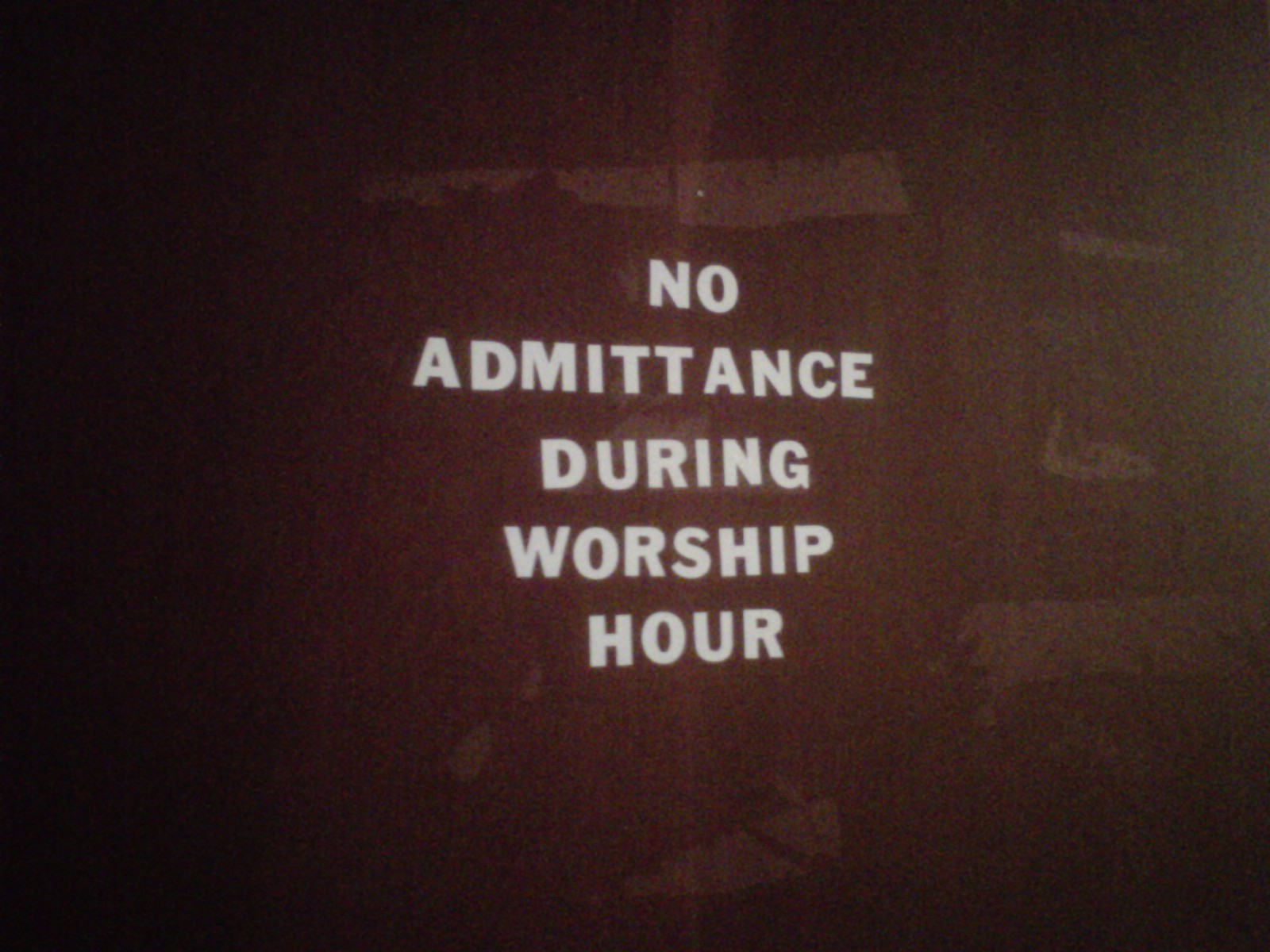
And I’ve seen – like this past Sunday morning – a vast array of elders leading everything from the pastoral care to the pastoral prayers.  It’s not that they don’t need a pastor; it’s that the pastor (or somebody) has taught them how to lead and has set them free to do it.  That’s what I call a healthy church.

Are Long Term Pastorates a Boundary Problem?

Last Friday I spent the day at the required Boundary Training  which has historically been about preventing sexual or financial misconduct.  But this workshop expanded the definition of inappropriateness and/or misconduct to include Staying Too Long in a parish.

Hmm.

Last spring, I left a parish after 22 years, and although I can’t seem to find a numerical definition for what constitutes a “long term pastorate” 22 years probably qualifies.  In fact anything past 10 years and certainly 15 years could be considered “long term” in our fast-paced, transient culture. 

Ed White of The Alban Institute  who has supported long pastorates for years says, “I used to think that long pastorates were a good thing.  I now think that they’re not just good, but necessary.”   After 10, 15, 20 years a pastor’s relationship with a congregation is sealed with history, loyalty, and devotion.  Especially if a pastor has been present for multiple generations of family milestones and years of community involvement, a congregation can find stability and deep transformation in those years together.  It takes a long, long time to change the culture of a church, especially if that church has experienced trauma or weak leadership.  And this shift from a 1950s Church to a 21st Century Church has been compared to turning an ocean liner.  It takes time.

But what if staying too long becomes a problem? What if it borders on misconduct?  It might be unintentional misconduct, but misconduct all the same in terms of a congregation’s health.

Frankly, I worried about this in the last years with my last parish.  I looked at other positions through the years, but nothing else felt like a call.  I did not feel called out of that congregation until circumstances nudged the move.  Was it healthy to stay for 22 years?  I don’t know. 

But what I do know, after just six weeks in my new call, includes this:

  • Churches can become complacent when the pastor is not only present for 20+ years, but when the pastor does too much of the ministry for the congregation.  Christendom nurtured a culture in which churches paid people to do the ministry for them even though the Bible teaches that a pastor’s job is not to do the ministry but to train others to do the ministry.
  • Our denominations offer incentives for pastors to delay retirement which makes it tough for younger pastors to move into those leadership positions.  Those nearing retirement worry about outliving their savings and churches can become stagnant if those pastors basically retire in place. 
  • Some of us pastors find it hard to give up “the power” of being the center of a congregation’s life.  It’s fun being The Beloved Pastor or The Institutional Memory, even if it’s no longer healthy for us to be there.
  • Pastors who have “always been there” can become an idol. 

It all comes down to the word “healthy.”  There are healthy long term pastorates and there are unhealthy ones.  There are pastors who consider themselves to be the center of the church and there are beneficent dictators and there are humble servants.  Maybe those of us who’ve served for multiple decades have a little bit of all those characteristics.

It’s not just about spiritual relationships and intimacy.  It’s also about theology.  God calls us to make earth as it is in heaven.  And that takes a long time.

Commuter Girl

It took me almost two hours to get to work Wednesday. 

Part of the delay involved the rain – that very strange variable that seems to freak people out and make traffic crazy, even traffic on a train.  I left my house at 7:15 am and arrived (wet and cold) in my office at 9 am.  Ugh.  I needed a (skim) mocha right on the bat to warm my bones.

On an average day, it takes about an hour and 15 minutes to commute to and from work from my house which is conveniently located just 7 houses from the train station.  It’s possible to 1) read books, 2) write sermons, 3) pen thank you notes on the train, but what I do is either 1) nap or 2) read the newspaper on my phone.  It’s the best I can do.

So, here’s my quandary:  I am losing about 3 hours a day on the road/train track.  Would it be more efficient to work from home a day or two?

I love the work-in-sweatpants-in-my-home-office idea.  I love having those 3 extra hours to answer emails while also doing laundry. 

I also love seeing my colleagues in the office and having people drop by to meet me and fill me in on what’s going on in their congregations/commissions.  Among the tidbits of information/questions shared as people walk past my office on a random day:

– “Why does THE PRESBYTERY come in to offer advice  like they are smarter than the congregation?”  (Good question. Note:  We aren’t smarter; we’re just trying to help.)

– Did I know that a commission is not the same as a committee?  (I did.)

– Would I like to attend their Octoberfest/Ham Dinner/Craft Fair?  (Probably not)

– Do I like my new job? (Yes.)

– Would I be their supply preacher on Christmas Day?  (No.)

So, what does a happy but needs-more-time-in-her-day commuter do? Do you commute to you job?  Do you have sage wisdom that will bring about the reign of God on earth as it is in heaven?  Please share.

ISO Seasoned Young Adults

According to Wikipedia   “Young adult” may refer to:

  • Persons aged 20 to 40 (psychology)
  • Novels targeted at ages 14 to 21 (young adult fiction)

I recently saw in a letter from Jim Singleton for The Fellowship of Presbyterians that –  at the January Covenanting Convention –  there will be a pre-conference event for leaders under age 45 in hopes of encouraging new leaders.  At the conference I’m attending in Pittsburgh, with a lot of gray hair in the room, people under the age of 45 seem to be considered “young adults.”

Noticing the ages of our church leaders interests me greatly.  I know some solid leaders under the age of 30 much less under 40.  They have fresh vision and fewer qualms about risk-taking.  They are quicker to toss ineffective practices out of  the church.

As a new Presbytery staff member, I asked someone why I was chosen and he said it was probably because I was “seasoned” but still “young.”  (How kind and blind of him.)  I am old enough to have 20-something children.  Actually, I’m old enough to have 30-something children. 

“Seasoned” is good but imagine having differently seasoned people in leadership positions – those with fresher memories of high school and college, those who don’t institutionalize everything (“Let’s do this every year!”),  those who long to learn how to be disciples.  Seasoned leaders currently lead our denomination.  Nevertheless, it would be wise to spice things up.  Differently seasoned leaders are out there.

Digital Voices

We all know preachers with radio voices.  They could read the phone book and it would sound soothing and comforting.  Think Barry White in the pulpit.

They used to have lots of wavy white hair.  And an attractive wife. 

They used to be able to say (often banal) things and everyone would sit deeply engrossed.  But that doesn’t work today – or at least it doesn’t work for long.

Having a Radio Voice used to be the mark of an effective preacher/pastor.  But today, the 21st Century Church requires a Digital Voice, not a Radio Voice –  with all due respect to NPR.

A Digital Voice involves and includes people who haven’t had a voice.  A Digital Voice shares the mike and invites others to share their voices.

In the next chapter for Jesus’ followers, there will the need for Digital Voices.  There will be the need for people who don’t freak out when someone asks questions about Basic Theological Stuff or questions that make our orthodox hairs stand on the back of our necks.  We need to give digital natives power.  We need to speak Truth and Authenticity with all voices instead of Emptiness and Fakeness with radio voice.

I’m done with the guy who reads Scripture like he’s trying out for Shakespeare Theatre..

WWCD

My question is not What Would Cher Do?  (Or Chaz or Calvin Coolidge.)  It’s not even a question but it’s an invitation to imagine What We Could Do as communities of faith that we are not now doing.

I remember a respected colleague who found much success serving an historic congregation which had previously languished with a tired, less imaginative pastor.  One evening when I was watching him in action at a Wednesday Night Live event, I commented on how obvious it was that the congregation was totally energized by his leadership.  His response:  “They are just now figuring out what the church could be and do.

This is a new day for the institutional church.  My own denomination has a new permission-giving constitution.  Other denominations are similarly shifting from tired to fresh paradigms.

One of my goals in the coming months will be to encourage my colleagues – especially those under 40 – to talk about what we could do as a church, as a presbytery, as a community.  I don’t really care what others would do.  What will we do? And let’s do it.

Ideas Week

It’s Ideas Week in Chicago and that means all kinds of innovators have come to town from Bill Clinton to Daisy Khan to Michelle Rhee to Rob Bell to share their creative reflections on making the world better.  Yellow banners adorn the streets.

I have some ideas too.  What if the church could be a change agent in our culture once again? 

I’m working on getting some innovators together for a couple of WWCD events:  What we could do.

Maybe we need our own Church Ideas Week.  Or maybe we can begin to ponder what we could be doing on our own or with a couple of friends.  More about this later.

Can Someone Explain This to Me?

Christ in me is to live.  To die is to gain. Lyrics by Gary Garcia based on Philippians 1:21

I’m not an Ayn Rand scholar.  I read her books in high school and honestly, didn’t think that much about it except that I disagreed with her.  Her ideas seemed the antithesis of what Jesus taught:

  • Love God.
  • Love neighbor as self.
  • Feed my sheep.
  • As you did it to one of the least of these, you did it to me.
  • You cannot serve God and mammon.
  • If anyone would be first, he must be last of all and servant of all.
  • Pray then like this: Our Father who art in heaven . . . your kingdom come, your will be done on earth . . .

 You know these verses too.  (Or at least you should.)

This being  a postmodern age, I get that it’s possible to embrace some of what Jesus said while also embracing some of what Ayn Rand said.  But fundamentally, they taught very different life purposes and philosophies.  Ayn Rand would say we live for ourselves.  Jesus would say we live for God by serving others.  How does someone reconcile the two?

Admittedly this is a incendiary video (and the narrator has one of those creepy the-end-is-near voices.)  But it’s confusing to hear self-confessed Christians laud the objectivist philosophy of Ayn Rand whose tenets are the opposite of everything Jesus stood for (and died for.)

Paul Ryan (“Ayn Rand . . . did a fantastic job explaining the morality of capitalism, the morality of individualism“)  is a  Roman Catholic Christian.

Ron Johnson is a Lutheran Christian.

Rand Paul (who was not named for Ayn Rand) is a Presbyterian Christian.

I am not saying that it’s impossible to be a capitalist and a Christian, although some would.  I am saying that we who claim to follow Jesus have a history of being very confused in terms of the way we live and aspire to live and the way Jesus lived according to our holy scriptures. 

One of the huge heresies – or at least misunderstandings –  of my religious upbringing was the notion that we follow Jesus to avoid going to hell.  This is a peculiarly Randian theology in that this makes our faith about us.  If we are serving God by serving others as a means of getting to heaven, then we’ve made our spiritual lives all about our own benefit. 

God being God, what true obedience looks like – in the image of Christ – has nothing to do with the afterlife.  Heaven is a blessing and a gift from God.  But if our basic motivation to follow Jesus is entrance into heaven, then we have made Christianity about us and our personal benefit.  (Very Ayn Rand.)

Anyone want to explain how you can follow Jesus and consider Ayn Rand’s philosophies to be foundational for your life?

Questions I’d Like to Ask Everybody Running for President

Lots of people seem to care about the religious lives of our Presidential Candidates.  Or at least we seem to care that our candidates sprinkle certain key words in their speeches and debate responses.

Since most of the candidates self-identify as followers of Jesus –  who said more about money than any other topic –  I’ve been thinking about questions I wish someone would ask at one of the debates:

  • Tell us about a poor person you know personally as a friend.  This question is not about how your policies would impact his/her life.  We just want to know who you count among your close friends who are poor. 
  • Why do you believe people are poor?  Give your top three reasons.
  • How does your faith inform your policies towards the poorest Americans?
  • What is our responsibility as wealthy and free Americans towards people in the world who are impoverished and oppressed?

I would like to hear Obama’s answers to these questions too. 

It would also be extraordinarily interesting to hear how all these candidates compare the way of Jesus with the way of Ayn Rand.  I would pull up a chair to watch that debate.

Note:  This is a good article about Objectivism and Christianity.  More about theology and Ayn Rand tomorrow.

Choir Bling & Tattoos

My autumn Tour of Congregations started yesterday, as I’m preaching in a wide variety of churches through November.  Although it’s wonderful to connect with the same church every week and find community with just one congregation, it’s also fun connecting with very different people every Sunday – each with their own DNA. 

Yesterday I was introduced to Choir Bling.

Remember Jennifer Anniston’s character in Office Space and her “pieces of flair”?  The Choir of Sweet Church of the Flatlands has the tradition of wearing pieces of flair on their choir stoles:  Pink Ribbon Pins, Harley Davidson Pins, I Heart Avon Pins, Pins of Dogs & Cats, assorted bejeweled crosses. 

At first I thought this was some sort of tenure tracking thing:  a pin for every year in the choir, for example.  But then I saw that it was more about self-expression.  Their grandchildren might have tattoos to express themselves; these ladies (and they all happened to be ladies) used pieces of flair to share their concerns and interests.

All of us express ourselves by the way we dress, paint our nails, wear our hair, pick out our socks.  Our possessions say something about us too. 

Although a tattoo can be a big commitment (see Jesus humongous face on that guy’s back to the right) and wearing pins might seem out there for choir members, being the church together is more about holding each other accountable to express ourselves and what we believe in the way we treat each other, spend our money, share our time.  It’s easier to put a bumper sticker on the car than love somebody.  It’s monumentally easier to ink or pin our devotions on our bodies than it is to love an enemy. 

Imagine a church that expressed ourselves primarily by the way we served the neighborhood.  The visible results would be amazing.