Welcome to this Ministry

How was your current pastor (or education and music leader) welcomed when she/he started with your congregation?  The act of welcoming in those first days is an important introduction to the community and everybody wants to feel like somebody is glad they’ve come on board.

On my first day of the new position, several of us went out to lunch.  It was great and it was exactly what I needed.  My point here is that I’m not expecting churches to shower the new person with gifts like he/she’s won the grand prize in a game show.  I’m talking about little things that make life easier for the stranger who will become your pastor or other spiritual leader.  Good ideas:

– If the person is totally new to the area, a small notebook with recommended barbers, auto repair shops, dentists, and tree surgeons.  A neighborhood Angie’s List if you will.

– A basket of local treats like a couple of gift cards to local restaurants, a mug from the independent coffee shop on the corner, a recipe book from the women’s organization.

– A written institutional memory – or if you have some time – a homemade video featuring members with a tour of the building & grounds (“This tree was planted in memory of a great lady in the congregation who died in 2003.”  “This room is named for the first pastor who was from Scotland – hence the tartan wallpaper.”)   A video would be more interesting than a notebook, and it would give a very personal introduction to life in your congregation.

–  And speaking of videos – a fun video with brief interviews about why you’re excited that ___ is your new pastor and your hopes for him/her.  Interview the kids, the young adults, the old adults, the Roman Catholics across the street, the local mechanic, whomever.  People could just say, “Hi I’m ___ and I just joined the church last summer but I’m glad you’re here.  Welcome!”  or – if you want to be funny/bold  “Hi, I’m ____ and this is my spouse ____ and we are the ones who always complain about the AC.   So we hope you’re cold-natured.

How has your congregation welcomed a new person to your church staff?  Or how have you been welcomed if you serve a congregation? 

Good and not-so-good (i.e. what NOT to do) ideas are encouraged.
That Day

I can’t bring myself to watch the 9-11-01 Remembrance shows. 

There are many things I still remember so vividly that my heart starts pounding and my throat gets dry when I share those memories.  I can still hear the voices, feel the ground shake, get that sick feeling when you can’t reach someone and fear the worst.  The plane that hit the Pentagon flew past our church building like a bullet.  I didn’t see it myself,  but our mild-mannered sexton was outside with landscapers and he screamed.  The plane was so low that it skimmed the treetops and even hit street lights on its way down Columbia Pike.  And then we felt it. 

I remember frantic emails about church members and loved ones who were in the Pentagon or the Towers that morning.

I remember picking up the children of federal workers from day care because the workers were in lock down – especially if they worked for the FBI or CIA.

I remember picking up my own children – schools closed early and there were no buses – and one of our middle schoolers said that when the Principal asked all students with parents working at the Pentagon that day to report to the library half his class left.  They would be meeting grief counselors in the event their parents did not pick them up.

I remember one elementary school principal who – after getting all her students to their families – learned that her own husband had perished in the Pentagon.

I remember a stranger who cried in our sanctuary all day but wouldn’t speak.  After several hours, she finally stopped crying and told E. that she’s witnessed the plane fly into the Pentagon on her way to work. 

I remember that we had a wedding scheduled for that Saturday and the bride and groom wondered if they should go through with it.  The groom’s family was coming from California. The bride’s family was coming from Europe.  And all flights were canceled. 

I remember that the groom’s family had  immediately rented an RV that Tuesday and drove across country.  And unbeknownst to the bride, her family had arrived early in the US to visit old friends.  They too rented a car and drove to DC.

I remember – after the wedding – driving to N.C. to preach at the ordination of a friend and, on Sunday, as we lined up to enter the sanctuary, The Almost-Reverend M said, “This is a terrible day to be ordained.”  And someone else said, “Actually, this is the perfect day to be ordained.”

I remember that we played the same song over and over and over again on a stream as people came into our sanctuary to pray and cry.  In the Lord I’ll be ever thankful.  In the Lord, I will rejoice.  Look to God; do not be afraid.  Lift up your voices, the Lord is near.  Lift up your voices, the Lord is near.  It helped us get through that day.

You can hear it here: http://www.youtube.com/watch?v=SGS26r7dKZQ 

(Note: WordPress hyperlink still on the fritz and the slides of snowy London are distracting.  Just close your eyes and listen.)

ISO 20-Somethings on COM

30-somethings would be good too.

To be clear: 

1) I appreciate and love my brothers and sisters in Christ of every age with whom I’ve spent literally hundreds of hours in church meetings. 

 2) Nobody joins a church for the meetings. 

As a longtime parish pastor and now as a Presbytery staffer, I’ve sat through lots of meetings – including meetings of the wider church.  One of the joys – and I mean that – of being in a connectional church is that we are indeed connected. 

The hope is that we are connected by relationship more than bureaucracy.  But the bureaucracy quotient increases as the size of an institution increases.  Bureaucracy means meetings.  Lots of meetings.

I’ve noticed – not surprisingly – that there is a dearth of human beings under the age of 40 at these meetings.  Why?  There are lots of reasons:

– Important meetings are often at 2:00 on a random Tuesday and the only lay leaders available are retired people. 

– Evening meetings are tough for people with young children.

– Saturday meetings are tough for people with young children.

– Millennial generations have a higher propensity to consider bureaucratic meetings to be pointless, frustrating, soul-sucking, etc.

So how do we engage people younger than, say, 55 that we want them to participate in policy-writing and decision-making?  I really don’t know.

Ideas?

Never Again

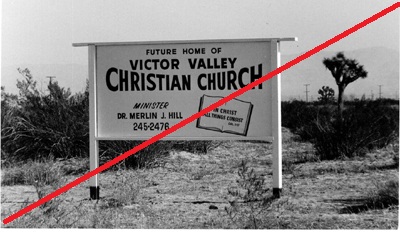
No, this is not a post about 9-11, although that post might be written later this week.  This is about the New Church Plants of the 21st Century and what – imho – will most likely never happen again.

It used to be true that groups of Presbyterians or Episcopalians or Lutherans or whomever found themselves in a growing community without their flavor of church (think post-war Washington, DC in the late 1940s.)  Maybe a group of friends threw together a Vacation Bible school one summer because there wasn’t one within walking distance of their apartment or new split level home, and they had so much fun that they decided to form a new church.  (Actually, I used to serve that church.)

Or maybe an established church in the neighborhood was so overwhelmed with new members (Baby Boomers everywhere) that they planted a new church themselves just a mile away.  You couldn’t have too many churches in the same zip code.

Later it was true that – as new housing developments sprang up in what were once fields out in the country – dioceses and presbyteries and conferences and associations recognized that those new burbs would need churches and so they parachute-dropped a charismatic pastor into that new neighborhood and a new congregation was soon established, and it grew and grew.

As recently as ten, fifteen, twenty years ago, this model still worked.  At least in some parts of the country, churches were planted in new neighborhoods and they thrived under strong leadership.  Yes, some attempts to starts new congregations faltered.  In fact most New Church Starts are not successful.  But occasionally, one catches a spark and flourishes.

In many areas – as we all know – megachurches sprang up in the past 20 years, often first meeting in a gifted teacher’s living room and eventually needing a massive warehouse or abandoned shopping mall to accomodate the hundreds and then thousands of people pouring into worship services.

I’m being ridiculously simplistic and over-generalizing here, but my point is this:  Those Days Are Over For The Institutional Church.  Sure, there could be a new megachurch or two popping up somewhere in 2015.  And this is not to say that many established churches, founded in 1950 or 1970 or even 1870 will not continue to thrive and serve in extraordinary ways.  But the days of multiple new churches in one neighborhood are over.  The days of dropping a fresh faced pastor into a new condo development and establishing a sustainable church replete with a shiny new building in less than 5 years are over.

Again, please hear me out.  Congregations that are already established can and will continue to do ministry well in their neighborhoods IF they are missional communities committed to adaptive change.  But the majority of new spiritual congregations will look more like Broad Street Ministries in Philadelphia or Wicker Park Grace in Chicago.  (Sorry but the WordPress hyperlink is on the fritz.)  Those congregations are fluid and open.  Membership stats are loose and worship is marked by art (often led by a curator rather than a preacher) and conversation (rather than a sermon.)  In Holy Grounds Alexandria (again I can’t hyperlink) we called it grappling. 

This may be painful for those of us who love membership rolls to accept but searching millennial generations are not going to join First Church on the Hill and sign up for the mission committee.  Sure, there will be young adults who grew up singing from hymnbooks who will seek out a church like the one they knew and loved as children, but even those brothers and sisters in Christ will want something more emergent.  Traditional in worship style perhaps but emergent in culture.

How do we make this shift in our thinking and our planning?  Baby steps.  While continuing to serve traditional congregations, we encourage the creation of missional communities that meet in nontraditional spaces:  art galleries, bars, coffee shops, diners, movie theatres, parks.  We’ve already seen them out there if we’ve been paying attention.

This is the future of new church developments if you ask me.

Grappling in Chicago

After spending some time last week with faithful people who have special concerns about orthodoxy and what it means to have a right belief, I find myself – more than ever – wanting church to be a community in which it’s safe to grapple with our faith.

As I’ve written before, Phyllis Tickle has shared that one of the shifts in the church is this:

The 1950s church experienced a Believe-Behave-Belong model of church.  It was assumed that everyone believed the same thing, they behaved accordingly, and then finally they could belong.  In some communities (you know who you are) one could be part of a congregation for decades and not really belong.  You could only truly belong if you could trace family membership back a couple generations.

The 21st Century church experiences more of a Belong-Behave-Believe model.  People yearn more than ever to belong to a community especially in these days when we tend to live away from family and find ourselves in an unfamiliar city or town. In this community we learn how the community behaves, and finally we come to believe.  Gone are the assumptions that everybody’s grown up attending Sunday School and having family devotionals.  I find that many of those coming through the doors of church buildings are trying to figure out what they believe.  They may have grown up in no church or in a church that fell short in the spiritual nourishment department.

And so we grapple together these days.

All I’m writing here is old news to most of you, but it’s essential to remember that the 21st Century Church culture needs to make room for people to have a safe place to ask questions, express doubts, and ponder together about The Holy.  The church that fearfully squelches these conversations is missing the point.  We are like a First Century culture again.  This is not to say that there is no Truth.  But we must welcome people who are seeking Truth in a postmodern world.

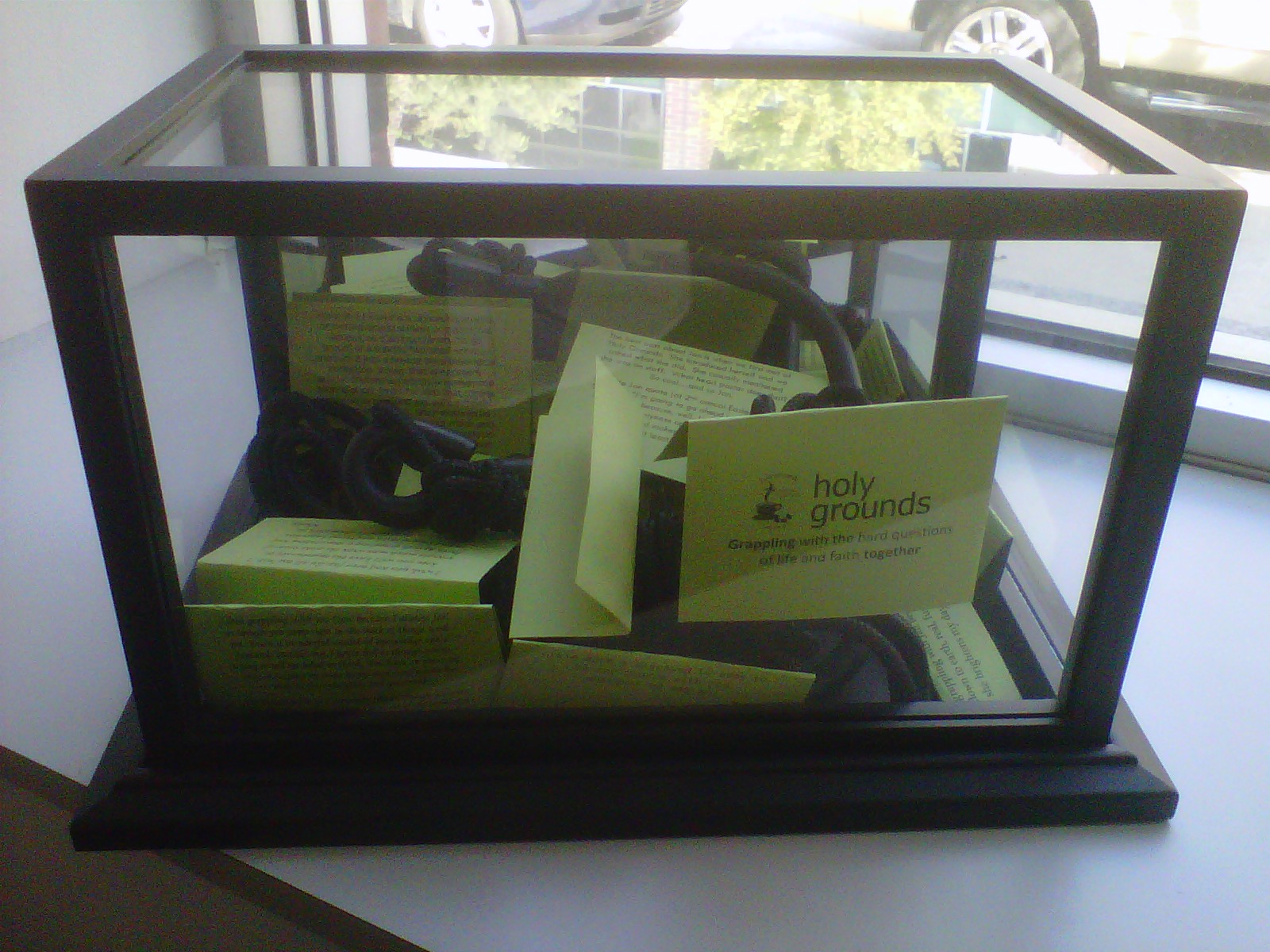
The photo above is of an encased grappling hook with accompanying grappling memories given to me by Holy Grounds, a community I love, that grappled with me on issues of faith and life.

All the Folders are People

After two days in my new position as Presbytery person, it is unmistakable that I’m in the Mother Ship in terms of the Institutional Church Universe or ICU. 

Already I miss (a lot) the sermon writing, the children’s story, the liturgy planning, the hospital hand-holding.  Instead I have spent the past two days sitting in meetings, making phone calls, and reading through files.  Lots of files.  Sometimes I file things myself and sometimes I examine a file someone prepared for me. 

I work with a great staff.  I sit with interesting people on the train and walk by other interesting people on the sidewalks for the jaunt from train station to the office.  But I Am In The Office and not out and about (much.)    But here’s the amazing ministry piece:  all those files in all those stacks in my new office are about people.  People who are called to serve in new ways.  People who are waiting to be called.  People who love the church and can’t wait to write the sermons and create the children’s stories and plan the liturgy and hold the hands of the sick and sad.  I get to help make that happen.  Cool.

And occasionally (like Wednesday) I get to talk with a pastor up close and personal instead of getting to know her via file folder. 

One of the crucial aspects of 21st Century Church is the relationship and I believe this is why The Institutional Church is so frustrating for people.  Human beings long for community.  Our structures give them institutionalism.  The processes and procedures kind of ruin it for people who simply crave spiritual nourishment and connections.

So how do we nurture Real Church in the throes of the administration in the ICU?  Step one seems to be remembering that these files represent real people who just want to serve, preferably in the joy of a true calling from God.

Learning from Others’ Mistakes

I try to learn from my own mistakes.  But I have learned a lot more from the mistakes of others. 

My call to professional ministry was sparked by three pastors whom I approached for pastoral care – none of whom were very helpful.  Not one even offered to pray with me.   I remember telling a friend that “even I could be a pastor than those guys” and, frankly, I had no designs on ever going to seminary.  But a call was born.

Today – Monday – was my first day in a new position that I feel called to serve – to some extent – because of the mistakes of other church people.  If I’ve come with a special agenda, my agenda is to make it easier for leaders to do what God has called them to do.  And to say no when necessary. 

I’ve witnessed faithful, outside-the-box leaders be subjected to jumping through so many hoops that it crushed their enthusiasm and felt more like hazing than healthy process.  I have a friend who was certified and ready to receive a call, having completed all requirements for ordination, but he was required to be “mentored” for an additional year when church officials were concerned about his tats and piercings.  (Actually, we could use lots more leaders who look like that guy.)

My hope is to encourage a culture of getting out of the way. 

Yes, processes are important.  But perhaps the most important process involves the discernment of the community.  And we have to know each other, we have to be in relationship with  each other before we can discern someone’s gifts and a congregation’s needs.   Healthy spiritual communities ask if a process, a decision, a call will promote the reign of God. 

I’m going to make some mistakes in this job.  My hope is that somebody will learn from them.

The Fellowship of Presbyterians Gathering Days 2 & 3

Comments I often hear out in the world:

All religions are basically the same.”  (To these folks, I suggest reading Prothro’s God is Not One: The Eight Rival Religions that Run the World and Why Their Differences Matter.)

All denominations are basically the same.” 

It doesn’t really matter what you believe as long as it doesn’t hurt anybody.”

Many of us take theology seriously – not just as an intellectual exercise but as something that impacts the way we live.  Do we base our theology on what we ourselves determine to be right and wrong, or do we live according to some sort of authority beyond ourselves and our personal opinion?

And can we be a spiritual community with those with whom we disagree?

At The Fellowship of Presbyterians meeting in Minneapolis August 24-26, there was much concern about orthodoxy.  What are “the essential tenets” of orthodox Presbyterian theology?  And does the fact that the PCUSA now officially ordains GBLT leaders require those who disagree to make a change in their denominational affiliation?

What’s not helpful:  Assuming that anyone who believes that ordaining gays cannot possibly be orthodox.  One of the organizing pastors suggested that we need “a firewall of orthodoxy” to separate those who rightly believe and those who do not.  This makes me a bit uncomfortable.

One of the essential tenets of our faith is that God is sovereign.  God is God and we are not.  It troubles me when any person or group implies that  they absolutely know the mind of God.  One example:

I have a brother who does not believe in the ordination of women.  He is one of the best, most faithful people I know but we disagree about this theological detail.  We can both make sound Biblical reasoning for our positions, but we disagree.  His church doesn’t ordain women.  My church does. 

He believes he’s right.  I believe I’m right.  One of us is wrong.

(Note:  I could also say – with my postmodern hat on – that both of us are right but that’s fodder for another post.)

I believe that some gay Christians are called to serve the church in an official way.  Many of my brothers and sisters in Christ do not believe this.  Both of us can make sound Biblical support for our beliefs.  But one side is wrong. (Unless we are both right – again the postmodern answer.)  

One lovely woman in my Fellowship Gathering Table Group – with whom I disagree – said that she would rather err on the side of righteousness and holiness.  I said that I would rather err on the side of grace and inclusion.  But both of us agreed that we could be wrong about our understanding of what God wants according to scripture in regards to ordaining GBLT believers.

I am not worried about the future of the church.  My denomination or any denomination or no denomination.  Seasons of church life come and go and God always wins.  It’s a very exciting time to be part of the church.  I say let’s make some changes and be generous with our words and property.  And then move on and serve the values of the Reign of God.

The Fellowship of Presbyterians Gathering – Day 1

Have you ever been a minority in a group of people?  It’s uncomfortable, isn’t it?

Have you ever been pegged (e.g. conservative, middle-aged, blonde, Asian) and then written off as if any single adjective could capture who you are?

Have you ever caught yourself pegging somebody else when, for example,  they use gender exclusive language (“mankind”) or dress a certain way (polyester pant suit) or hail from a certain part of the country (Mississippi)?

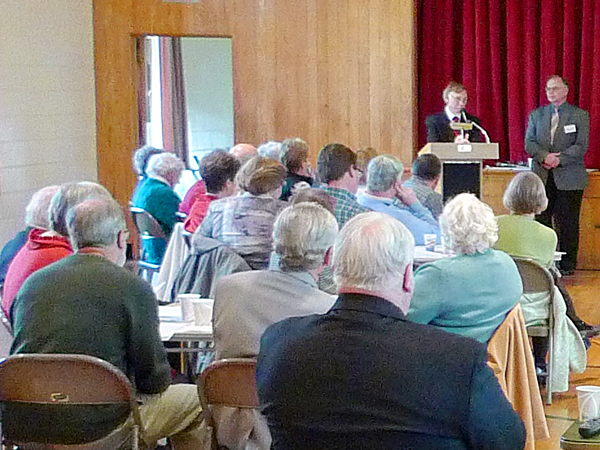
So, here I am in Minneapolis for a gathering of The Fellowship of Presbyterians, the folks who brought us this letter back in February.  I wrote a couple of guys involved with the letter to share my thoughts.  And then I signed up to attend this thing.  In the meantime, I was elected to serve on a Presbytery staff so this event turned out to be more than a theological field trip.  It’s sort of my job now to work with pastors and churches that are interested – or intrigued – about doing something dramatically new in our denomination – like maybe leaving the denomination.  Or perhaps creating A New Reformed Body.  You can read details here.

So here are my first thoughts after worship Wednesday evening:

– I feel like a minority in a crowded room of People Not Like Me.  But maybe they are indeed more like me than I now realize or will admit.   

With a nod to Brian McLaren, I self-identify as an evangelical, Reformed, conservative, liberal, green, grappling, postmodern, missional, pastoral, traditional, emergent, mystical follower of Jesus.  And yet, I can feel some people immediately appraising me based on everything from my age and gender to my Blackberry and nametag which erroneously says I’m from Alexandria, VA which means National Capital Presbytery, which means liberal.  Or maybe I’m just paranoid. 

– It’s totally easy to be judgmental here: 

Exhibit A:  we sing gender exclusive songs and I feel the snarkitude rising.   A woman prays “for mankind” and it ticks me off.  Note to self:  pray for a gracious attitude.   

Exhibit B:  I met a well-known leader of this organization in the registration line and I remembered a colleague once telling me that this person was the meanest human being he’d ever known.  Do I take his word for it or try to make a friend?  

Exhibit C:  Where are all the 20 and 30-somethings?  They are not here.  I imagine if they walked by the ballroom during worship tonight, they could have mistaken us for a megachurch gathering – and maybe not in a good way.  Again, I need to pray for a gracious attitude, but honestly it makes me nervous  when people applaud the resurrection. 

Exhibit D:  I realize how much I now believe that the kingdom of God is now.  (Note:  See, I can use gender exclusive language too.)  And it really bugs me when the church considers “the exhibition of the kingdom of heaven to the world” to be about the afterlife.  I believe Jesus was talking about bringing heaven to the world now.  This is the point, if you ask me.

And so here I am at a conference with almost 2000 people from 49 states and 3 countries beyond the US  – according to the handouts – because I love the church.  What do we mean if we say that we love the church?  That we love the tradition?  The building?  The denomination?  No, the church is the people.  We have to love the people even the ones who make us crazy/angry/tired.

I got an email from a former parishioner today telling me that she’s left the church we served in together.  This makes me sad – not because she left but because I doubt she sought out those with whom she disagreed before leaving.  It’s easy to sort outselves from those with whom we disagree.  It’s hard to stay and wrestle and love each other in spite of our differences.  But grappling and staying together seems to be a more Biblical way.

Congregation

Who is in your congregation?

I’m not asking this of parish pastors alone.  I’m asking this of everyone.  Lobbyist.  Medical student.  First grade teacher.  Game show host.

Imagine being a pastor – professional or not – in your community.  How would this alter the way you interact with people?  My congregation is about to be The Presbytery of Chicago.  This is an overwhelming and yet fascinating endeavor.  I kind of can’t wait.

How about you?  Who are your people?  Whom do you serve?  How do you create community and equip the saints of God.  I’d love to hear about it.