The Way We Learn Our Own History

For some of us it’s easier than others.

Last Friday night, my Edmiston family enjoyed a Post-Wedding celebration (thank you Covid) and while there were no formal family history shares, I love how the brain (i.e. the Spirit) reminds us of moments we might have forgotten. While watching my cousins and sister dancing to Justin Timberlake in a circle, I flashed back to the same people – as children – dancing to Sammy Davis, Jr. in our cousins’ living room.

On Saturday, my Linker cousins enjoyed a luncheon at the table of our matriarch while passing around old photos and telling stories that reminded me of my grandmother’s spark and my mother’s grace. I also got to hear stories they would never have told me as a child.

On Sunday, First Presbyterian Church of Charlotte celebrated their 200th Anniversary and the preacher took us back to all those who had walked along the road by the church building from the Native Catawba to the NFL Panthers. And as I spent part of the afternoon reading Lois Stickell’s 200 Years in the Heart of Charlotte: A History of First Presbyterian Church, I was grateful for her truth-telling in times when truth-telling feels rare:

At the dawn of creation, a billion years ago, the land that First Presbyterian Church occupies did not exist. No land existed east of where the Blue Ridge Mountains sit today. There was only an ocean with islands and small continents. As tectonic plates shifted, those pieces of land collided to create eastern North America. Seven hundred million years later, the African plate hit the North American plate with enough force to create mountain ranges as tall as the Himalays all the way to middle Tennessee. Lois Stickell

Reading this brought great comfort to me. It shares the geological science that tells a story much different from the Genesis story of the world being created in 7 days, and that’s fine with me. The Bible is not a science book. It’s the story of God’s power and unmeasurable love.

The preacher proclaimed Good News from The Parable of the Good Samaritan and I remember that Jesus – like most rabbis – explained things through parables which are the shocking stories told to reveal the depths of God’s love. Jesus made up this story to make a point: that those who show mercy are our neighbors – even if they are the most unlikely candidates.

As we go along the ancient and new roads of life, we are called to be neighbors if only we will see them all as God’s children.

Some of our personal stories, some of our church stories, some of our national stories are crushing. Along with those family members who showed mercy, there are always those who traumatized us. Along with the church stories that led us to Jesus and filled our souls to the bursting, there are always stories of exclusion and cruelty. Along with the stories of our nation living in unity and pulling together to bring healing after 9/11, there are heinous stories of unspeakable brutality again Natives and the Enslaved, not to mention the reactions of some of us to show intolerance towards Muslims after the Towers fell.

My neighbors – and my family – include heroes and rounders, saints and sinners, and so do yours. It’s not only good to see all their faces. It’s good to remember that we need mercy as much as the next person.

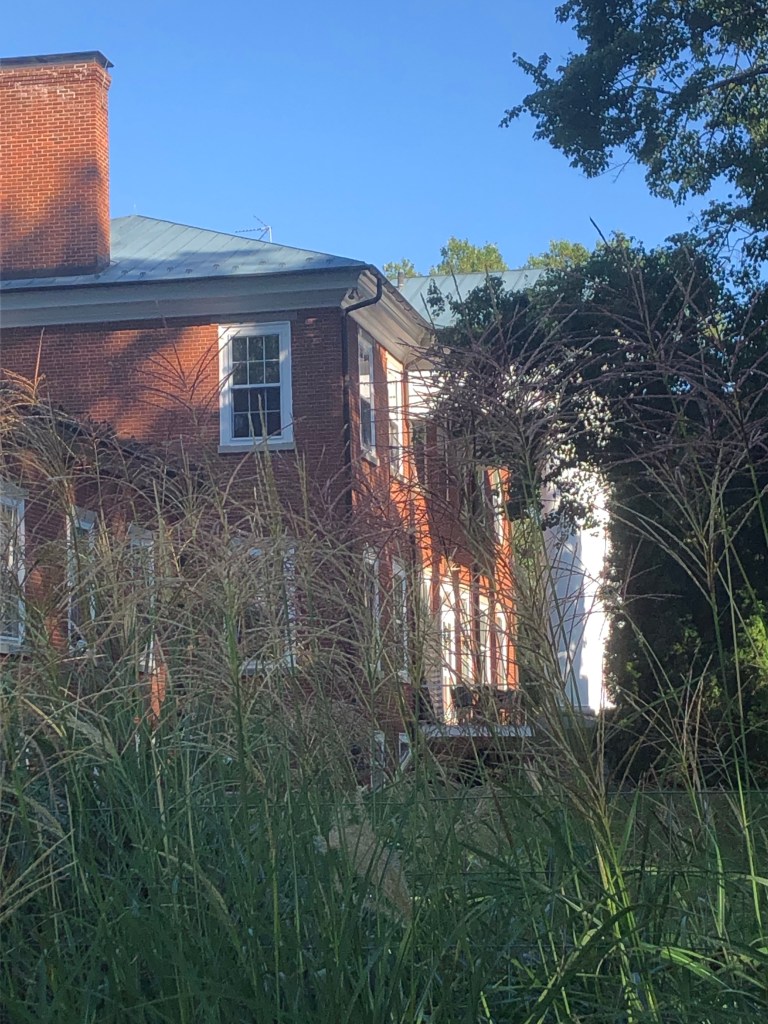
Image of Wade Hampton Linker – my great-grandfather – who was surely a good and also imperfect man. He was named for Confederate General Wade Hampton who is lauded as a great leader who also held 335 human beings as slaves in 1860.

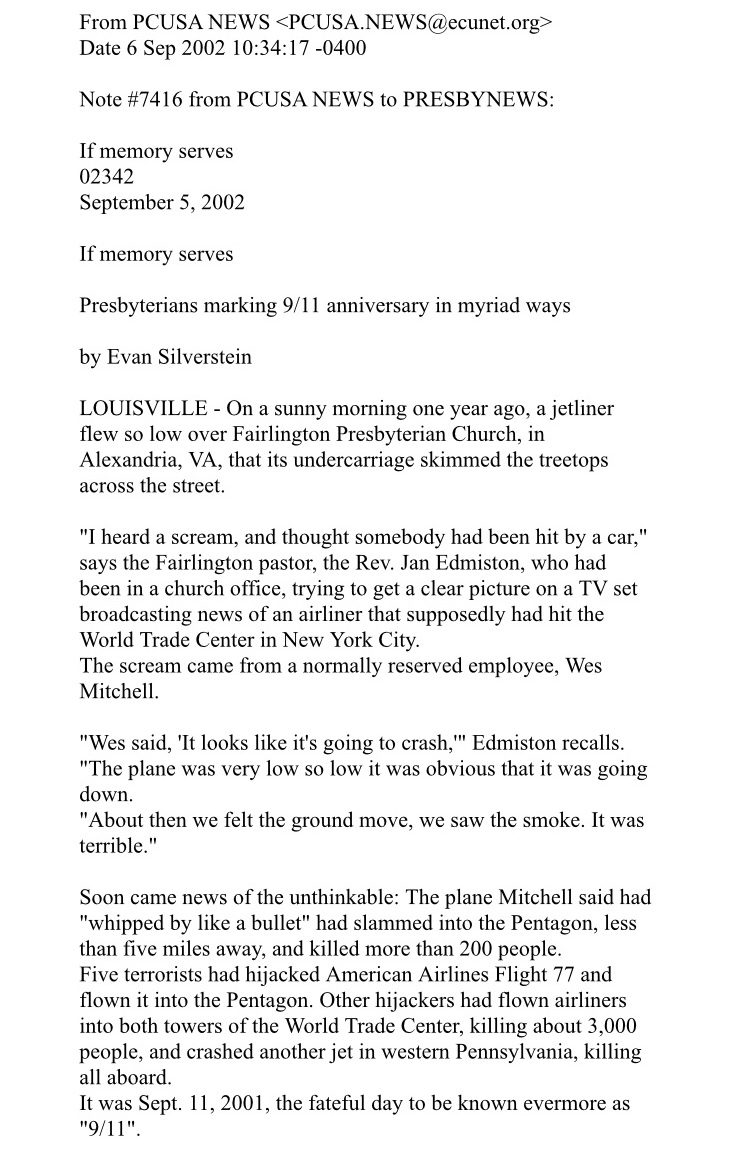
Twenty Years Later, We Still Pray for Peace

From an article by the PCUSA news service for the first anniversary of 9/11.

The End of Casseroles?

I still remember the Chicken and Broccoli Casserole Mary Moretz brought to our home after Mom died. It was so comforting and after she shared the recipe, it became a staple in our household when the kids were young. Broccoli, chicken, cheese, sour cream, and a can of cream of mushroom soup. Lots of fat and salt and deliciousness.

I’ve written about the culture shifts involving sanctified casseroles before, but COVID has changed things even further. Not only do we Emergency Meal Providers need to worry about food preferences, allergies, and special diets, but now there’s the concern that we could be spreading COVID between each other’s kitchens.

So now we send Food Delivery Gift Cards – at least if we live in urban/suburban parts of the world.

It’s kind of perfect in that a family can order from hundreds of restaurants exactly what they feel like eating when they feel like eating it, and there are no dishes to return. Voila. The purpose of providing a meal has been achieved: the family didn’t have to cook while welcoming a new baby/grieving a loss/recovering from surgery/waiting for a family member to be discharged from the hospital.

What we miss in not having a homecooked meal could be important. I’m not sure yet.

It’s indeed so meaningful to know that someone made soup or a chicken and broccoli casserole from scratch. But if the purpose is to show love and concern, a Door Dash card can bring the same kind of relief. If we want to offer that personal touch, we can deliver the gift cards in person to say a quick “hi” and “how are things?”

The world is changing and this includes the neighborly practice of taking casseroles to people in need. There are things to lament about such cultural shifts and there are things to applaud. Both are true.

Stuff We Need to Know in the Post-Pandemic Church: We Need Cults

Bear with me here. I remember how disconcerting it sounded when my Hebrew and Greek Bible professors in seminary spoke of “the Israelite cult” or ‘the cult of Jesus.” To me, cults were about madmen who literally forced followers to drink the Kool-Aid or commanded that they torture and kill starlets in LA.

But the historic and linguistic definition of “cult” is simply this:

A system of religious veneration and devotion directed toward a particular figure or object. Source.

Every house of faith is experiencing less participation these days. And it’s not necessarily because of a lack of spiritual hunger. Followers of Jesus, followers of Muhammed, followers of Moses, followers of Ganesh, followers of Guru Nanak have quite of bit of competition – although I’m not sure that “competition” is the right word.

Imagine that you are a 25 year old whose parents or grandparents grew up in The Church. It was an essential part of their lives and from cradle to grave, they belonged to a community of faith that brought meaning to them.

In the experience of a 25 year old living in the 21st Century, Roman Catholic priests have been found guilty of tolerating pedophilia to the highest levels. Church leaders in the news have shown themselves to being greedy, untrustworthy, and homophobic. Churches have seemed out of touch at best and dangerous at the worst.

Don’t get me wrong, there are “systems of religious veneration and devotion” that continue to thrive these days for many young people related to Jesus: Young Life. International Justice Mission. Montreat Conference Center. Elevation Church. The Cool Bible Study. Note: There is richness about allegiance in these organizations. And also – in the strictest definition of the word – they can be cultish.

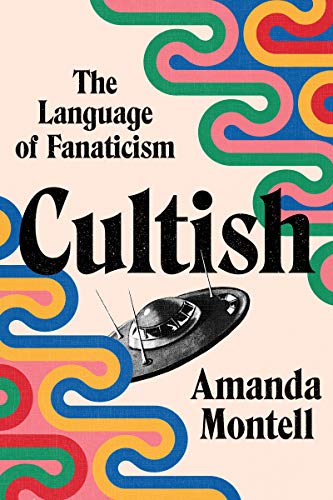
Amanda Montell has written a brilliant book about Cults in terms of both the sinisters ones and the helpful ones that bring meaning and community to seekers. Again – forget David Koresh and Q-Anon (although she addresses those too.) Consider Soul Cycle, Noom, Dave Ramsey, Pelaton, Ted Lasso. All have their devotees. All have a special language and a sense of being on the inside.

Repeat after me: Roy Kent! Roy Kent! He’s here. He’s there’s . . .

We are devoted to many things in these days. Among other things, I am devoted to Ted Lasso. And also Giddy Goat Coffee, The Bento Society, Public Libraries, Fleabag (still), and British mysteries. And to Jesus most of all – I pray.

It used to be true that we were devoted to fewer things and one of them was Church. It was once something special to be a member of Big Steeple Church because it meant you were connected to Important Citizens in your community. We knew all the inside words: special music, narthex, circle meetings – not to mention words like Pentecost and Confirmation and Eucharist. Even if yours was Small Steeple Church, you were probably devoted.

I remember taking an unbelieving friend to worship with me several years ago and when I asked afterwards what she thought, she said this, “There were a couple of times, it felt like a cult.” She was referring to the mindless recitation of The Apostles Creed – with people staring into space and speaking words without much consideration for what we were saying.

One more time: I’m referring to “cults” according to the traditional definition. And yet, while we have often recited creeds and prayers and scripture passages mindlessly, we have displayed little devotion to Jesus. Devotion to the institutional church maybe, but not so much about God.

When I was co-leading the national denomination of the PCUSA (2016-2018) speaking all over the place about The Church, more than one person pointed out that I had swallowed the Kool-Aid. Yes. And I believe that the Church of Jesus Christ is doing extraordinary things to transform the world that rarely get any press – from disaster assistance to affordable housing projects to jobs training programs to youth programs that welcome kids who have never felt welcomed before. The Institutional Church is a hot mess. And, it’s also saving lives on our most faithful days.

As we are considering what the post-pandemic Church might look like, we need to remember that every human being wants to be valued. Every human being wants to belong. Every human being seeks community that’s meaningful and safe. Every human being is struggling with something. Every human being carries a measure shame with them. Every human being is made in the image of God.

Congregations that only perpetuate themselves offering programs that don’t feed anybody’s soul and filled with people who are gossipy and mean and spiritually immature will never be the community that people crave. And they will not survive the culture shifts that are upon us. And this is okay. Because Jesus calls us to be a Body of people who are different from the world, and if we aren’t then we indeed need to shutter our doors and allow something new to be born.

I’d love to hear about your favorite cults from Harry Potter to Accupuncture to Trader Joe’s. And – for what it’s worth – my deepest devotion remains “the cult of Jesus.” I still believe that the world will be saved through him.

Vacation

Blessings to you these last summer days. I’m taking a break on writing new posts until after Labor Day.

Is Empathizing the Same as Coddling? (Your Answer Impacts Who We Are As The Church)

Let’s say our congregation is committed to becoming “more diverse.” That could mean several things:

  • Our congregation is predominantly White and we want to look more like our changing neighborhood where people happen to have a variety of skin colors and heritages.
  • Our congregation is comprised of members over the age of 60 who would love to welcome young families.
  • Our congregation is aware that there’s an influx of refugees moving into town and we’d like to welcome them to our church, our preschool, and our community.
  • Our congregation would like to make it known that we welcome LGBTQA+ neighbors.
  • Our congregation is primarily English-speaking but we’d like to welcome the Spanish-speaking neighbors.

[Note: Becoming “more diverse” is not about political correctness or being the cool church or gimmicks. Faithful congregations want to share the life-changing news that God loves us with everybody. Jesus says so.]

So, let’s say that our church is successful in welcoming all kinds of people. Yay. We’ve become a community comprised of people who don’t look like, speak alike, or have the same experiences. The heavens are singing.

But then something painful happens: Black members want to talk about the everyday racism that they experience. Immigrant members want to talk about why they needed to come to this country in the first place. Women who’ve experienced abuse by former pastor need to share their stories. Recovering addicts need to share their stories. Former refugees need to share their stories. Victims of bullying need to share their stories.

And the longtime members of the church don’t want to hear about those things. “If you believe in Jesus, all that is past,” one older White woman who grew up in the church says. “Don’t be a snowflake,” another member says. “I can’t stand all this talk of victimization,” says a prosperous White member.

One of the issues dividing The Church in the United States is the battle over how we in the Church will address the societal realities of our culture. Both “liberal” and “conservative” congregations are struggling with this.

Bethlehem Baptist Church in Minneapolis – the congregation that noted conservative theologian John Piper led for many years – is experiencing an ugly church split on the cusp of its 150th anniversary. The issues?

racial justice and critical race theory (CRT); the #MeToo movement and the call to believe women; and the nature of trauma and abuse.

You can read the recent Christianity Today article here. Members are divided on whether or not empathizing with those who have experienced trauma and abuse is actually coddling them. (Read that one more time.)

Is it safe to share personal pain in your church? Will someone sit with you in that pain and “see” you? Or will someone simply tell you to buck up and explain how your sinfulness causes your pain. Ouch.

I speak on a daily basis with church leaders who tell me that there are – simplistically speaking – church members who want to be the kind of church that feels safe to share personal stories of pain and difficulties in hopes of finding relief and restoration – and resurrection. And there are other church members who simply don’t want to hear it or talk about it. And it’s dividing those congregations deeply.

In the same predominantly White churches there are those who want to understand systemic racism and there are also members who don’t want to hear that #Black Lives Matter. I know of churches with members who believe God is calling them to befriend the poor while those in the next pew believe people are poor because they are lazy.

These are the very divisions that are tearing up our nation. Are we called to empathize with our neighbor? Or are we merely coddling people who need to move on? And is talking about hot topics in general only going to split the church?

If we want our congregations to thrive and if we authentically want to be a more diverse church, we must be safe enough for people to share their whole lives with us and allow God to teach us something. We must be unafraid to grapple with difficult issues that we might not understand. If we trust that God is with us and if we believe we are called to love as Jesus first loved us, we can talk about hard things. People are hurting out there.

The Most Important Thing

But I make you laugh. You said that was the most important thing.” Martin to Claire in Fleabag

Turns out, it wasn’t the most important thing.

When talking with couples planning to be married with so many decisions to make about the festivities, I always ask them to identify the most important thing for this special day. Is it the dress? The food? Is it to have Grandpa present? Is it to ride off into the sunset on horses?

By the time a couple marries, I make the sacred assumption that they’ve already committed themselves to each other in God’s eyes – if God’s eyes are even a consideration. Perhaps the most important thing is to stand in front of all the people you love most in the world and state out loud your intentions to love each other forever. This remains a holy thing.

So if we asked your church leaders and friends, “What’s the most important thing about your church?” what would they say – assuming they are telling the God’s honest truth? So many would say “the building.” Church people really love the buildings. Or do they love the cemetery most of all? The church’s history? The pastor? The nursery school?

We could make the sacred assumption that – of course – the most important thing has to do with God. Is my church a community in which I feel close to God? Does our church show the world what God’s love looks like? Are we serving the community in God’s name – specifically in Jesus’ name?

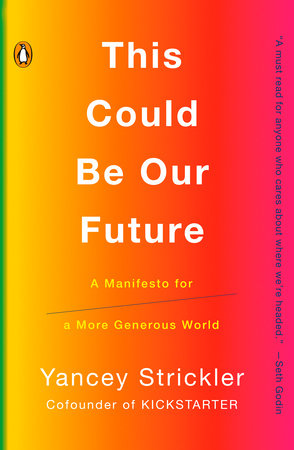
Again I turn to Yancey Strickler who is trying to shift the for-profit business world from a culture of making money as the most important thing to creating a better planet as the most important thing. Of course businesses want to make a profit which is why they are in business, but Strickler points out that over the past 30 years, businesses have become greedy about making money to the point of destroying the middle class and increasing the divide between rich and poor. He believes (and I agree) that you can make a very prosperous living by taking others into consideration as a for-profit business. Businesses can make money while treating their employees well. Businesses can make money while practicing good stewardship of the earth. Businesses can make money while supporting non-profits that address the needs of the community. Businesses can give back.

Kickstarter (which Strickler co-founded) like Patagonia and King Arthur Flour, Eileen Fisher, and Allbirds is a Benefit Corporation. We need more of those. By definition, “Benefit Corporations are for-profit companies that are obligated to consider the impact of their decisions on society, not only shareholders. Radically, positive impact on society becomes part of a Benefit Corporation’s legally defined goals.” (Source)

The Church can learn from this too. Of course churches and other communities of worship are not for-profit organizations. We are not about financial optimization (unless we are and then may God have mercy upon us.)

If the most important thing in our church is to make lots of money to save for a rainy day, we are missing the point of money. (Note: it’s a tool for ministry, my friends.)

If the most important thing in our church is to serve the needs of the members, we are falling short of Jesus’ commandments. Yes, tending to members’ needs is important, but is it THE most important thing? Is it the most important thing that those who donate the most money are kept happy under all circumstances? Is it the most important thing that we get more members? Is it the most important thing that there’s a Sunday morning Bible study just before worship?

Growing congregations are those with a clear identity. And that identity is utterly and totally about God.

Growing congregations exist to serve God by serving God’s people. And God’s people include refugees, police officers, D students, first responders, prison inmates, and hospice residents. And you and me and people who consume too much MSNBC and Fox News. And sweet little old ladies and cranky old men and non-binary siblings afraid for their futures.

What’s the most important thing in your Church – really? This is a great time to figure it out so that God can use us. The world desperately needs Good News and healing and hope.

The Great Resignation (It’s Not What You Think)

According to various news sources, there is a Great Resignation among workers in the United States. The pandemic has taught some of us that:

  • Working from home can be awesome (and so if you – Employer – will not let me work from home at least a couple days a week, I will find a position that will.)
  • Working for minimum wage is untenable and I’m holding out for bonuses and/or a liveable wage.
  • Life is short and I need a job that feeds my soul.

First of all, these are the positions of the privileged. There are millions of workers who have few choices in terms of where they work in terms of geography and education level. If we can resign from our current job and look for new employment in a leisurely way, we are clearly people of privilege.

The Great Resignation I’m talking about here is not about employment though. It’s about the Millennials and Gen Z-ers. Middle school and high school teachers, church youth directors, young adult ministers are all saying that the young people they are serving feel resigned to “the way things are” as in: “that’s just the way life is.”

Life is unfair, unjust, untrustworthy, and unpredictable. That’s just the way things are.

This is The Great Resignation of our youngest generations and it doesn’t have to be like this. Imagine a spiritual community that inspires our youngest generations in terms of:

  • Who they are: Children of God who have the capacity to change the world.
  • Who God is: the One who gives them all they need to make the earth more like heaven.
  • What the Church is: the community that supports, empowers, and releases them to make a difference in this life.

Can we be that Church? Or will we continue to exemplify a community full of judgment and injustice that our youngest generations shun?

I spent Wednesday with several Youth Ministers and they are excited to share with youth members the possibilities of making a difference in the world because that’s who God created us to be.

Maybe those adults who are resigning from their pre-COVID jobs will be inspired to be that kind of Church. Thank you Youth Ministers with an eye on the way things could be.

Image of Myers Park Presbyterian Church Youth at Montreat, NC Youth Conference in 2019.

Remember that Church with the Infamous Banners?

At first people wondered how a church could be so culturally clueless to have banners for Worship, Teaching, and Friends lined up in such a way to spell a common acronym for profanity not to be spoken by Good Church People. (Note: please forgive me if even the reference to this offends you but bear with me here.)

The church in question is in Albuequerque and originally it was called Village Church. Then it was called Copper Pointe Church. Now it’s called Citizen Church. It’s was or still is an Assemblies of God congregation. And the WTF banners line up was not an accident.

Was it a gimmick to draw attention to the building? Maybe? Yes? The Institutional Church has often used gimmicks and other marketing tools to attract attention to itself through the years. I’m not a fan of this..

So, hear me out regarding what many people consider words unbecoming a follower of Jesus. As I talk with Millennials and Gen Zs – and even with older generations, there is a strong sense of hopelessness in the world.

At the end of conversations about college debt, climate change, health care inequities, police violence, systemic racism, opioid addiction, rural poverty, education inequities, and rampant terrorism, I often ask my younger conversation partners, “Where do you see hope?” I need to hear words of hope as much as they do.

The Church of Jesus Christ is about hope even in the throes of hopelessness. Jesus touched the untouchables and took on the Powers. Jesus healed those with broken spirits and broken bodies. Jesus spoke words about how we treat those who are seen as “the least of these” in this world. Jesus both raised and was raised from the dead.

Jesus has a lot to say to a world in which too many people look around and want to scream WTF. Jesus especially has things to say to those of us who are offended by that acronym but not by the fact that hundreds of thousands of children are hungry every day. Many of us are more offended by the f-word than the fact that rich children can get cancer treatment while poor children cannot.

Some would say that – considering what God’s intention for creation is – this is f-ed up. Again, please forgive me for offending those who are surprised I’d even type that “f.” If it makes it easier, imagine I’m channeling Eleanor in The Good Place.

So back to the church banners. This is a congregation which has apparently tried different things, including an assortment of church names. Maybe their WTF banner line up was gimmick-y. Or maybe it was an intentional outreach to those for whom that term feels like they feel.

I get this. I long for a church that’s a community of Wonder, Transformation, and Faith. I dream of a church that considers with every gathering . . .

  • How are we expanding our wonder for the God who created the heavens and the earth?
  • Who or what was transformed and how?
  • How did our faith in God grow?

I want a church that invites “I wonder” questions.

I can imagine a church that seeks to transform the world for good in the name of Jesus Christ.

I long for a church that marks its success in how our spiritual growth is deepened.

What is your dream for the Church of Jesus?

Nobody Knows What We’re Talking About

I was driving by a church building in Charlotte last week and the marquee in front of the sanctuary said “ELCA!

This is not a post against Lutherans. Some of my best friends are Lutherans, as they say, and I would have had the same reaction if the sign had said PCUSA! UMC! RCA!

Insider knowledge: The ELCA stands for Evangelical Lutheran Church in America, not to be confused with the LCMS which stands for Lutheran Church Missouri Synod. The ELCA ordains women and gay people. The Missouri Synod does not. Anyway . . .

I had a visceral reaction to the ELCA! sign – that was probably intensified by my personal COVID-related stress quotient – in that I. Was. Enraged. Seriously, I felt deep rage, and I would have felt the same rage if the sign had “shouted” any other denominational acronym.

I would probably love that ELCA congregation in terms of the people but their church sign exemplifies one of those enormous Adventures In Missing The Point that makes The Silent Generation say things like “Where are all the young people?” while Generation Z shrugs. Also most other generations shrug.

This is Church on most Sundays where I live, (And I live in the Bible Belt.)

  • People gather for a 15 minute Bento Zoom to focus on being intentional this week regarding personal and community goals.
  • People gather en masse to coffee shops with their babies and dogs to hang out with friends who also have babies and dogs.
  • Brunch at the craft breweries is extremely popular.
  • Physician Moms are meeting for an online coffee to comfort each other during COVID and share the craziest stories they heard last week. (My own doctor participates in these. Last week’s crazy story: that the COVID vaccine causes infertility in young adult women which is ridiculous.)

I could go on and on, but I want to get to my point: the average person doesn’t know and doesn’t care that our church is ELCA or ECOP or AoG or LDS or AME or REC. Adding an exclamation point after the initials doesn’t inspire excitement. It looks a little ridiculous and it screams: “Nobody Knows What We’re Talking About.”

I served a congregation for many years that was established in 1947 and it grew to 1000 members within two years because 1) everyone was grateful that we beat the Nazis, 2) everybody was having babies and wanted preschools, Sunday schools, and Vacation Bible schools, and 3) if you built it, they would come.

Congregations established just 30 years later may or may not have thrived. Citizens of the U.S. were not necessarily on the same page in the early 1970s when it came to fighting wars in other parts of the world. And our young leaders were being assassinated.

Congregations established in the 1990s were often established because of growth in the suburbs. More than one congregation has told me that “it was the Presbytery who wanted to put a church here.” In other words, there was not a core group of believers who organically wanted to be The Church together.

I don’t know how to start new worshipping communities today but I do know how it won’t happen. It won’t happen based on what we put on church signs. It won’t happen because people are looking for a church. (Okay, yes there are people who move into the community and immediately look for a church. I live in Charlotte, NC – the birthplace of Billy Graham. But of the 21,000 people who moved to Charlotte since March 2020, I’m going to guess that most of them have not joined traditional churches.) For towns and cities whose residents are moving away, churches are getting even smaller.

Yes, there are exceptions. But even the most conservative, evangelical congregations are losing members.

What we’ve also lost: an understanding that whether people are “in church” or not, they have spiritual lives and they crave meaning and they want to serve their communities. How can we be The Church for a totally different time? It’s all in the relationships. We can’t be the Church with and for people we don’t understand.