The Crying Pastor

Have you ever seen your pastor cry?

Pastors have lots of reasons to weep and yet we try to control ourselves.  Nobody can fully prepare for the constant good-byes of professional ministry: the families who move away, the families who basically disappear without understanding why they left, the youth who leave for college and never return, the people who die.  Pastors are not supposed to be blubbering messes and yet sometimes we are.

The hardest I’ve wept as a pastor: leaving congregations I’ve loved, burying elders I’ve loved, burying children.  No one prepares us for the layers of losses.

The best pastors I know show their vulnerability.  They share their hot-messedness.  They make it clear that they haven’t cornered the market on God’s Truth.  They authentically apologize when they make mistakes.

All pastors are human.  We cry.

We can only offer sound pastoral care if we serve according to our scars – not our wounds.  There was a time that I got choked up every time I preached and a lot of that had to do with losing my mother.  I didn’t have to be preaching on mothers or even thinking about my mother, but it was a deep, deep wound.

Wounded pastors lose the capacity to serve in healthy ways because we become the pastored rather than the pastor.  #BoundaryProblems

And yet, we also need to share our scars if in no other way than knowing the importance of keeping our mouths shut when other people share their brokenness because we know.  We know the pain.  We know to be present and we also know we can’t possibly fix it.

Some of the best ministers I’ve met have never been to seminary.  They are the neighbors who bring pie and sit in silence.  They are the friends who pray when they say they will.  They are the staff members who wear bow ties to the last staff meeting.

Tears of joy are obviously different from tears of despair.  I’ve experienced both in parish ministry, and if you look at human tears under a microscope, tears literally vary in appearance depending on the reason for the tears.

When was the last time you saw your pastor cry?  The answer reveals some essential information about that person.  Please pray for your pastors this week – both those who went to seminary and those who inherently know how to preach the gospel in the way they live their lives.

It’s quite possible that all of us need a good cry these days.

Image source.


What Have We Learned From This?

What have we learned from the pandemic so far?

I’ve learned that I really like to touch my face.  And eat out.

After living in two different time zones for the past two years, HH and I are in the throes of packing up our home in Illinois and moving everything to North Carolina.  And I’m learning all kinds of things as I go through every piece of paper, every drawer, every cabinet.

I’ve learned what not to do next time as often as I’ve learned what to do in life.

Don’t:

  • Keep mean letters/notes someone might have sent to you.  (Why do that to yourself?)
  • Go cheap when doing home improvement.  (That guy who removed the dead tree had no idea what he was doing.)
  • Keep blurry photographs.  (Why?)
  • Save spices after they’ve lost their flavor.  (Jesus said something about this.)

Do:

  • Keep journals because we forget things and it’s good to look back and remember what we’ve survived.
  • Recycle everything you don’t want to keep.
  • Save a copy of your dog’s adoption papers. (That was a good day.)
  • Expect to find treasures you lost a long time ago.

Moving during a pandemic has its challenges.  Goodwill, Salvation Army and Habitat ReSale stores are all closed.  Realtors can’t show your home to potential buyers.  Good-byes are difficult during social distancing.

But these are the days we also learn gratitude for the friends who send pizza and the moving guys who don’t cancel and the wonderful memories and the unknown joys ahead.

Every Day’s a School Day – especially during a pandemic.  (Thanks AAM.)


Resurrection Happens Even Behind Closed Doors

Like the first disciples of Jesus who remained in hiding after the Resurrection, still living in fear, we continue to be in seclusion behind our own closed doors today.  In addition to the binge baking, HH and I are packing our worldly belongings.  We have about ten days to pack up our home in Illinois to complete our move to North Carolina.

Moving sucks.

Most of us don’t like what it means to move.  It means deciding what to toss and what to keep.  Moving from our first empty nest home where we were custodians of our young adult children’s stuff “until they could take it” means sorting through artwork, trophies, various sizes of ruby slippers, and an arsenal of Nerf weaponry in deep discernment.

Do we take their childhood memorabilia with us? Or do we simply take photos of the memorabilia?

Are we keeping the fine china and crystal?  The kids don’t want it.

And the books.  What does it mean to give away almost all my books for the sake of downsizing?  The writing careers of Anne Lamott and Barbara Brown Taylor are now in boxes in my living room.  Do I keep the Bible commentaries when I do most of my exegesis online now?  Yes, we are keeping the autographed Harry Potters.  No, we are not keeping all the anthologies of short stories.

Traveling lightly is a spiritual practice.  I’ve seen The Darjeeling Limited enough to know this truth.  Also there’s Abraham.

Moving – even behind closed doors – is an act of resurrection.

Christ is risen!  Christ is risen indeed!

And let’s not forget that the risen Christ can enter even through locked doors.  There’s no hiding when God wants us to move forward.

Image of our front door in Illinois on Easter morning.

Why Do You Seek the Living Among the Dead?

Christ is risen! Christ is risen indeed!

Raise Your Glass

Although most of the lyrics to Raise Your Glass by Pink are not church-appropriate, I always think of Jesus when I hear this refrain:

So raise your glass if you are wrong,
In all the right ways,
All my underdogs,
We will never be never be, anything but loud
And nitty gritty, dirty little freaks
Won’t you come on and come on and raise your glass,
Just come on and come on and raise your glass

I imagine Jesus sitting at table with the disciples on the Thursday before his death singing those words.  The disciples were culturally powerless people following someone who told them to turn the other cheek, love their enemies, consider themselves blessed in difficult times.  He made “weak” the new strong.  He would soon make women the first evangelists.

There they were at table:

  • Wrong in all the right ways.
  • Underdogs.
  • Loud.
  • Freakish.

And if we don’t consider ourselves any of these things, I wonder why we are following Jesus in the first place.  He told offensive parables about Samaritans and prodigals.  He did offensive things like talk to women in public places and touch lepers.  He was literally an enemy of the State.

Following Jesus is an act of defiance against all that is “correct” and “exclusive.”  Especially during these times when many of our practices and procedures are being tossed out the window, we have the opportunity to see what’s most important.

Relationships are more important than regulations. Communion with Christ is more important than the type of crackers we are eating.  Proceeding with the work of the Church is more important than gathering for meetings.

Let us raise our glasses tonight and try to be more like Jesus – who was not the Savior the world expected.  At all.

Image of the Antioch Chalice.  Also I like the Glee version of Raise Your Glass more than Pink’s.


Pandemically Pregnant

These are days when we are called to remember medical professionals in prayer.  Or grocery store employees.  Or food delivery people.  Or scientists seeking cures.

Today I’d like us to remember those who are expecting babies in the midst of a global pandemic.  It’s scary enough being pregnant.  Pregnant bodies ache and swell in unfamiliar ways.  Pregnant bodies experience moments of utter exhaustion and other moments of superhuman strength.  Pregnant people are expecting new life, imagining new life, preparing for new life but don’t know what that new life will be like.  We do know that – once that new life arrives – our own lives will never be the same.  But expecting a child in the throes of social distancing and toilet paper hoarding ratchets up the anxiety levels substantially.

But this post is not about pregnant people.

This is a post about the Church that will be born after this pandemic.  My very wise friend and colleague Mary Ann McKibben Dana has famously said that the Church is not dying; it’s pregnant.  Unfamiliar things are happening. And sometimes we feel like we are going to die.

But we are not dying.  We are simply experiencing some serious labor pain.  Before any of us had ever heard of COVID-19, there was concern about what the 21st Century Church was becoming.  There was pain about technical transitions and other transitions.

A pregnant Church during a pandemic is even scarier.

  • Will everybody be used to staying home on Sunday mornings?
  • Will we permanently shift Bible studies and meetings to ZOOM calls after noticing that  attendance was actually higher when people didn’t have to travel for those gatherings?
  • Will our congregations without the capacity for technology permanently shutter their doors?
  • Will we stop passing the offering plate after acclimating to online giving?
  • Will the trauma after weeks of sickness and death, after not being able to say good-bye properly to retiring pastors or family at their death beds, after missing out on joyous celebrations like graduations, after losing our jobs, after having to shelter in unsafe places be too much to bear?
  • Will Church mission and other programming become more trauma-informed?

We don’t know.  But I agree with those who say that “this is hard” but it will be even more difficult after the pandemic ends.  Yes, there will be joy in the streets.  There will be happy group hugs.  And then there will be processing all the grief.

And so let us pray for those who are expecting babies in these pandemic days.  And let us also pray for the pandemically pregnant Church.  There are crucial trends coming.

Greek icon of Mary and her cousin Elizabeth both expecting babies.  I love the extra person checking on them from behind the curtain.  That person is all of us.

The Deadliest Week?

Did Jesus know what would happen the week he entered Jerusalem?

We Christians start the week with palms and then move swiftly through the torture and death of Jesus, and then celebrate resurrection.  Boom.  Boom. Boom. So much happens so fast.
We’ve been commemorating this last week of Jesus’ life for so long that the whiplash from parade to cross to empty tomb doesn’t jolt us terribly much.  We know the end of the story.

We don’t know the end of the Covid-19 story.  (As a person of faith, I’m still going with resurrection, but the unknown between now and then can be stressful  – faith or no faith.)

And now the Surgeon General – that official person who advises us on the dangers of smoking – has warned us that this could be the deadliest week of our lives:

This is going to be the hardest and the saddest week of most Americans’ lives, quite frankly.  This is going to be our Pearl Harbor moment, our 9/11 moment, only it’s not going to be localized.  (Source)

So here we go.  Holy Week is going to be the deadliest week?

As we stay home and stay safe, it’s an amazing juxtaposition we face:  Long ago there was a deadly kiss. There was a leader who washed  his hands in front of a crowd.  There was fear and shame.

It’s an interesting time to ponder the deadliest week in Jesus’ life as we live through what’s could be the deadliest week in our communal life.  I hope we take time to connect the spiritual dots.


Reach Out and Touch Somebody’s Hand (Or Not)

I’m trying to imagine how things will be different after scientists create a vaccine for COVID-19 and we can all go back to eating in restaurants and returning to the office.  I wonder if we will decide that working from home is viable for a large percentage of workers.  I wonder if we will stop shaking hands when we greet each other.  I wonder how spiritual practices from Passing the Peace to passing the offering plates will forever be changed in houses of faith.

Our songs will be different.

And yet touch will remain important.  I believe The Church will continue to be a community where people are touched – in healthy ways – physically, spiritually, emotionally.

One of my favorite moments in HH’s Sunday worship has been the benediction.  The benediction doesn’t get nearly enough attention in seminary, but – if you remember nothing else about the worship service – I hope to be moved by the benediction.

At HH’s church on the Sundays he preaches, he stands at the base of the chancel (i.e. the front of the sanctuary) and he asks people to face the center aisle and “if you are comfortable” touch the shoulder of someone near you.  This means that – for a moment – everyone is connected to someone.

As HH speaks the words of the benediction and walks slowly down the aisle, there are always tears in someone’s eyes.  It’s moving to see people who may or may not know each other connect.  It might be the only time some of those folks will touch another human being all week.

It is beautiful.  Except today, it’s not safe or healthy.

One day we might be able to touch each others shoulders again.  Maybe we’ll even touch someone’s hand whom we don’t know.  One of the opportunities of going through a pandemic together is that life as we’ve known it has changed for every single one of us, and soon and very soon – I pray – we will discern new ways to reach out into the world together.

Image of the great Diana Ross (November 20, 2015 in Las Vegas)

It’s (Only) Pollen

COVID-19 PANEL
Note to Patient The results of your recent tests look fine. We look forward to seeing you at your next appointment.

It’s only allergies. 

I was bracing myself for different news because I haven’t felt well for about a week and COVID-19 is on everyone’s brain.  My head and throat hurt.  I have a dry cough.  My breathing is labored.  And the big sign that something’s off:  coffee doesn’t taste good.  I can barely drink it.

But it’s only allergies.  And I am very grateful.  And I’m still staying home and washing my hands and cleaning my doorknobs with antiseptic wipes.

In all of our lives at this very moment people we love are dealing with positive test results about everything from COVID-19 to lung cancer to COPD to strep throat.  All suffering is suffering.  It’s never a competition.

Brene Brown addresses comparative suffering in her new podcast series (which is excellent by the way) and comparing my pollen issues with someone else’s coronavirus is obviously ridiculous in terms of basic misery quotients and mortality issues.  Comparative suffering also makes us discount other people’s (and our own) pain.

NOTE: I am simply allergic to things.  I’m not going to lie.  It’s miserable but it’s also not fatal.  I have no desire to compare how terrible my sinus allergies are against your skin allergies – or whatever.  If I lost my mother at age 32 and you lost your mother at age 73, both of us are allowed to feel pain.  Grief is grief.

Wise words about comparative suffering according to Brene Brown:

What’s crazy about comparison when it’s triggered by fear and scarcity is that even our pain and our hurt are not immune to being assessed and ranked, so without thinking we start to rank our suffering and use it to deny or give ourselves permission to feel.  ‘I can’t be disappointed about my college graduation right now. Who am I to be sad that I’m not going to be able to have this great ceremony ’cause people are sick and dying.’

But this is not how emotion or affect work.

When we minimize our feelings, we get shame (and we all know what Brene says about shame.)  We are not bad people if we are lonely in these days, even though some people are lonely without a roof over their heads.  Empathy is not a zero-sum game.

These are really, really difficult times for everyone.  We are all suffering in an array of ways on many levels and with many layers.  But our feelings are real and we need to allow our feelings to be felt.  Suffering is suffering. Grief is grief.  Hurt is hurt.

I’m really thankful that I tested negative for COVID-19 but I still miss human touch.  Instead of comparing my misery with yours though, let’s allow each other to express boundless empathy towards each other and ourselves.  It’s a good time to be empathy giants all around.

And let’s keep washing our hands.

Image of beautifully dyed pollen samples.


Who We Say We Are and Who We Really Are

I hear from pastors fairly regularly that the church they’ve been called to serve is not who they said they were when that pastor was interviewing to lead them.  Examples:

  • Church A says they want to reach out beyond the walls of their sanctuary when what they really mean is that they want to attract people who look like them who want to participate in the mission they’re already doing.
  • Church B says that they want to be more “diverse” when what they really mean is that they are happy to welcome 1-2 families who don’t look like them as long as they act like them.
  • Church C says that they are excited about moving forward into the future but what they really mean is that they want their former pastor to participate in future weddings and funerals and they can’t bear to let the church administrator go even though she doesn’t want to learn new computer skills.

I was reading about an upcoming course at Columbia Theological Seminary yesterday which is being offered because the pastor’s vision conflicts with the congregations (authentic) vision.

Despite rhetoric and confessed beliefs about Gospel mission and mandate, it remains true that congregations are a type of religious community. As such, they operate more like family or tribe despite also being a body organized around a mission. Simply put, congregations, as communities have a tendency to be bounded, focused inward, generative, and focused on self-preservation. None of those are “bad” in and of themselves, but their reality can hint at why it is so difficult for clergy to move a congregation toward an outward-looking, missional ministry orientation. Israel Galindo

Amen and amen.

Every day I talk with congregations who minimize the differences between who they say they are and who they are.  And this is what’s placed us where we are today as the institutional Church.

We say we want to be disciples of Jesus Christ and follow the way of Jesus.  But actually we want to survive as an institution.  We only want to change when we have no choice but we continue to believe we have lots of choices.

Here’s the Good News:  Jesus’ Church is thriving at this very moment as we can’t worship in sanctuaries.  God is working in the thick of this to remind us that our basic purpose in life is to glorify God and enjoy God forever.

We are still doing this without church buildings and face to face board meetings.  Once God came to show us up close and personal what it looks like to be the living Word.  And now God is showing us how to be the living Word through an uncontrollable virus.

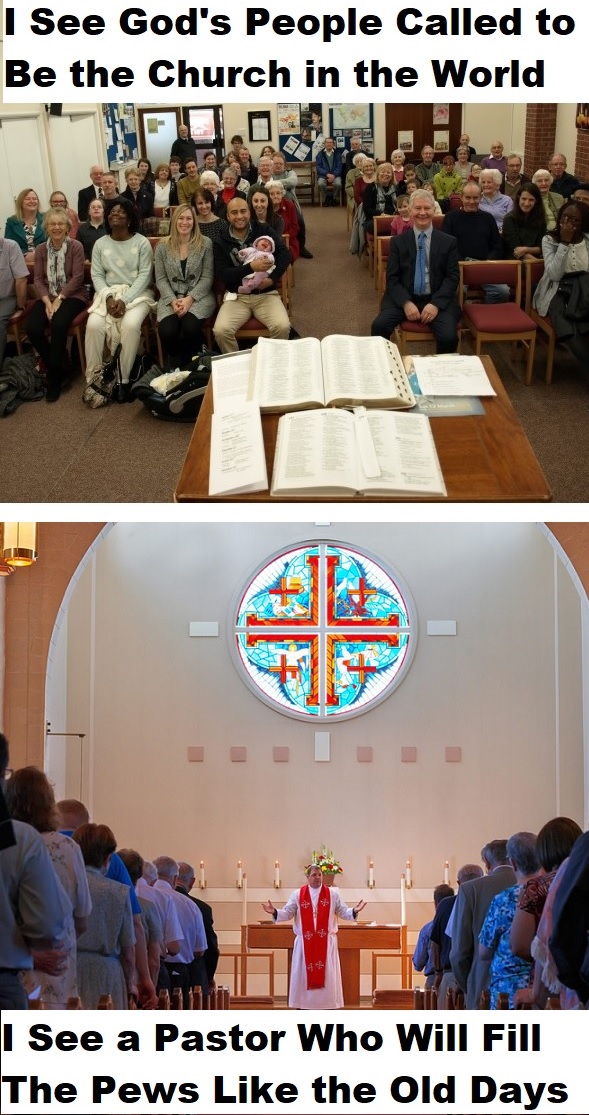
Many will die and I don’t want to think about that.  I want to focus on the resurrection that will happen after both the physical and the institutional deaths.  God will always have a Church.  Our role – if we are serious about our faith – is to be the Church God created us to be.