Immersion As a Spiritual Practice

“Let me be courageous in a way that I haven’t been before, so that I can get to know people who are different than me.”

This is not a post about baptism, although I’m a fan of all kinds of baptisms including full immersion.

This post is inspired by an article I read yesterday.  I strongly suggest that you read it. (And thank you S.S.)

Johnathan Kelso is a self-described privileged white man who grew up in Florida.  He never thought much about victims of lynching in the history of this country because he didn’t have to.  But he was moved one day in church to immerse himself in the stories of people who were tortured and murdered in the Southern United States in the 19th and early 20th Centuries.  It has changed his life.

My children were in Spanish Immersion programs as elementary school students.  They learned math and science in Spanish half of the school day and literature and social studies in English the other half of the school day.  It was not easy.  I could not always help then in spite of a summer spent in Guatemala while I was in high school.  But it changed their brains in a good way.  And it exposed them to stories and relationships that cracked open their worlds.

If we immerse ourselves in self-centered things, our brains will change – but not in a good way.  One of the problems with the rampant individualism in our culture is that we come to believe that our life’s purpose is about protecting/prospering/serving ourselves and our own.

The message of Jesus is the opposite of this.

Jesus – who himself crossed cultural, racial, geographic, and social boundaries (please read the Gospels)  – expects us to do the same.  Johnathan Kelso knew nothing about the horrors of racial injustice but after noticing the realities of racial segregation in Church, he was drawn to meet with the descendants of lynching victims.  He read the horrible stories.  He looked hard at the photos – sometimes postcard photos printed as souvenirs of “festive lynchings.” The article about his journey says this:

Not until he traveled to places where lynchings of blacks happened and talked to the families of victims did he begin to understand. He needed to see and hear for himself the stories of others and take ownership.

“But not in a way to say like, ‘Let me own that, too,’” Kelso said. “It’s more like, ‘Let me be sensitive. Let me be courageous in a way that I haven’t been before, so that I can get to know people who are different than me.’

Can you begin to imagine if each of us immersed ourselves in the lives of people whose experiences are foreign to our own? Not to “own it” (they are not our stories to own) but to “become more sensitive” to the experiences of people whose lives we may never have had to notice before:

  • The families of lynching victims
  • Incarcerated people
  • Undocumented people
  • Refugees
  • People of other religious faiths
  • People dying of incurable diseases
  • People who are chronically homeless
  • Rural people
  • Urban people
  • People who are our political enemies

Johnathan Kelso chose – as a spiritual discipline – to immerse himself in stories about lynching.  What might we immerse ourselves in – as a spiritual discipline?

In a divided world, this is perhaps one of the most essential spiritual disciplines of our time.  We will never live in peace without making a shift from “otherizing” people to immersing ourselves in their stories.

And while I didn’t intend for this post to be about baptism, maybe it is.

Image source.  And again please read this article by Tim Turner from The Bitter Southerner.
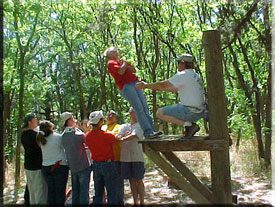
 

No More Trust Falls

Do Team-Building Groups even do Trust Falls anymore?  I’m trying to picture 70+ year old church elders at a retreat falling backwards into a group and hoping to avoid a broken bone.

And this is not about trust.  It’s about slapstick humor/something painful about to happen.

Institutional trust is low these days, and the Church is right there on the low end.  Between unchecked clergy abuse and run of the mill hypocrisy, people don’t trust The Church.  Maybe we trust our congregational pastors but there are many folks who don’t even trust their pastors.  According to this 2018 Forbes survey, nurses are still considered quite trustworthy probably because they literally have our backs.

Imagine a culture of trust in the institution you serve.  This is what I’m hoping to convey today when our Presbytery meets for one of its quarterly gatherings today.  I believe that:

  • if we are as transparent as possible,
  • if we tell the truth,
  • if we seek to partner with and not control,
  • if we focus on relationships instead of regulations,
  • if we treat each other with respect and kindness

. . . trust – even in church institutions – will grow.  And we don’t do this for ourselves.  We do it to expand the reign of God.  God gets more done if we trust each other.

Happy Tuesday.

Images from a corporate trust fall and from Forbes.

Death by Gaslighting

This article in The Atlantic is really disturbing – so read it at your own risk.  Newt Gingrich boasts about the effectiveness of name calling and smear campaigns and he see these tactics as essential “if you want Western civilization to survive.”

Imagine a preacher trying to pull this off:

  • Declaring “I am a servant of God’s people” (while taking advantage of the congregation financially, emotionally, spiritually.)
  • Persistently lying, misdirecting, and contradicting leaders, therefore confusing and destabilizing them.
  • Manipulating supporters into doubting their reality.  Parishioners are told they are unconditionally loved and yet they are shamed and blamed for personal and congregational failures.

The trend towards gas-lighting is killing our culture.  Individuals fall victim to this in unhealthy work situations and – believe me – it can be deadly.

But our culture is being gas-lit by our national leaders in several fields – especially in politics.  As the Mid-Term Elections are soon upon us (and early voting is now open in many states) the levels of political gas-lighting – even by self-professing Christians is troubling.  As a Christian myself, I’m trying to get my head around political leaders who:

  • Lavishly lie.  They stand before cameras and microphones and make statements that are easily disproved scientifically, mathematically, and historically.  And then they declare that science, math, and history cannot be trusted.
  • Claim that what we are seeing with our own eyes is not real.  It looks like someone was bowing to a tyrant, but that’s not what was actually happening.
  • Call people names.
  • Mock the weak.
  • Respond with cruelty instead of respectfully agreeing to disagree.
  • Sowing seeds of doubt in the very institutions that bring order to our civilization.

I still believe in a world in which all human beings are created in the image of God.  I still believe that we will be judged by how we treated “the least of these.”  I still believe that God is love.  I still believe that we who claim to follow Jesus have been commanded to make disciples throughout the world (and disciples are made when they see what God’s love looks like.)

I will be voting for candidates of any party that espouse these values.  The power of love is stronger than the power of manipulative self-service.  Gas-lighting leads to the death of relationships and the death of Truth.  Please considering voting for leaders of good character.


Image from the 1944 film Gaslight about a husband who manipulates his wife into thinking she’s insane.

Speaking the Truth in Love

This post from Wednesday has caused a little stir.  I’ve received several private messages from readers who shared it with their congregational leaders only to experience wrath and outrage.  How dare someone suggest that a volunteer’s offering of time and talent needs improvement?

I remember the old Tom Bandy Church Addiction True-False Quiz which included this statement:

True or False? Accepting whatever volunteers offer is not good enough.

(The answer is false.)  God deserves our very best and if our service is indeed about God and expanding the reign of God, then we will strive for perfection, right?

Instead of being outraged at the notion that our volunteer service needs improvement, what if we had a culture of healthy feedback?  This also assumes that we have a culture of training people to do the service they’ve signed up for.

So, let’s say that we train church members to do hospital visits and we hear back from a recovering parishioner that it didn’t go well with one of the Deacons visited him on the cardiac ward:

Recovering from Heart Attack Guy (to the Pastor):  Please never let Deacon Bob visit me in the hospital again.  It almost put me back in ICU.

Pastor:  What happened?

RFHAG: He sat down beside me and said he was sorry that I’d had a heart attack, but that he’d had a heart attack once and it was the best experience of his life.  And then he spent 20 minutes telling me about his open heart surgery.

Clearly Deacon Bob needs more training.  Role playing.  Constructive criticism that doesn’t shame him but does remind him why he is visiting.  (e.g. It’s not about him.)  Have a conversation with Bob about how he can improve his bedside manner.  Because we love Bob.  And we love RFHAG.  And we love Jesus who wants us to care for God’s children well.

Spiritual communities are healthy when we work together to serve to each other and beyond.  The apostle Paul talks about this.

And note that neither he nor Jesus say anything about avoiding conflict or ignoring harmful comments or accepting behavior that damages the community because we don’t want to hurt somebody’s feelings and they might leave the church.

Those who are mature in faith will welcome loving criticism for the sake of the kingdom.  And we all want to grow spiritually mature, right?  Right?

Good Church People Who Are Not Good for the Church

This is a hard post to write.

Just yesterday I attended a lovely luncheon honoring Church People over the age of 70 who won “Legacy Awards” in our Presbytery.  They have run choirs and classrooms, clothing drives and coffee hours.  They have been the pillars of their congregations.  This was my second Legacy Luncheon and I hope never to miss one.  It’s so clear that these people are beloved by their congregations and that they have loved God by loving the people in God’s family.

I know scores of additional Church People who have served and then served some more.  Many have found their niche (and their power) by serving in the many realms of Church World.  Often they also serve in higher levels of Church Leadership shepherding seminarians, training Pastor Nominating Committees, organizing mission projects, and administrating the heck out of complicated systems.

And while it’s painful to type this “out loud” some of them are unwittingly damaging the Church they love.

Over many years of professional ministry, I’ve observed leaders coming into rooms of anxious church folks hoping to guide/teach/help them and after sharing that guidance, that teaching, that helpfulness they report back to me that “it went really well.”  And yet when I get feedback from those anxious church folks, they are not just anxious (still) but now they are also angry/confused/frustrated.  Many of them will resent the denomination for a long, long time after such interactions.

How do we tell leaders who have been leading for a long time that they are actually not as effective as they think they are?  How do we teach those who want to serve that their ways often come across as cynical and coarse rather than pastoral and compassionate?

This is delicate business.  It’s also holy business – not the only holy business, but holy nevertheless.

In my denomination, we rotate leaders after three year terms.  This ostensibly brings fresh perspectives and crisp new ideas.  But because of the way we are organized, congregations often recycle leaders over and over again and our experienced leaders become the very people who keep us stuck.

Again, this is hard to type because I’m talking about committed and faithful people here.  And yet there is a reason why we rotate our leaders and why we expect continuing education for all ages:

The 21st Century Church is about relationships not regulations.  We are about community not crackdowns.  We are about pleasing God not pleasing ourselves.

Any of you who know me and work with me have permission to pull me aside when I become cynical or harsh or tired or afraid to let go and please remind me that what I do is not about me.  It’s not for me.  It’s about expanding the reign of God.

I hope I also have permission to check in with you.

The Church is full of nice people and we dread hurting feelings (although we hurt people all the time.)  Yet we can do better.  We can let go of the way we’ve always done things and turn those stuck ways on their heads.

Image of the sculpture Device to Rule Out Evil by Dennis Oppenheimer.

“Shunning Ostentation” & How Calvinism Has Screwed with Me

Related to this central affirmation of God’s sovereignty are other great themes of the Reformed tradition: A faithful stewardship that shuns ostentation and seeks proper use of the gifts of God’s creation. From F-2.05 in the Constitution of the Presbyterian Church (U.S.A.)

Sometimes groups want me to lead their retreats/training/workshops and – because I am not Jen Hatmaker – I have no agents and no contracts.  Asking people to complete and return a contract before I will put them on my calendar smacks of my thinking too much of myself.  As if I’m all that.

But over the weekend, I realized that I have double-booked myself: two women’s retreats with two different churches from two different towns, blessedly at the same location on the same weekend.  My options – in addition to obviously revealing my lack or organizational skills when it comes to my outside gigs include these:

  • Go back and forth between the two groups in hopes of covering both retreats even if it looks like an episode of I Love Lucy.
  • Just say no to one church.  (They literally asked on the same day -hence my confusion and how hard it would be to pick.)
  • Ask one of them to reschedule.  (At least one of these groups made reservations at the conference center a year in advance.)

One sure thing – not optional – is that I have disappointed people.  This is part of life and it’s definitely part of Church – but I hate it. And I blame John Calvin.

We Presbyterians are taught to shun ostentation.  One of my siblings literally asked me once what I would think of him if he drove a Mercedes – because he found a good deal on one.  After a serious conversation, he decided to pass on the Mercedes because of the way it would look for a Christian to drive a Mercedes.

We Presbyterians – and definitely we Edmistons – are not like Joel Osteen  – or any other tradition that believes that displaying great wealth = displaying one’s blessedness and therefore inspires others to aspire.  (I can feel my parents shudder in their graves as I type this.)

But with me personally, it has meant taking myself seriously as a person who is asked to lead things beyond my regular day job – which is also a night job.  I love meeting with new leaders, women, men, youth, seminarians, other denominations, secular organizations, etc. because it gives me hope and energy.  And it – so far – doesn’t take away from my regular ministry.  In fact, it enhances my regular ministry and I always learn things to take back to my corner of the Church.

We’re not talking about scores of invitations here.  We’re talking about a handful over the course of a year.  But I’ve been so busy shunning ostentation/considering that what I do is important enough for a contract that I’ve found myself in a pickle.  Two retreats on the same weekend.

I need to write and require a Covenant for groups to complete before I agree to meet with them – unless they are part of my day to day ministry.  This makes me feel like I think I’m hot $#&^.  But it looks like I need to organize this ministry better.

And to be fair, Calvin is not all bad.  Sometimes he is right on target:

“We are not our own: let not our reason nor our will, therefore, sway our plans and deeds. We are not our own: let us therefore not set it as our goal to seek what is expedient for us according to the flesh. We are not our own: in so far as we can, let us therefore forget ourselves and all that is ours. Conversely, we are God’s: let us therefore live for him and die for him. We are God’s: let his wisdom and will therefore rule all our actions. We are God’s: let all the parts of our life accordingly strive toward him as our only lawful goal.”  John Calvin, The Institutes of the Christian Religion, III.VII.1

Also Jesus.

Image of my new covenant form.  

Tougher Than Nails (Except Sometimes)

A quick survey of the news illustrates that there are millions of people being identified as “victims” out in the world today:  Victims of hurricanes and tornadoes. Victims of war and terrorism.  So many victims of sexual assault.

But sexual assault victims are different.  The shame of being sexually assaulted is different from the shame of losing property and safe shelter.

Many talk about their victimization immediately.  Many talk about it for the first time decades later.  Many never talk about  it.  And some have moved on.  No Big Deal, right?

I have a friend who grew up in a tough neighborhood in Chicago and she shared that she was assaulted at the age of twelve by local boys.  “But it happened to everybody I knew,” she said. “So, I just put it out of my mind and got over it.”  Well, she sort of “got over it.”  She happened to mention it to me more than once when we were  in our 50s, so it’s not like she ever forgot.

All boys victimize girls, right? All men victimize women, right? (Except the ones who don’t.)  Read this article especially if you’re concerned about boys and men being falsely accused.

Today we are hearing that:

  • Boys and men are the real victims of sexual assault (accusations).
  • Tough women get over it.

Kellyanne Conway: “Every time that happened to me, when I was younger and in the workplace, every time that happened to me, I always told a friend, I always told a female relative. There is shame involved because you tend to think it’s on you, ‘It’s your fault,’ somehow.”  She went on to say that she saw perpetrators as weak.  She didn’t fear them.  She was tougher than that.

Senate Candidate Kevin Cramer of ND about the women in his family: (They) “cannot understand this movement toward victimization” because they are “pioneers of the prairie” and “tough people.”  (We don’t know what the women in his family would say for themselves, nor do we know if they were ever assaulted.  But they are apparently nobody’s victim.) Mr. Kramer generally questions the validity of the #MeToo movement.

Who are the victimized?  And who are the victimizers?  Sadly, it’s become a political game.

But the truth – for every political party, every age, every gender, every culture – is that there are more victims out there than any of us can possibly imagine.  That’s not okay, but it’s not the end of the story. There is hope for broken people.  Hello therapy/spiritual counseling/community.

Churches that don’t want to be seen as gatherings of the broken and traumatized have missed the point of Jesus. Some tough guy churches will say that Jesus was never a victim.

They are mistaken. This is why I’m a Christian:  The God I believe in knows what it’s like to be a victim of assault and mocking and betrayal. But it’s not the end of the story.

If you are an assault victim, know that you are also more than that.  If you are broken today, know that you are more than that.  You are more than your victimization.  You are more than what someone has done to you.  You are more than what has happened to you.

Image of nails.  We can be tougher than them.  But sometimes we aren’t.

#ChurchToo

Today’s post comes from my siblings in the North Carolina Synod of the Evangelical Lutheran Church in America.  God’s work. Our hands.

Thank you Bishop Timothy M. Smith.

Accepting This Church Lady

I will never look like a hipster.  I have zero tattoos. I wear pearls and sweater sets.  I’m 62 years old.

But a miracle happened at my favorite corner cafe on Monday.  It was a Church Miracle.

Me:  Hey C.  Can I just sit outside? (I had entered the place and it was packed inside.)  How are you?

C:  Sit anywhere, Jan.  I’m great because you’re here! [Note:  C. has dreadlocks down past her waistline and she is consistently effervescent.]

I go outside and take a seat by myself.  I like to eat here by myself or with people.

M (my server who aspires to be a stand up comedian): Oh my gosh.  Jan.  I need a hug. This place is a mob scene.  We forgot it was a holiday.

Me:  What’s the holiday?

M: Columbus Day. Do you want coffee?

Me:  Sure.  No rush.

[Note: Now I get why so many people are drinking champagne on a Monday morning.  It’s Columbus Indigenous Peoples Day]

I ate my omelet and drank my coffee while M and C ran around serving mimosas.  They asked hit and run questions about my weekend in Chicago and shared quick bits about their lives.

After things slowed down another server named L stopped by my table on her way off her shift.

L:  Hi Jan. (She takes a seat beside me. L is a queer grad student training to be a sex therapist.) I’m headed home but I’m just going to sit with you for a minute.

Me:  You just came in for the rush?

L:  Yep, I’ve got a project due tomorrow for class. 

Me: What’s the project?

L: It’s about the ethics of treating queer people.  You know I want to be a sex therapist, right?

Me:  I remember. You will help so many people.  (We chat about some other random things. L stands up to go.  We hug goodbye.)

L leaves.  I stand up to leave.

And then a woman who’s been sitting at the next table with her German Shepherd who has apparently been watching me speaks.

Woman Who’s Been Sitting At the Next Table With Her German Shepherd:  Are you the owner of Zada Jane’s?  

Me:  Definitely not.  I’m literally a church lady.

So, here’s the miracle:

Where I spend lots of my time  – in church – people with long dreadlocks or multiple piercings or an unconventional gender identify or the ability to talk about uncomfortable things comfortably are often judged harshly.  We Church People consider ourselves to be friendly and welcoming but we don’t welcome people as well as we think we do.

C, M, & L not only did not judge me in my colorful infinity scarf and pearl earrings – but they were interested in my life and wanted to share bits of theirs. 

C, M, & L will never step across the threshold of a church building – including C who was raised Presbyterian.  But they want to talk about the meaning of life and God and how the world can be better.

How can we be Church with my friends at Zada Jane’s?  The answer begins with the hope that we love and accept people as I was loved and accepted Monday morning.

Seriously.  Infinity scarf and pearl earrings.

Image of Zada Jane’s Corner Cafe.

Deep Breath

If you think Sean Hannity is the only media person who speaks the truth, please stop watching him for the next four weeks.  If you think Rachel Maddow is a genius, please stop watching her between now and the mid-term elections.  The chasm between political sides is killing us – spiritually, emotionally, and perhaps even physically.  I’ve heard of people literally getting sick because … Kavanaugh/Ford/Collins/Booker/Graham/Feinstein.  Many Americans have simply stopped watching the news according to my unscientific/random surveys among friends and colleagues.

At the risk of people thinking I’m saying that I appreciate Nazis (“very fine people on both sides”) what I’m actually saying is that we have got to breathe and stop demonizing each other.  Among the comments I’ve read/re-read in the past week:

  • Senators who don’t oppose President Trump’s Supreme Court nominee Brett Kavanaugh are “complicit in the evil.”  Cory Booker
  • You don’t hand matches to an arsonist, and you don’t give power to an angry left-wing mob.Donald Trump
  • “Republicans are the Taliban of the USA.”  James Hodgkinson who shot Republican Whip Steve Scalise in 2017
  • “Trump that bitch!” T-shirt vendor who sold out of shirts with this saying in Cleveland before the 2016 election.
  • “The time for endless delay and obstruction has come to a close.”  Mitch McConnell on Brett Kavanaugh’s nomination
  • The American people should have a voice in the selection of their next Supreme Court Justice. Therefore, this vacancy should not be filled until we have a new president.” Mitch McConnell on Merrick Garland’s nomination

Both sides have demonized political enemies.  Both sides have seemingly lost our minds and our perspectives.  We need to step back and take a deep breath and …

  • Stop expecting the worst of each other.
  • Try to listen to another perspective.
  • Seriously do. not. watch. Fox News or MSNBC.
  • Read opposing views to supplement reading what we already believe.
  • Try to see – and this is really a hard one – the face of Jesus in every person we meet.

What’s especially hard is that trying to see someone with the eyes of Christ (or the face of Christ) makes no difference if we are in heated conversation with someone who mocks/denigrates/bullies people.  How do we see the face of Jesus when someone is openly shaming people?

I frankly don’t know.  How do we forgive those who shame us over and over again no matter how disrespectful we might be?  Again, I don’t know.

This will take divine and miraculous intervention.  But we must try to take the high road.

Image of that high road.