Before arriving here at Ferncliff Conference Center in AR I believed I could continue to write a blog post most days. And I believed that I could respond to work emails. And I believed I could keep up with work texts.
Now – after less than 24 hours here – I believe I need to take advantage of this time of reflection. So I believe I will do that. Back next Tuesday.
Yesterday’s blog post was about money. Today’s is about money as well, only different.
Over the weekend, I read a couple disturbing pieces about our colleagues in ministry affiliated with Elevation Church (one of the largest Southern Baptist Congregations where I live in North Carolina) and our colleagues in ministry affliated with the “He Gets It” project which is an initiative of The Servant Foundation which is an initiative of The Signatry which exists to promote “biblical generosity.” (This took some digging.)
Rachel Held Evans famously said that millennials have excellent bull@*^! detectors. I would offer that other generations can also smell inauthenticity/traps/foolishness a mile away depending on our own spiritual maturity. Both Elevation and “He Gets Us” don’t pass the smell test.
And this is why we can’t have nice things.
Yes, Elevation Church is cool and there are some authentic people involved. And also they are charging up to $1000+ for “tickets to worship” at the Kia Center in the Los Angeles area in November.
I believe this makes Jesus weep. Yes, you can attend by purchasing cheaper tickets, but . . . gross. Pastor Steven Furtick is known for some sketchy activities from faking spontaneous baptisms to living a lifestyle that looks more like Herod than Jesus. Unbelievers sincerely seeking spiritual answers will not find it in a pay-to-worship venue led by a man who needs a helicopter pad in his backyard.
Some of the television ads sponsored by the “He Gets Us” project are well done and yes, I believe that Jesus gets us. The whole fully divine and fully human thing.
And also this organization – though definitively not aligned with any denomination or political party – is run primarily by successful white men whose personal church affiliation is very conservative theologically. Some of my best friends are theologically conservative successful white men and yet I would like to scream, if I may: Jesus is not a brand.
A $100 million effort launched this year is blanketing cities and the web, aiming to redeem Jesus’ brand from the damage done by some of his followers.
Billboards with messages like “Jesus let his hair down, too” and “Jesus went all in, too,” have been posted in major markets like New York City and Las Vegas. And ads featuring black-and-white online videos about Jesus as a rebel, an activist or a host of a dinner party have been viewed more than 300 million times, according to organizers.
The He Gets Us campaign, funded by the Signatry, a Christian foundation based in Kansas, will expand in the next few months, with an updated website, an online store where people can get free gear if they forgive someone or welcome a stranger, and an outreach program for churches, all leading up to a Super Bowl ad.
Again, this smacks of marketing for a religion that is not about hipsters or t-shirts. I like hipsters and I like t-shirts, but saying that “Jesus let his hair down” makes me queasy.
What if – faithful readers – we who are trying to follow Jesus simply did what Jesus commanded: feed the hungry, clothe the naked, visit the imprisoned, support the weak, and serve “the least of these”?
Again, we make many mistakes misrepresenting what Jesus is all about. We confuse church attendance with spiritual maturity. We avoid sharing what we believe to people craving hope. We pretend we have it all together when we don’t.
Real Church is about discipleship and service. Disturbing Church is about profits and branding.
If your professional clergyperson is doing a good job leading your congregation, we need to have a serious spiritual conversation. (Note: if your professional clergyperson is not doing a good job leading your congregation, your personnel committee needs to have a serious spiritual conversation directly with that leader.)
I remember serving a congregation (a couple of them in fact) who struggled with finances. Or at least they believed that they couldn’t “do any better” than what they were giving financially to their church. The disheartening thing for the whole staff was that no matter how well we served, no matter how effective we led, no matter what we did, there were rarely any raises or cost of living adjustments. We knew this and yet we continued to serve to the best of our ability.
In a frank conversation with a couple dozen pastors earlier this year, one pastor disclosed that he had never received an increase in salary in the ten years he had served his current congregation. Not a Cost of Living Adjustment (COLA). Not an extra week of vacation. Not a Christmas bonus.
His was not a “poor” congregation. His parishioners included lawyers and orthodontists and business owners. Maybe they didn’t believe he was an effective leader? Nevertheless, as difficult at money conversations might be, this pastor needed to talk with his leaders about this.
Today, I’m talking with you – church members – about this.
Again, if you appreciate your pastor and church staff, please – at least – consider budgeting for a Cost of Living Adjustment for 2023. The Social Security Administration is adding an 8.7% COLA to all SS checks in 2023 because that’s what the current economic situation in the United States warrants. The cost of living will be about 8.7% higher in 2023 than in 2022 which means that if we do not increase our church staff’s salaries, they will be paid less in 2023 than in 2022 in terms of the purchase power of their salaries.
NOTE: All salaried workers deserve this. I get it when people tell me that they don’t get COLAs and so their pastors shouldn’t get them either. I hear that parishioners resent pastors who get sabbatical time after 7 years of service. Believe me when I say that all of us need both fair pay and spiritual refreshment. And also please believe me when I say that effective pastors and other church staff members work long hours – including almost every weekend – and make regular sacrifices for you and your families. We pastors didn’t go into professional ministry for the money, but we still have bills to pay, loans to repay, and hopes of having a little extra for things like college for our children. Just like you.
There’s nothing holy about poverty. And your spiritual leaders will not be as effective if they are constantly worried that they can’t pay their rent or mortgage.
A couple tips if you want to support your pastor:
Consider putting extra money in their reimbursable continuing education funds. It’s not taxable and they can go someplace interesting and come back rejuvenated.
Consider cash or gift cards for the holidays. I have found that most congregations do not include such gifts in the budget assuming that individuals will offer simple gifts to their pastor. Gifts from the congregation express appreciation from the whole congregation rather than one or two thoughtful parishioners. Also, about gifts: I was once on a staff when each of us received crystal cross paperweights. Lovely, but one member of the staff was Jewish. Think seriously about the gifts you give. Again, all people can use cash or gift cards.
If you cannot give your leaders a raise, consider giving them an extra week of vacation – and then please don’t complain that they are taking “too much” vacation.
Consider that your staff is an investment in ministry. They often make the difference between your congregation having a lively, organized, inspiring ministry and having a tired, disorganized, dreary ministry.
I know that some of you reading this are thinking, “Nobody goes to bat for me when I want a raise or deserve a bonus or need a cost of living adjustment.” Well, you should have these things too if you are working hard and serving dilligently.
To all of us: it’s both okay and admirable to have honest conversations about money with our employers. We live in a world where the divide between the wealthy and the struggling grows larger with each year. In appreciation for those who serve us and our families – not to mention God – this is the time to remember that it’s shortsighted to ignore the financial health of our professional church staffers.
Do any of these situations sound familiar, Church?
Your seasoned pastor is beloved by the congregation. And he hasn’t attended a continuing education event or enrichment conference in decades (although he annually attends a gathering of colleagues where they relax and share what’s going on in their lives.)
Your new pastor is an impressive young leader. And she scoffs at the idea of getting a coach/spiritual director/mentor because it feels patronizing and she wants to prove herself as Ready to Pastor as a new seminary graduate.
Your pastor is stuck and six years from retirement. Sermons are lackluster. Leadership feels phoned in. Members quietly quit. You wonder to yourself what the future holds if things continue to feel so uninspiring.
I’ve written many times about how all pastors (and humans?) need a team of supporters who keep us honest and fresh. And some nod and agree while not taking any action.
Preachers (even the great ones): when was the last time you took a preaching class?
Teachers (even the experienced ones): when was the last time you learned creative ways to teach the Bible?
Pastoral caregivers (even the gifted ones): when was the last time someone assessed your bedside manner?
Administrators (yes, you have to do some of this too, pastors): have you simply given up or are you willing to improve your organizational chops?
We who work with pastors and congregations require certain things. In my Presbytery, we require annual statistical reports from the elders. We consider two weeks of continuing education to be the minimum offered to all clergy. We require all pastors to take both Anti-Racism Training and Healthy Boundaries Training every three years – and if they don’t they find themselves not in “good standing” (i.e. clergy timeout.)
But we don’t require our pastors to have a mentor or ever take continuing education. And – siblings in Christ – it shows.
According to this month’s Harvard Business Review “New research finds that mentorship programs can indeed produce valuable gains—for employees and their firms—but only when they are mandatory. That’s because if mentoring is optional, the people most in need of it tend to decline the opportunity.“
Yep.
All of us get bogged down in the minutia of ministry. The emails overwhelm us. The zoom meetings may or may not be necessary. Our daily plans are disrupted by drop-in visits or unexpected crises or family needs. And yet creative juices don’t flow by themselves. We need sparks, improv, jolts and nudges. We need stare-into-space time.
This discipline is at least as essential as prayer, healthy food and exercise.
Beloved clergy colleagues: please believe me when I say you need feedback. All of us need someone who loves us to say, “You seem to be unhappy/distracted/unfulfilled/done with this.” And we need to listen.
It’s a mature spiritual leader who knows when to seek renewal, training, and enrichment. If you don’t want to do it for yourselves, do it for the people God loves.
My favorite television show right now is Bad Sisters on Apple TV. It’s got everything: Irish sisters, romance, family dinners, the beach, and a nemesis, who – in this case – is the worst, most heinous character ever created for a television show. John Paul, the brother-in-law of four of the sisters is abusive and vile. And we learn in the first episode that he’s dead. Did someone murder him? Did he die of natural causes? Did God strike him dead because even God couldn’t take him anymore?
The show is clever and twisted and wonderful. Even I want to kill this man. But of course, this is not my call, nor is it anybody’s call to take a human life under most circumstances.
Yes, there is just war. There is compassionate death. There is self-defense.
Even the saint Dietrich Bonhoeffer plotted to assassinate Hitler for the sake of humanity, although he was captured and hanged on April 25, 1945 the day before his POW camp was liberated. His last words: “This is the end—for me, the beginning of life.”
My very favorite book is also about this theme:
Crime and Punishmentis the story of a broken man named Raskolnikov who plots to murder his miserable and hateful landlady both because she is a terrible human being and because he believes he can help himself and others with her corrupt wealth. It drives him crazy.
Hate will drive us crazy. I think about the January 6th mobs that threatened to kill Nancy Pelosi and Mike Pence over political disagreements. That was insane.
I think about people who have such irreparably broken relationships with their family members, their exes, their bosses, their neighbors that they act out in ways that could best be described as unhinged. Or maybe I should say we. We act out in ways that will never be confused with Jesus’ behavior even on that toss-over-the-tables day. I confess before you and God, I’ve felt angry enough to kill someone. I didn’t come close to doing it, of course, but the feelings were fierce and real.
I attended an inspiring funeral last weekend for a former Moderator of the Presbyterian Church USA General Assembly – Price Gwynn – and all three of his fine sons spoke. One said that Price once revealed the secret of life to him. “I can express it in a single word,” the father had said to his son: “Forgiveness.“
How do we forgive those who have deeply hurt us? How do we forgive those whose lives have been spent destroying people either by falsehoods or physical blows or emotional abuse or taking what doesn’t belong to them?
I can only point to the Holy Spirit here. Yes, the peace that passes all understanding is possible but it takes supernatural power for it to be real and lasting. One message I hope we in the Church can share both in words and actions is that forgiveness is possible with holy assistance.
It’s terrifying to forgive someone who has hurt us because we don’t trust they will not do it again. There is always that possibility. And even if the worst happens, we cling to Bonhoeffer’s words: “This is the end – for me, the beginning of life.”
I can’t wait to find out if it’s possible to forgive John Paul.
When was the last time you did more than take a vacation? (Taking vacation time is essential , but vacations can also feel as busy as non-vacation time.)
Renewal periods are not vacations but times for intentional exploration and reflection, for drinking again from God’s life-giving waters, for regaining enthusiasm and creativity for ministry. From the Lilly Endowment Clergy Renewal Page
Last week I was blessed with Renewal Time. It was neither a vacation nor sabbatical time, but it happened during a gathering of denominational colleagues at Ghost Ranch in New Mexico.
This is a post about the glorious gift of “the free afternoon” during conferences. If you are in charge of a weekend retreat or conference, please – for the love of God – schedule in a free afternoon.
It felt like a sin to use free time in northern New Mexico taking a nap, which is one of my usual top three renewal practices. Although napping outside surrounded by cloud cathedrals and rainbow mesas would have been okay.
One free afternoon last week, my soul was fed Lilly-Sabbatical-Style. It only took one afternoon driving along The High Road in Truchas and visiting galleries there and in Chimayo, NM.
The national treasure known as Bill Franck of the Hand Artes Gallery holding a non-representational tryptych by Carol Fallis.
It truly only takes one afternoon of soaking up the majesty of God’s creation – the buttes and rock chimneys of the Southern Rockies – while adding a few moments to marvel over what humans have created – the sculptures and paintings – to feel like a new person. The Lilly Foundation (jokingly called “The Church’s One Foundation” by some pastors I know) calls this the thing that makes your heart sing.
When was the last time your heart sang? And what can be done to make that happen more often?
It’s a question for Heads of Staff to ask their ministry teams. It’s a question for Personnel Committees to ask the pastors they supervise. It’s a question for parents to ask their children. It’s a question for children to ask their parents.
Life is short. October is busy. Let’s encourage each other to stop and breathe – even for a single afternoon.
[A tip of the hat to my colleague KR who’s been thinking about this too.]
“I just want to be heard.”
It’s frustrating when you don’t think people are listening to you, and in these divided times, it’s essential to hear the voices of everyone in the room. The dominant voices often silence the minority and it’s also true that the loudest voices are not necessarily in the majority.
What does it mean to be heard?
Agreeing with everything somebody says?
Giving everybody the opportunity to speak, even if it’s incendiary?
Even (especially?) in Church, it’s hard to know what God is saying when everybody is heated or aggrieved or frustrated. Most especially in Church, I’m often in spaces where some feel intimidated and are afraid to speak up and so they don’t – even if they wholly disagree with what the loudest in the room are saying.
How do we create space for everybody to have the chance to be heard? And – more importantly – how do we create space where we allow God to speak?
In times of conflict and strong feelings in church settings, it’s important to set ground rules (i.e. only one person speaks at a time and we take turns offering different perspectives/opinions) and it’s important to remind everyone that we are all Children of God and not one of us knows the perfect mind of God.
Is it possible that God loves pregnant women who want/need to have an abortion? Is it possible that God is calling us to repent for the historic sin of slavery – even if we have not enslaved people ourselves? Is it possible that God loves immigrants who enter the United States without following legal processes? Is it possible that God loves people who believe the opposite of what I believe?
Yes.
It’s essential to remember that each of us deserves to be heard. And listening is not just about waiting for our turn to talk. It’s about listening thoughfully, remember that Jesus died for that speaker.
Note: On this day when we have historically honored Christopher Columbus, I hope we will honor the Native people who were here long before Columbus was born. It was wonderful to be in New Mexico last week and learn more about the many native tribes who first lived in that beautiful part of the world. There are over 100 Native congregations in my denomination comprised of people from the Navajo, Pima, Maricopa, Yavapai, Seneca, and inter-tribal people.
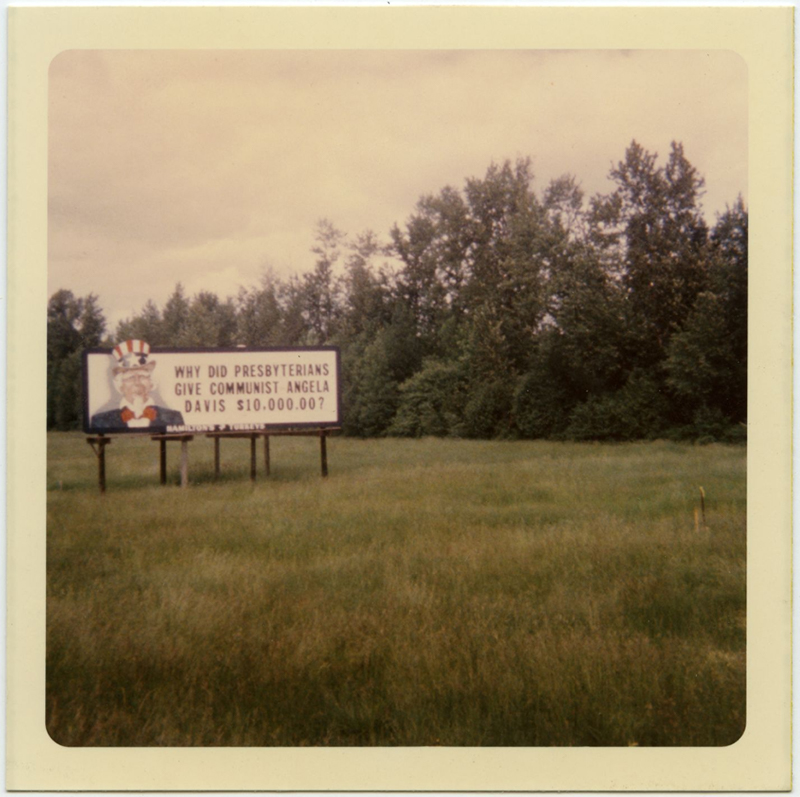
Hey, remember that time – at a PCUSA General Assembly – when they let a Muslim officiate during Communion? Remember when $10,000 of church funds was given to the Angela Davis Defense Fund in 1970? Oh, and that time that Presbyterians forced all congregations to support same sex weddings?
Not one of these things is true any more than Sarah Palin ever said that she could see Russia from her house or that the current resident of The White House is an actor since Joe Biden supposedly died in the 1990s.
There’s misinformation and there’s disinformation. Misinformation is untrue but it is shared mistakenly and not for devious purposes. Disinformation is untrue and is created to cause mayhem and disharmony.
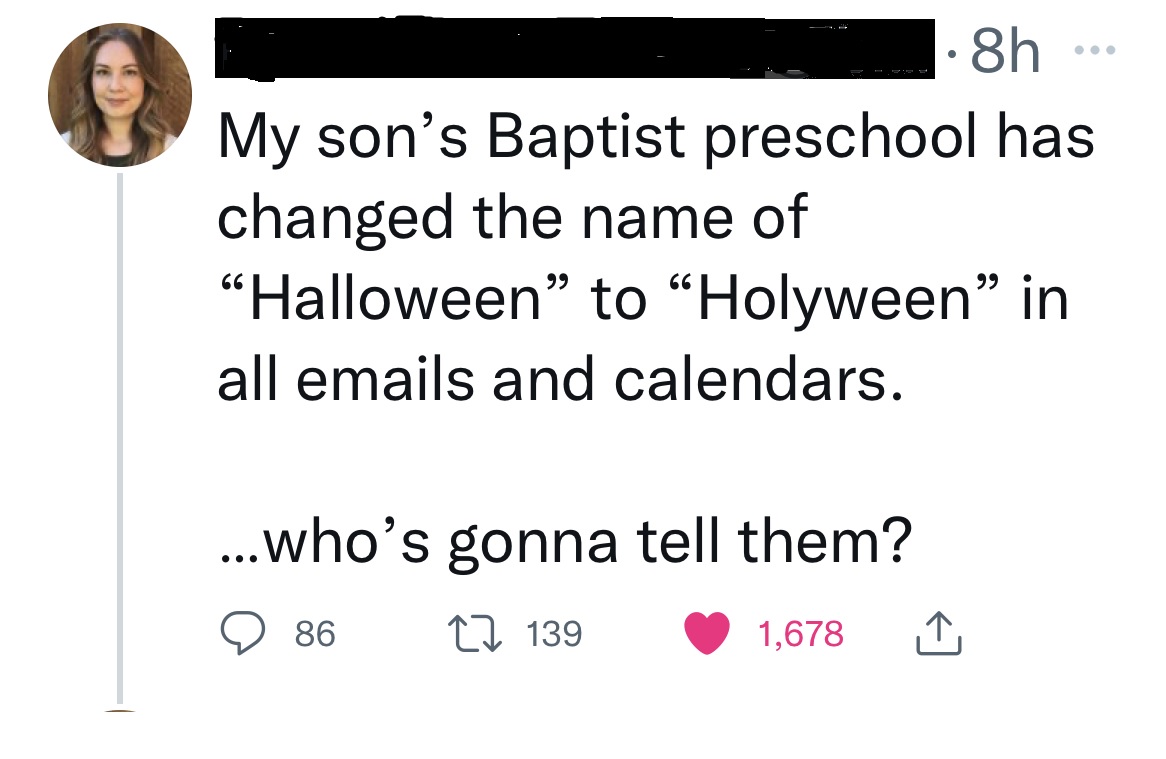
One of my favorite Tweets from last week is this one:
This illustrates misinformation as shared by a Baptist preschool.
Every Day’s a School Day as my friend AAM says. If we hear something that sounds off, we have a duty as citizens and followers of Jesus to check it out. Sodom and Gomorrah is not about gay sex. Mary Magdalene was not married to Jesus. And your pastor doesn’t work one day a week, even if they don’t keep regular office hours.
Again, if you hear something strange/disturbing/scandalous, you can do either of these two things:
Research it. (This is the faithful, curious response.)
Spread it. (This is the divisive, unholy response.)
And in the interest of learning new things, I’m headed to Ghost Ranch this week with other PCUSA Mid-Council Leaders. There might be new posts or maybe not.
From Eboo Patel’s excellent book We Need to Build: Field Notes for Diverse Democracy:
Here is what diversity lookes like in the city of Mostar, located in Bosnia and Herzegovina. If you work for the Croat Catholic fire department, you don’t reponnd to the burning buildings of Bosnian Muslims, even if you happen to be closer. And if you work for the Bosnian Muslim fire department, you let the flames engul croat Catholic homes. They have their own fire department.
We don’t do it that way in the United States of America. When Florida (a politically red state) experiences destruction from Hurricane Ian, Republicans, Democrats, and Independents – of course – vote to send relief to Florida. When the horrific shooting occured at Sandy Hook in Connecticut in 2012 (a politically blue state) Republicans, Democrats, and Independents – of course – voted to send emergency relief to Connecticut.
Rescuers evacuate residents from the Avante at Orlando assisted living facility on S.R. 436 in Orlando, Fla., due to flooding from Hurricane Ian, Thursday, Sept. 29, 2022. (Joe Burbank/Orlando Sentinel via AP)
Actually this is not true. It should be true. We do not support our neighbors based on their political proclivities, their religious background, or their ancestry – right?
Actually, in the past week, there have been politicians, tweeters, and cable news commentators expressing their opinions that those who disagree with us – politically – should not receive assistance. They are not “on our side.” They “do not deserve to be saved.” They are “those people.”
This is the opposite of what Jesus teaches. For God so loved the world . . . Not “the Christians” or “the Jews” or “the good people” or “the locals” or “our people.” Jesus died for Nancy Pelosi and Ron DeSantis and Joe Biden and Donald Trump and Ilhan Omar and Tucker Carlson and the MAGA lady in the Orlando retirement community who is trapped in her apartment and the Democratic Socialist on their roof in Pawleys Island. We have got to get over this notion that some people are not deserving of rescue, love, or forgiveness.
Yes, this annoys me too. What if I believe they don’t deserve it? (News Flash: Not one of us deserves the grace we receive in this life.)
Here’s the infuriating thing about The Gospel: the slackers, the greedy, the heinous, and the undeserving are all people Jesus loves. Errr. It’s enough to make us Pharisees.