Author Archives: jledmiston

Seeing Visions

Your sons and your daughters shall prophesy,
and your young men shall see visions, and your old men shall dream dreams. 
Acts 2:17b

For the record, young women also see visions, old women dream dreams, and gender fluid folks see visions and dream dreams as well.

At the risk of sounding Pentecostal, I have both seen visions and – on three different occasions in my adult life – strangers have seen visions about me (and taken steps to find me and fill me in.) I have shared this information with my therapist for a psychotic behavior check and she says I’m okay.

I tend to keep these stories to myself.  I shared one of my stories in a sermon and was ridiculed by a colleague so I learned to talk about my supernatural experiences sparingly.

Yesterday I wrote about churches who might have reached the point of no return in terms of a thriving future ministry.  Death – including Church Death – is part of our tradition and theology, so death doesn’t scare me.  We also believe in resurrection from death.  And we believe in visions and dreams.

Thriving leaders and congregations see things that most others cannot see.  We see potential.  We see miracles.  We see a future where others see only the past.  We see things.  Hope is our super power.

It’s not a false hope and it’s not a cartoon hope.  We see something real and while it might be fuzzy around the edges, we are clear about one thing: it’s about what God can do.

Who are the visionaries in your midst?  Who are the prophets in your spiritual community?  Without them, we are missing out.

Image of Marc Chagall painting the mural in the Metropolitan Opera House in NYC.  (1967)


When Has a Church Passed the Point of No Return?

I got a phone call a couple weeks ago from a sweet lady who told me that her church had decided to close.  They’d been struggling to keep going for some time but the part-time preacher had quit, the part-time musician had quit, a couple elders had quit and she (the caller) was in no shape “at her age” to keep things going.

When does a church reach the point of no return?  When we look at the life cycle of congregations and we know churches that are 100, 200, 300 (yes, there are some of those in the United States), it’s clear that – during that life cycle – those oldest of congregations made a choice that renewed them and moved them into a period of growth again.

Churches grow and slow and some die and some find rebirth.  Again – how do we know when a congregation has reached that point when nothing will bring them back to life – even in a new semblance of life?  Here are some choices that seem to prompt certain death:

  1. Leaders choose to keep more money in The Cemetery Fund than in the general fund for ministry and mission.
  2. Everyone – and I mean everyone –  has their own pet project/thing they love and they’ve stopped asking “What does God want from our church?”  It’s become what we want and we argue about that.
  3. The same people have been serving in the same leadership roles for over 10 years.
  4. The surrounding area is brimming with new people, new commercial projects, even new public transportation options and the church is not growing.
  5. The congregation does not look like or sound like the neighborhood and there are no efforts to change this.
  6. Not one leader in the congregation knows the names of: the principal of the closest school, any of the cashiers at the closest stores/gas stations/diners, the names of the people who live in the house/farm/apartment building closest to the church building.
  7. The majority of every meeting of the governing board is spent talking about Attendance, Building, and Cash.
  8. Sunday morning worship is the #1 portal through which people participate in the life of the church.
  9. Nobody prays out loud or talks about Jesus except for the pastor.
  10. The majority of people are fine with changing things as long as it happens after their own funerals.

Sometimes by the time a church contacts me for support, it’s too late – at least in a worldly sense.  They no longer have the capacity to stay alive whether they want to close or not.

At what point has a church reached the point of no recovery?  It depends on the church.

But my hunch is that – in the next five to ten years – most of our small congregations will close. By “small” I mean our congregations with 1 to 25 regular participants whose vision and energy has dried up.

There are congregations with a handful of members who love and serve their neighbors with a lavish faithfulness that makes their ministry quite large.  Those congregations will be fine.  If they die, they will rise again in glory serving their communities in a new way.  It will be beautiful.

The Good News is that Jesus will always have a Church.  It just won’t be the Church we have experienced for the past 500 years.  And – as much as we loved that church –  this too is Good News.

That Time Yusef Salaam Changed My Life

I first heard Yusef Salaam speak at one of the national White Privilege Conferences several years ago.  He was one of the keynoters and after hearing him, I tossed the rest of my schedule and attended every one of his workshops for the rest of the week.  His story changed my life.

During one of the breaks, I was in the hallway staring into space talking with a woman from Massachusetts about Salaam’s story, trying to process the profundity of it all. And then I realized that we were standing beside a table stacked with the book Waking Up White and Finding Myself in the Story of Race. The woman had been selling the book and I figured the least I could do was buy a copy since I’d taken so much of her time.  Her name was Debby Irving.

The story of Yusef Salaam and four other men of color is unspeakably disturbing.  And now that Ava Duvernay’s four part Netflix series about The Central Park Five is available, I wish every American would watch it.

When They See Us is not for the fainthearted.  It made me sick actually.  But it tells a true story and a True story:  the criminal justice system in this country is beyond broken.  White Supremacy is embedded in our nation’s DNA and the fallout has contaminated every single one of us.

Please watch this series and talk about it with your people.  It’s sadly one of thousands of stories that will never be told by Netflix.  It’s a story tied to the long history of chattel slavery from 1619 to the present.  It’s a story that each of us needs to know – especially those of us who consider ourselves to be white.

The amazing thing about Yusef Salaam is that he continues to be a man of peace.  After everything he’s endured, he calmly speaks about justice for all.  After experiencing the most destructive features of racism, he works to fight racial injustice with hope.  He honestly changed my life.  For the love of God, listen to his story.

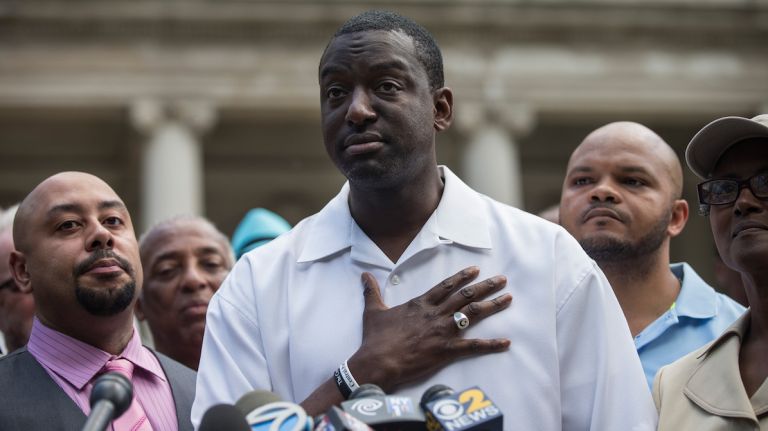
Image from June 27, 2014 when The Central Park Five won a lawsuit in civil court after their wrongful conviction.  Yusuf Salaam is in the center of the photo. Also, next year’s White Privilege Conference will be April 1-4, 2020 in Mesa, Arizona. Presbyterians get a discount thanks to MC.

Because Nakia Lied to Me

She had a good story and I had literally just noticed that my schedule was open for a few hours and I was happy to have a little free time.

She rapped on my car window and was crying. Sobbing actually.

“Do you know where I can get find an ATM?”

“Get in the car.”

[Note to my spouse & children: yes this is dangerous but she had fun hair. And the crying.]

She was from Wilmington and in town to see her mother who had had a heart attack and she’d run out of gas and a guy had filled up her tank and wanted $46 in cash to pay for the gas and she’d left her 14 year old autistic brother named Jeffrey with him so she could run to a cash machine but she didn’t know where to find one and she was just in a production of 101 Dalmatians and she played Cruella deVille for a non-profit theatre company that supports autism research and her name was Nakia.

Nakia lied to me. She said all the right things:

  • Jesus Christ is her Lord and Savior.
  • She’s in college in Wilmington and the first in her family to go to college.
  • She’s involved in her Methodist church.

It was about this time that I knew she was lying. Her story wasn’t lining up. But I got her some money and a water bottle and some cookies for Jeffrey and I dropped her off in a parking lot where she was going to pick up some fast food and walk to her car on the other side of McDonald’s.

Me: I can go through the drive through and take you to the car.

Nakia: Oh, you’ve done enough. I’m happy to walk and I need to use the bathroom inside.

Yep. The old “bathroom inside” trick. I prayed with her and gave her my business card that said “Reverend” on it and hugged her goodbye.

God bless you,” she said.

I drove out of the driveway and went around the block and saw her leave with no food and I followed like a detective from a bad TV show.

And as she walked into an apartment parking lot behind a 7-11, I drove up and asked if she was ok. And she knew that I knew that she had lied to me.

Because Nakia lied to me, I may not believe the next stranger who asks me for help. Or maybe I will. Apparently I’m a sucker for crying ladies who look like Cruella.

Proximity is Everything (also: This Is the Most Important Blog Post I’ve Written Lately)

Location. Location. Location.  It’s the motto of realtors everywhere because people generally want to be close to what makes life better/easier:

  • Close to work
  • Close to a Target
  • Close to family
  • Close to the beach
  • Close to good schools

Last night, I had the privilege of hearing National Treasure Bryan Stevenson speak in Charlotte. My first thought upon seeing him in person was that I thought he would look much older and weathered, especially considering what he has seen in this life.  (Read Just Mercy.)

He started by saying that we could talk about issues of injustice all night.  But he wanted to talk – instead – about solutions.  Talking about injustice weathers us.  Talking about solutions gives us hope.

I wrote a post last year that asked “Who is the poorest person you know?”  Many of us have narratives in our heads about “poor people” just as we have narratives in our heads about Black men in prison, unmarried pregnant women, immigrants from Central America, people addicted to drugs, Trans people, etc. etc. etc.

We read and hear news stories about “them” and we believe we know who they are.  Actually we have no idea who they are.

We only learn the true stories about people when we are close to those people.  Proximity is everything.

Sadly, many of us want to be “successful” in order to remove ourselves from the poor (i.e. “bad neighborhoods.”) In fact, we want to move far away from anybody who makes us uncomfortable.  But this is the opposite of what Jesus did.

This.  Is.  The.  Opposite.  Of.  What.  Jesus.  Did.

I’m not say that we need to move out of our comfortable homes or refuse to stay in nice hotels on vacation.  What I’m saying is that each of us needs to make choices to become more proximate to the very people whose lives we fear or condemn.

  • If we are angry about immigrants coming into our country from Honduras, Guatemala, and El Salvador we have a holy and civic duty to meet people in this very demographic.
  • If we are adamantly “pro-life” to the point of equating a six week old fetus with a six month old infant, we have an obligation to get to know some people who are pregnant as a result of rape, incest, or in brutally difficult circumstances.
  • If we fear young Black and Brown men in hoodies, God is calling us to get to know such men and hear their stories.

I’m not talking about one and done conversations here.  I’m talking about relationships.  If all our relationships are with people who look, speak, and live like we do then we have missed the point of Jesus.

This is the most important thing I can say this morning – except to quote my father who, upon hearing me complain about people, always said, “Just love ’em.”

We can’t love people we aren’t willing to know and be in proximity with.

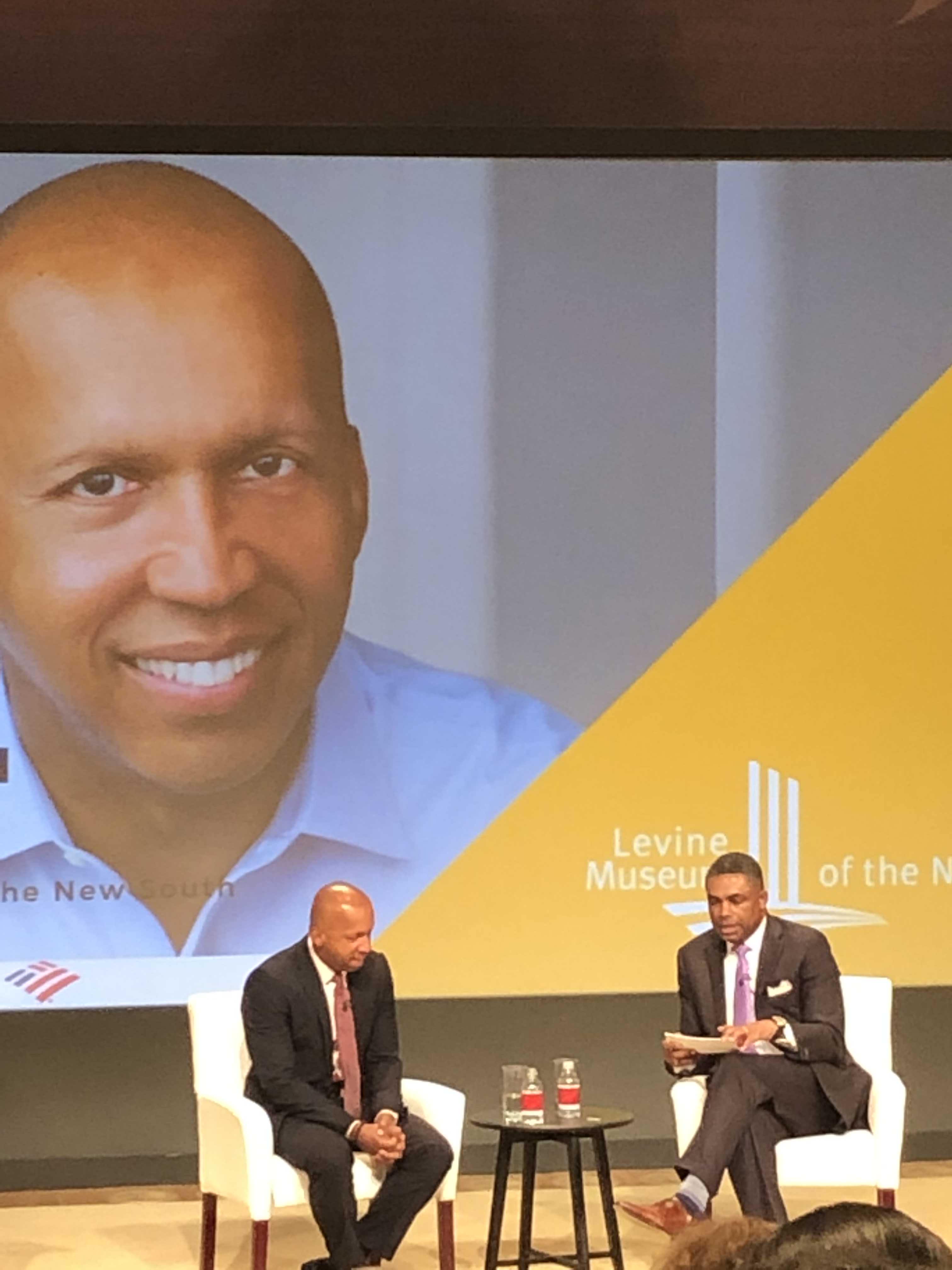
Image of Bryan Stevenson speaking on May 30, 2019 in Charlotte, NC


Energy, Intelligence, Imagination, & Love

The eighth ordination vow made by all Ruling Elders and Ministers of the Word and Sacrament in my denomination is this:

Will you pray for and seek to serve the people with energy, intelligence, imagination, and love? I will.

When I hear about pastors and congregations who feel stuck, I think about this promise.  My hope is that all pastors and all elders evaluate ourselves in terms of how well we are keeping this one.

First of all, are we praying for the people God has called us to serve? And secondly, are we seeking to serve them with these specific markers?

Do we have energy for this ministry?  If not, we need to ask why?  Is it because we are simply in need of a Sabbath, a vacation, or a Sabbatical?  Do we have energy for other things – but not for this particular calling?  If so, maybe we need to consider a new ministry.  If our energy is generally depleted for ministry it could be time to retire.

Are we still willing to learn new things?  Do we attend conferences, lectures, and retreats to hone our skills?  Do we read books, watch webinars, and listen to podcasts that enhance our ministry?  Or do we believe we know all we need to know?

How imaginative are we in this calling?  Can we see the possibilities?  Are ideas easily sparked?  Are we excited about the potential all around us?

Do we love these people?  Can we see our congregation through the eyes of Jesus to the point that we can love the grumpy ones, the judge-y ones, the mean ones, and even the hateful ones?

Effective Ministry – whether as professionals or as volunteers – requires enormous energy, bountiful curiosity, fertile imagination, and abiding love.  When it comes to annual evaluations of both paid and unpaid staff (and I’m including all volunteers here) we need to ask ourselves and each other these questions. God deserves our best efforts.

Keeping this particular ordination vow will free up  a stuck congregation every time.

Serving Jesus with Narcan

It’s common knowledge that seminary doesn’t teach everything needed for professional ministry in the 21st Century.  Yes, we get Hebrew, Greek, Exegesis, Church History, Theology, Worship, Preaching, Ethics, Administration, Christian Education, and Field Education.  We don’t generally get Community Organizing, Non-Profit Management, Finance, Property Maintenance, or Conflict Mediation.

Much like CPR and Mental Health First Aid training, church leaders today need to know how to administer Narcan (naloxone ) the opioid overdose reversing nasal spray.

(Note: by “church leaders” I mean anybody willing to love people with substance use disorders.)

The North Carolina Council of Churches is to be applauded for offering free breakfast gatherings in cities throughout the state to teach people of faith what we can do to address the opioid crisis. Please seek out such events often sponsored by Harm Reduction Coalitions in your own states.

Perhaps you don’t think your particular congregation needs this training, but here in NC, we have pastors asking for training in:

  • Disposing of dirty needles left in church parking lots
  • Clean needle exchange programs
  • What to do if they find unresponsive people on church or other public property.

I’m asked this of pastors in our lovely rural communities as well as our lovely suburban neighborhoods.  It’s not the kind of thing any of us trained for when we signed up to lead the Church.  And yet there are many things we Church People can do to serve Jesus by serving those with substance use disorders.

What can The Church do?

  • We can use stop using stigmatizing language (“actively using” instead of “dirty.”)
  • We can offer Sunday School classes about substance abuse and its impact on our community.
  • We can do a prescription pill drive inviting people to bring in all old prescriptions to be picked up by local authorities. (This is better than flushing them down the toilet which pollutes water systems.)
  • We can install boxes for people to safely turn in needles.
  • We can start a local needle exchange.

Check out the Top 25 cities for opioid abuse in the United States:

Yikes. As you can see, most of these cities are in the Bible Belt.  If we sincerely intend to serve Jesus, we can start by learning how to administer Narcan and then keep a couple doses in our cars, our homes, our offices.  It’s become the new CPR.  We need to learn how to do this for the love of God. #21stCenturyLeadershipTraining

Image of Narcan Nasal Spray (Naloxone) which can be purchased without a prescription in most states.  Tell your pharmacist you are hoping to channel your inner Good Samaritan if you are embarrassed to buy it. If you have medical insurance, it will most likely cover all or most of the purchase price.  In North Carolina, sign up for one of these free training events to learn more:

Memorial Day Question: Is a Global Catastrophe Necessary to Change Us?

As we remember with the deepest respect those who have died in service to our country today, I can’t imagine what it’s like to receive the news that a loved one has died in war.  To those families who know what it’s like, we hold you in deepest compassion.

War is one of the catastrophes of life that utterly alters human society, much like the catastrophes of epidemic disease, cultural revolutions, and toppled regimes.

This article from The Atlantic from last February recounts how catastrophes often bring economic shifts that level the playing field.

We constantly hear today that the rich are getting richer and the poor are getting poorer.  In Charlotte, NC both of these things are true:

So which is it?  Are people doing well in this particular city or are they not doing well?  It depends.

Throughout the United States, those of us living comfortably with thriving investments might believe that all is well.  But for those struggling with unemployment or under-employment, who have no health insurance, who are shouldering heavy debt, who are the most negatively impacted by white supremacy there is a deep desire for things to be different. And people who speak of economic revolution are repudiated for being “radical.”  (Note: Jesus was executed for being somewhat radical himself.)

Wars, in particular, often happen as a result of deep economic injustice.  It would be noble (and holy) if we human beings simply loved our neighbors as ourselves.  But we tend not to do this.

While I don’t believe God causes catastrophic war, I do believe that 1) God allows them to happen and 2) God uses tragedies for good in spite of our greed.

This doesn’t have to happen and – God knows and we know that – war brings unspeakable grief.  As we remember the fallen today, let’s also remember that we were born to love God and to love our neighbors, and when we don’t there are always cosmic consequences.

It doesn’t have to be this way.

Image from the movie Saving Private Ryan.  We are grateful today for sacrificial love. John 15:13

Free Money

I gave a report Tuesday to the denominational mid-council I serve about How Rich We Are as The Church.  This automatically brought forth a flood of “tell us more” requests.  Here’s the truth:  Free Money is not for everyone.

We have congregations that want all the usual things:

  • Growth!
  • Young people!
  • More young people!

But let me tell you who gets money for ministry:

  1. People who are energized to go where the Spirit of God is leading them.  This means achieving the kind of growth that we never imagined.  This means serving broken people of every age.
  2. Congregations partnering with other congregations to do ministry together because this isn’t about Our Particular Church Doing A Good Thing For the Community.
  3. Servant Leaders who are teaching people to follow Jesus.
  4. Churches unafraid to move.  Maybe God is telling your church to relocate geographically.  Maybe God is telling your church to relocate missionally.  Maybe God is telling you to get out of the pews and out into the neighborhood.  Not moving = No funding for new ministries.

The money “out there for ministry” requires deep discernment and prayer before we are ready for it.  I have no interest in helping congregations get grants for technical changes (e.g. new church sign, new paint job.)  Congregations can and should have enormous impact without fresh paint. (Note: if you need a sprinkler system before you can open your preschool for low-income children, this is different.)

There is money for congregations excited about adaptive change: culture shifts from “getting people to church” to “being the church.”

As I shared last Tuesday, former Moderator of the 206th General Assembly Bob Bohl once told this story:  He was leading a Session meeting surrounded by elders wringing their hands because the church budget was flat and giving was down.  One elder said, “If only someone would die and give us all we need.”  And Rev. Bohl said, “Somebody has.”

We are rich as the Church of Jesus Christ.  If we are authentically and selflessly doing God’s work in the world, there is funding out there to do more.

Happy Memorial Day Weekend, Everyone.


So Happy For You!

The news of billionaire Robert F. Smith’s announcement that he would pay off the student loans of Morehouse College’s Class of 2019 has been celebrated for several days now.  This gift undoubtedly changes the lives of hundreds of young men forever.  What was earmarked for paying off debt can now be used for buying homes or investing in graduate school or paying forward the fruits of their own successes.

I am so happy for them.

And I also wonder about the students who graduated with no student loans.  Surely there are many young men in this class whose parents saved up to pay for their college educations.  Maybe there were grandparents who made sacrifices.  Maybe they sold property or other treasures to cover college.

They who worked hard to keep their sons and grandsons from incurring debt will not benefit from Mr. Smith’s extraordinary gift.  And yet, I hope they can be thoroughly happy for those whose debts are covered.

I hope all of us are happy for anyone whose debts are covered.  But one of the trends I see these days is a hesitance – if not a resentment – over giving those who struggle a leg up.  Increasingly, we blame the poor for their poverty.  We consider those who struggle wholly responsible for their financial situations.

We who were born on third base forget that most of the world struggles to get to first.

One of the blessings of living in a civil society is that we are a community interested in the common good.  We are happy for others’ good fortune.  We rejoice when our neighbors prosper.  And this means that – in our efforts to build each other up – life is not fair.

Life. Is. Not. Fair.

This is the truth and it’s not bad news.  If life were fair, all of us would be in big, big trouble cosmically.  (I say this as a lifelong Presbyterian.)  I do not in any way deserve the life I now enjoy.  I won the genetic lottery at birth as the desired child of two parents who offered me a safety net for the entirety of their lives, whose network of family and friends have benefited me throughout my existence.  They were not wealthy by the standards of the community in which we lived, but by global standards, they were astoundingly rich.  I was blessed with piano lessons and braces and medical care.  I enjoyed vacations and abundant food and my own bedroom.   I deserved none of this while many of my classmates – not to mention neighbors in the world’s poorest nations – had none of these things.  Life is not fair.

I believe that God desires every human being to have basic needs: food, shelter, health care, sanitary conditions.  Every human should be paid a living wage for their labor. Every human should have a safety net.  And God has given us the responsibility for ensuring this for our neighbors.

Thank God for Robert F. Smith who has taken financial burdens from hundreds of young men – because he could.  Who among us could do more to relieve the burdens of our neighbors – but we don’t?

Everyday, there are stories in the news of the lack of affordable housing, abject poverty in our rural communities as well as our cities, families ruined because of a lack of health care or the inability to afford it.  This – I believe – is a sin.

Does everybody deserve a home?  Health care?  Food?  Education?  Yes.  Maybe you worked hard for yours.  Maybe someone (parents, grandparents) worked hard to get you yours.  Maybe you are in a position to expect your heart’s desire.  Wonderful.  I am happy for you.

Can we also be happy when others receive their heart’s desire?  I hope so.  It is one of the great joys of life to change people’s lives for good, whether they deserve it or not.  Do any of us truly deserve the blessings we have?

Image by Steve Schaefer/Associated Press of 2019 graduates of Morehouse College in Atlanta.