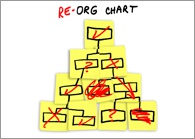
 Our Presbytery voted overwhelmingly today to restructure. After countless meetings, writes and rewrites of proposals, and finally a lengthy discussion about the job title of a new two-year position (“Community Organizer”?) we approved a new Connectional Mission Design.
One of Big Three Shifts for the 21st Century Church is Organizational Change. It used to be true, for example, that every member of a church governing board headed up a committee of the congregation (e.g. The Stewardship & Finance Committee, The Education Committee, etc.) That organizational structure is dead – or should be.
True restructuring will never happen without authentic, deep, broad, difficult, courageous change with buy-in from the majority of the congregation. Among the easy attempts at church transformation that will not work:
- Changing the church’s name
- Installing a new sign
- Re-naming committees “teams” or “work groups”
- Calling a new pastor
- Changing the order of worship
- Changing the time of weekly worship
- Shifting the worship style
- Using words like contemporary, missional, special, & emerging
- Participating in a denominational or other program that will help you grow/change/figure everything out.
Those things might be pieces of the strategy. But if there is no energy, if there is no absolute willingness to toss everything that is not about Jesus, then transformation will never happen.
So, now for the good news:
- This is about the moving of God’s Spirit and so – if we are willing – God will do extraordinary things that will rock us.
- If we focus on relationships (with God and each other) rather than processes, our souls will be fed.
- If we consistently ask “How is this _____ (chili cook-off, Bible study, play group, harvest festival) transforming people and communities for good?” we will stop wasting our time on activities that “we’ve always done” or “we have to do” that simply waste precious resources.
- If we treat people like people – and not like numbers, targets, dollars, trophies or “fresh meat” – we will experience the reign of God.
- If we model transparency, trust, and grace the behavior of the community will shift.
- If we focus on the big message (i.e. why we exist) rather than the small messages (e.g. what happened at last week’s rummage sale, the fight over sanctuary paint colors) we will alter the congregation’s DNA.
- If we truly love our people, we will have the pastoral capital to challenge them.
Lots of organizations are addicted to reorganizing, so we need to look out for that too.
Every denominational entity is reorganizing these days. But none of it will work if we aren’t willing to give up all the things we love and worship more than Jesus.