Category Archives: Uncategorized

Continuing Education as a Disruptive Activity

Wild Goose 2014Clergy – at least in my denomination – are essentially required to take continuing education.  Some of us take preaching classes or attend conferences on everything from church redevelopment to spiritual direction.  Some take a week at a lake and write sermon outlines for the coming liturgical season.

It’s kind of a great gig.

But what if we chose something that so stretched our sensibilities that we returned to regular life a bit jostled?  Imagine continuing education as something that disrupted our usual Way of Thinking.

As you read this, HH and I are headed to the Wild Goose Festival in Hot Springs, NC.  It’s been described as a Progressive Christian Woodstock, but mostly it’s four days of pushing and pulling and music and really good food and interesting conversations and stretching my old school Presbyterian mindset.  I. Love. It.

Before we can grow as a spiritual community – especially those of us who are connected to denominations that have Historical Significance – we need to broaden our vision.  I’m a fan of experiencing Continuing Ed that makes us a little uncomfortable.  How about you?

Faithfulness is Disruptive

My denomination has been disrupted and we don’t yet know the consequences. disruptive-innovation

Last week – as documented on the front page of the New York Times, our General Assembly approved (rather overwhelmingly) an overture to change the definition of marriage from “a man and a woman” to “two people, traditionally a man and a woman.” Also approved (barely) was a vote to divest denominational investments from three corporations that supply Israel with equipment used in the occupation of Palestinian territory.

Some people are very upset.

In throes of hate mail, calls for congregations to leave the denomination, and general anxiety among many faithful Presbyterians, an usher welcomed me into worship yesterday, and upon learning that I work for the Presbytery of Chicago, he shared that he might leave the church and that he was tired of “the church being led by children who interfere in issues they have no business talking about.” Good to meet you too.

In the meantime, HH and I received a text from our 20-something FBC sharing that he was proud of the Presbyterians and that lots of his friends were talking positively about the denomination of his baptism. Believe me, this was a first.

Disruptive innovation is a concept in technological development in which – initially – results/performance/growth might be lower, but eventually there is prosperity as traditional parameters change. Check it out here.

After years of prayerful conversations, studies, debates, and even General Assembly voting, GA 211 finally made a disruptive decision: to change the definition of marriage to include GLBTQ couples and to stand with oppressed Palestinians – both Christian and Muslim. Some people will leave the church. Some will send hate mail. Many will misrepresent what happened in Detroit.

But innovation is disruptive. And faithfulness is even more disruptive. Thanks to all the commissioners who worked so tirelessly last week in Detroit.


Thinking About What Is Beautiful and What Is Not

This or ThisSome of us – sisters and brothers in Christ – lift up Philippians 4:8 as a life verse: Finally, beloved, whatever is true, whatever is honorable, whatever is just, whatever is pure, whatever is pleasing, whatever is commendable, if there is any excellence and if there is anything worthy of praise, think about these things. Generally speaking, we focus on what is beautiful and wholesome. We post uplifting images and stories. We live comfortably and securely and we want that for others.

Others of us – devoted sisters and brothers in Christ – lift up Matthew 25:37-40 as a life verse: ‘Lord, when was it that we saw you hungry and gave you food, or thirsty and gave you something to drink? And when was it that we saw you a stranger and welcomed you, or naked and gave you clothing? And when was it that we saw you sick or in prison and visited you?’ And the king will answer them, ‘Truly I tell you, just as you did it to one of the least of these who are members of my family, you did it to me.’” Generally speaking, we focus on social injustices. We post provocative images and stories. We live uncomfortably if only because the realities of the world weigh heavily on us to the point of trying to do something beyond writing a check for the offering plate.

These are ridiculously extreme descriptions, but you get what I mean.

What I’m talking about here is not necessarily a political divide. There were followers of Jesus at this Romney retreat meeting here to discuss American leadership last week and there were followers of Jesus at this Democratic leadership retreat meeting here last winter. There are Christians living in gated communities separated from danger and unpleasantness, and there are Christians living in intentional communities in the inner city in the thick of danger and unpleasantness.

How do we reconcile living the beautiful life with living in an ugly world.

Someone posted on Facebook yesterday – with the now famous photograph of children being held by our own government – these words:

“If you are a Christian and this doesn’t anger you, then you need to repent. Jesus was a refugee. His followers were law-breakers. If protecting the borders or ‘American culture’ are more important to you than compassion to children and aliens, then you need to admit that Jesus’ opinion means less to you than the opinion of Rush Limbaugh.”

Some of us are moved to the point of trying to Do Something (from writing our members of Congress to serving undocumented people in our own neighborhoods.) And some of us look away and post another picture of happy children.

How do we as followers of Jesus indeed follow Jesus in light of what is not true, honorable, just, pure, pleasing, commendable, excellent or worthy of praise in this world?

If God has blessed us with abundant life, what are we doing in response to this blessing? How is it possible that we sit and admire what is beautiful without a concern about what is not?

Image includes the time stamped May 27, 2014 which – if true – shows a Texas holding station for unaccompanied immigrant children.


 

If I Hang Out at Your Church, Will I Actually Meet People Who Are Like Jesus?

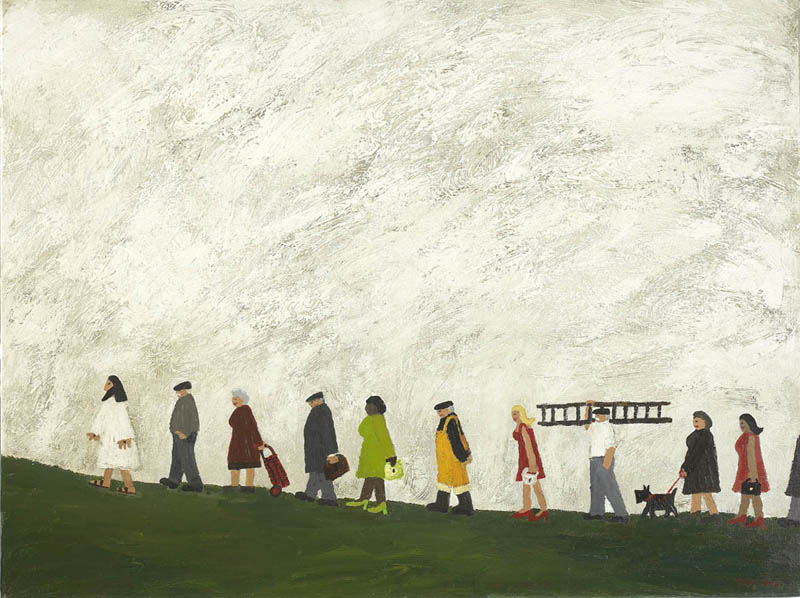
Some People Following Jesus by Gary BuntMy favorite tweet of the day yesterday via Erin Dunigan:

“If I hang out at your church will I actually meet people who are like Jesus?  Or will I just hear about him? @MLabberton #GA211”

Mark Labberton nailed it.

Among the comments I’ve actually heard in the past month in Church World:

  • The congregation thinks I don’t spend enough time doing my job now because I have a baby.
  • We don’t want a pastor who won’t wear a robe.
  • Someone told my daughter her skirt was too short for worship.
  • Her sermon was not very sophisticated.
  • All our pastor does is read his email all day.
  • We don’t have enough money to keep the church going past October.
  • Only 4 kids are registered for Vacation Bible School.
  • That woman is evil.

Imagine walking into a church building and seeing people who remind you of Jesus.  What would that look like?

Image source.

What Trust Looks Like in Church World

CJ_triple_trapeze_MayA colleague told me yesterday that she’s seeking a new call in professional ministry which will almost certainly not be in the town where she currently lives. She put her condo on the market – trusting that a sale, a closing, and a call (not necessarily in that order) would follow. The whole situation instilled zero anxiety in her deepest parts.

Read this again: She put her home for sale without knowing where she’s going next. This is trust.

She trusts that God will indeed call her to her next position. She trusts that cosmic timing with work out. She doesn’t believe that God performs magic tricks (If I leap off this mountain, God will catch me) but she does believe that God works in the world in mysterious ways.

As the 221st General Assembly of my denomination discusses difficult issues this week in Detroit, as I counsel pastors whose elders are anxious, as I listen to Search Committees who wonder about the efficacy of our Church Leadership Connection system, as I hear complaints about the worthiness of our Presbytery Office, it’s clear that we don’t trust each other, much less God.

Trust doesn’t come easily. It involves connecting relationally and expecting the best from each other. (The second season of OITNB has messed with my mind in terms of absorbing a don’t-trust-anyone attitude, at least until I recover from the season finale.) But I am a trusting person most of the time.

People of faith are – by definition – people who trust.

  • For some of us it’s easy because people in our lives have been trustworthy for the most part.
  • But for others of us who’ve experienced unrelenting disappointment, bitter betrayal, and long term deception, it’s a miracle we can trust the sun to come up.

But in pondering the events of this week in Detroit and throughout our spiritual communities, trust seems to look something like this:

  • Fearlessness in spite of the risks. We trust that everything will ultimately be okay because of forces bigger than ourselves.
  • Confidence in The Other. We trust when we feel safe, even after we’ve made mistakes/bad choices.
  • Understanding that the world is not about me. We trust that there’s a bigger picture and a higher purpose.
  • Collaboration occurs even between people who disagree. We trust that colleagues will listen to us – which is not the same as waiting for their turn to talk.
  • Positive results trump “winning.” We trust that participants in group processes will refrain from being belligerent and combative.

Do you trust your pastor? Do you trust your church friends? Do you trust your Presbytery or Association or Diocese or Conference? Do you trust your denomination?

Why or why not?

Image source.

What’s Your Blue Sky Proposal?

“My blue-sky proposal: teach America’s kids to read by making them read Awesome-Blue-Sky-poetry.”  William Logan wrote this here.

For our families, our jobs, our classrooms we sometimes propose ideas for the future.

Sometimes these proposals are attempts at making peace between factions.  Sometimes we imagine the best case scenario for a difficult situation.  But every once in a while we lift up our highest dreams and hopes and Great Visions:  our Blue Sky Proposal in the words of writer William Logan.

If all skies were blue and all options were open what would be your Blue Sky Proposal for changing the world?  We might articulate it this way:

(What you want to do) by (idea for doing it) as in . . .

  • Teaching kids to read by making them learn poetry.

Here are a couple of mine related to my church work (from simple to harrowing):

  • Teaching ruling elders to be spiritual leaders by requiring them to be available for individual, confidential prayer after worship each Sunday to anyone who needs private prayer.
  • Teaching ruling elders to be spiritual leaders by having them relinquish all committee work.
  • Helping congregations become unstuck by eliminating all committees for one calendar year.

I’d love to hear your Blue Sky Proposals too.

Is It Okay for Me to Wear Naots?

Naot OutletNaots are very cute and comfortable shoes made in Israel. The people who make Naots in the Kibbutz Neot Mordechai are surely good people who are simply trying to make a solid product and live their lives in peace.

But the soles of Naot shoes are made in Gush Etzion, just south of Bethlehem in the West Bank and Gush Etzion is considered illegally confiscated Palestinian land by most readings of international law.  Others say that the land was purchased by Jews long before the Jordanian invasion in 1948.

This is so complicated.

My point is this:  my denomination, the PCUSA, will be debating Middle East realities  at the 221st General Assembly in Detroit next week and this is why it matters – simplistically speaking:

  • Do we, as a denomination, support the Palestinians – some of whom are our Christian sisters and brothers – whose homes have been bulldozed and whose land has been taken?
  • Do we, as a denomination, divest our pension monies from businesses like Caterpillar whose tractors do the bulldozing?

Again, this is ridiculously simplistic but we Presbyterians are trying to do the right thing.

None of us are purists – let’s be clear about that.  While I might not wear Naots, I have owned a Hewlett Packard computer and HP is another company from which my denomination is considering divesting.

This has been very ugly.  And I have no good answers.

But I’ve come down to this:  I – myself – can choose to practice spending my own money as a personal spiritual discipline a la Julie Clawson.  Perhaps this is the wimp’s way out but it’s often the best we can do.  And none of us will ever be purists.  We just can’t do it.

If you can comment calmly, where are you on divestment?

Image source: The Naot Outlet in Israel.

Exclusive Geekdom

GA-221-border

The General Assembly of my denomination will be meeting in Detroit this Saturday for a week and the FOMO is setting in . . . which is a little strange.

On the one hand, I am allergic to the meetings, the politics, the procedures, the vying for attention, the cool kids’ tables, and the denominational narcissism.  On the other hand, I have been known to watch the General Assembly life-streaming on vacation, coach candidates standing for Moderator, keep wall-sized photographs of Moderatorial candidates in my office, and try on the Moderatorial cross when no one was looking.  I know the trivial catch phrases of Moderatorial elections since the 80s.

I’m not going to GA this year, which is just fine – although I will regret missing the reunions, the after-plenary meet-ups, the election of good friends (I hope), and the debate on issues that will change our world – at least a little bit.  Instead I’ll be 1) holding down the fort at the office and 2) holding the rings of friends getting married.

We who love Church World forget that the very things we love about it (acronyms, Montreat, pithy speeches, inspiring worship, connections, politicking) make our World exclusive to others.  Most of the world doesn’t care about Frank Harrington’s gaffe when he stood for Moderator in 1992 or Cindy Bolbach’s signature quote in 2010 or the voting totals on the definition of marriage issue in 2012.  My heart is lifted when I read Gradye Parson’s welcome to the 221st General Assembly, but most of the world will not care.  Most people in the world do not know any Presbyterian followers of Jesus.  At least I think that’s probably true.

And yet we seek to be a church that transforms the world and models what it looks like to follow Jesus in every day situations and in global situations.  Many will say that denominations are ridiculous and exclusive.  But I continue to be grateful for my own, as I pray we fling open the doors to anyone who can connect to God through our corner of the Church.

Based on the Sermons of . . .

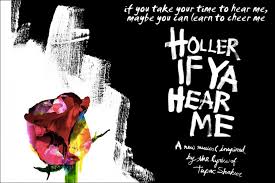
HollerAs we debrief last night’s Tony Awards this morning (loved The Music Man rap) I’m also looking ahead at the new season on Broadway. Plays are often “based on” the songs or books or lives of great and random people.

The 2014 season brings us Holler If Ya Hear Me based on the songs of Tupac Shakur.  In this article, August Wilson is quoted as saying, “There’s nothing contained in your life that’s not contained in that music. There’s love, honor, duty, betrayal, love of a people. There’s a whole universe in that music.” I’ve heard sermons like that. Sure most preachers have the habit of preaching virtually the same single message each week no matter what the season (“God loves us.” “Life can be different.” “Serve the least of these.”)

But occasionally there is a sermon so transformative, so absolutely inspiring that there is a whole universe in that message.

Clearly the Bible covers “love, honor, duty, betrayal, love of a people.” So why hasn’t someone written a play based on the sermons of MLK or some of the famous-ish preachers we all know? I’m not talking about satire or a cartoonish version of the Gospel. I’m not talking about the sermons of Joel Osteen.

Imagine hearing a message after which someone could say “There’s nothing contained in my life that’s not contained in that sermon.” Even better: imagine writing and then preaching that sermon.

Let’s face it. Even the word “preaching” prompts rolled eyes and sagging shoulders. Preachers are considered by both the secular and sacred world to be dry and inconsequential.  And yet, we have the privilege and responsibility to speak to universal truths (and most of us clergy are actually paid to do this.) Imagine doing it with the possibility in mind that someone might one day write a fabulous play based on our words.

D-Day

fallen-9000-6[6]While there are several D-Day stories on television this week (all roads lead to Tom Brokaw) there are few references on social media today, as far as I’ve seen.  I wonder if it has to do with the fact that people young enough to connect via social media do not know much about D-Day.

I count myself among those who recognize “Normandy” and “Omaha Beach” and “Saving Private Ryan” but I don’t know 6-6-44 like I know 9-11-01.  My heart doesn’t physically tense up when I think about that day.

“That day” was 70 years ago and it was not just a day.  The battles continued for months. British Chaplain Leslie Skinner wrote 72 days into the fighting:

Place absolute shambles. Infantry dead and some Germans lying around. Horrible mess. Fearful job picking up bits and pieces and re-assembling for identification and putting in blankets for burial.”

Fearful job.  Bits and pieces.  Re-assembling.

This is what chaplains and pastors and all followers of Jesus still do if we are doing it well.  Ministry is not always pretty.  If we are doing it well, we regularly sit in @%^! with people and it can be terrifying.  We seek hope alongside them and they with us. Resurrection often takes on the form of re-assembling bits and pieces of life.

On June 6, 1944, the Allies failed to complete all their goals.  There would be more horror and more loss, and yet it was the beginning of a new chapter that would bring peace.  This is the best we can hope for sometimes:  peace in the (sometimes distant?) future.

I don’t know how to honor those who fought 70 years ago today except in this way:  Ponder who in your life needs to be liberated – from depression, addiction, misfortune, loneliness, paralysis, cruelty, misunderstanding, deep grief.  And be there.  That’s often the best we can do.

And a profound thanks to those who were there in the thick of things 70 years ago today.

Image is called The Fallen by Andy Moss and Jamie Wardley.