Pants We Didn’t Realize Were On Fire

It burns.  

In my years of professional ministry there have been occasional moments when someone has come to me in need of pastoral care after discovering that what they once believed to be true about their parents/siblings/spouses/friends is actually not true at all.  Sometimes these truths are revealed after people pass away or when a secret child shows up or when someone on her death bed decides to clear the air before breathing her last.

These moments can be devastating.  They can shatter trust.  And they can happen even in the thick of ordinary life in terms of “what we have always believed.”

I was taught that M&Ms melt in your mouth, not in your hands . . . until I was holding a fistful of them in my hand one summer and they melted like butter.

I was taught that our great nation offers “liberty and justice to all” and that if people work hard, they will succeed . . . until I got to know people who worked much harder than I did who were struggling to catch a break time after time.

I was taught all my life that Robert E. Lee was a great man, a general who – against his own deep sense of patriotism – chose to support his beloved Virginia during the Civil War.  I was told he hated slavery from both my history textbooks and Shelby Foote. (Shelby, how could you?)  The truth is that he, too, was a slave holder.

At the risk of having you make the false assumption that I don’t love M&Ms, my country, or my Southern heritage, can we admit that we all tell lies?

  • Sometimes we tell lies inadventently because we deeply believe they are actually the God’s Honest Truth.
  • Sometimes we tell lies because we want them to be true.
  • Sometimes we tell lies to protect ourselves or someone else.

Lying – whether we are talking about fake news, or political operations, or history as told by the winners, or face-saving devices – is a sin.  If that sounds too pious, one could also say that lies ruin things. Lies enslave people. Jesus encourages us to seek the truth because – you know – the truth will make you free.

But first it will make us miserable because we will be disappointed.

What if following Jesus = always seeking the truth – not only about ourselves but also about our world history?  Remember when Ben Affleck denied his own ancestral history of slave owningTruth is hard.

Most of us are not proud when learning that our beloved ancestors, for example, enslaved other human beings.  I know I’m not proud of it.  But shame doesn’t bring wholeness.  Wholeness comes when we confront what is true, when we lament, when we make amends, when we ask forgiveness – whatever is required in our particular situation.

Hermann Göring’s daughter never believed that her father was guilty of war crimes during WWII in spite of the evidence that resulted in his death sentence.  She said that she only knew him as a loving parent. Sometimes we just can’t bring ourselves to believe that people can be this complicated:  that a loving father was actually a Nazi.  That our ancestors could have been members of the KKK or perpetrators of sexual abuse or incarcerated for embezzlement or – that they were simply liars.

As a native North Carolinian with a Great Great Grandfather who fought and died at Antietam for the Confederate States, I have much to learn.  And I’m taking some time to teach myself after Thanksgiving.  I want to be free too, so I’m seeking the truth about my own heritage throughout the South.  I hope to light a different kind of fire.


Saints

My notion of saints has been impacted by watching Season 2 of Stranger ThingsI love this show for many reasons but one of them is the culture of making sacrifices for others.  This is saintly behavior – even on Netflix.

Spoiler Alert:  Steve gives us the starting lineup for babysitting.  Barb gave up her life for BFF cover up. Joyce gives up Mother of the Year for saving the planet.

Last night during Trick or Treating, I observed a big brother choosing a Twizzler over a Reese’s Pumpkin because little brother said he wanted the last Reese’s.  In the past week, I witnessed community organizers giving up their own privilege for others.  I watch people every day do make sacrifices from giving up their seat on the train to giving up their vacation money to ensure that a refugee family gets a car.

This is what 21st Century sainthood looks like.  Thanks be to God.

Image is All Saints Day by Wassily Kandinsky (1911)

The Imperfect Reformer

On our way to visit the Castle Church in Wittenberg about 30 days ago, HH and I stopped to visit other church buildings where Martin Luther had preached.  Although my German is negligible, I recognized the word “Juden” in some of the quotations painted in the lobbies of one church building.  The words were hateful.  In the entry to the Church.

Martin Luther recognized that reforms were necessary for the Church to be faithful.  What he didn’t recognize was that Jewish people are beloved children of God and the Church will never be faithful until we accept that truth.

Our reformers have always been imperfect.

While the Reformation changed many things, it didn’t change everything.  And as we continue to reform God’s Church in these days, we continue to cling to our blind spots and our unfaithful biases.

Do you know that you can walk right up to the Castle Church doors in Wittenberg and touch them?  The original wooden doors burned during the Seven Years War about 50 years after Luther’s famous hammering moment. Now the door is bronze with the 95 Theses imprinted into it.

But the door itself is not holy.  It’s just a door.  Worshippers leave through this door after worship.

What happens after we leave through those historic doors is the true reformation.  The way we treat our neighbors and our enemies, the way we make everyday choices.  My hope is that 500 years from today, the Church will continue to be reforming in ways that please God.  Not one of us has gotten it right yet.

The Accidental Prophet

I was raised to be A Good Girl.  A Good Girl is compliant.  She doesn’t complain.  Her job is to take care of things. She rarely stands up for herself.  She takes the bullet.  She is nice.

Prophets are often angry. They rarely stop to rest.  The problems of the world rest on their shoulders.  They are often humorless.

I would like to redefine these narratives.

A 21st Century Good Girl persists for the sake of righteousness.  She puts on her own air mask before she helps those around her.  She expresses what is true in the most loving way possible, and she realizes that she cannot fix everything but that’s okay. It’s her job to organize people who will work to fix it together.

A 21st Century Prophet persists for the sake of righteousness.  She puts on her own air mask before she helps those around her.  She expresses what is true in the most loving way possible and she realizes that she cannot fix everything but that’s okay.  It’s not her job to fix it.  It’s her job to organize people who will work to fix it together.

Moving forward.  I hope you are too.

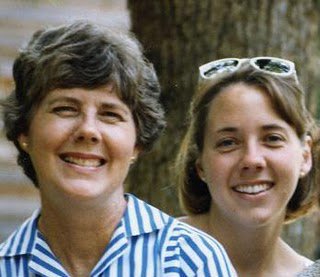
Image of a couple of Good Girls circa 1979.

The #1 Reason Why Theories Won’t Fix Our Churches

I’ve been doing church redevelopment work and culture shifting for a while.  I’ve participated in lots of training in theories and movements.  The big theorists’ names are familiar to many of us.

I’ve worked with congregations and mid-councils who have tried multiple programs and used a variety of consultants and spent lots of money on it all. But usually nothing changes and often things become worse.  Trust is diminished and impact is minimal.  And it’s all because of a single thing that Community Organizing has taught me this week.

Relationships are everything.  Our relationships with each other and with God make or break our best efforts.

If we do not have have authentic relationships, every theory we try and every movement we join will fail.  If we do not choose healthy leaders who have healthy followers, if we do not lift up leaders with strong emotional intelligence, whatever efforts we make leave our people anxious and frustrated.

Healthy relationships = healthy churches and systems. That’s pretty much where effective ministry begins and ends.


A World Without Church Fundraisers?

In my 33 years of professional ministry I have participated in many church fundraisers including this incomplete list:

  • Roast Pork Suppers
  • Turkey Suppers
  • Ham Suppers
  • Spaghetti Suppers
  • County Fair Food Booths
  • Bake Sales
  • Cake Walks
  • Plant Sales
  • Pumpkin Sales
  • Christmas Tree Sales
  • Quilt Raffles
  • Fall Fun Fairs
  • Fish Frys
  • Pancake Breakfasts
  • Silent Auctions
  • Car Washes
  • Yard Sales
  • Flamingo Flockings

In all the above situations, at least part of – if not all – the proceeds benefitted the general operating budget of the church.  They paid for everything from boiler repair to the pastor’s salary.

Yesterday, the Community Organizing trainees here in Baltimore were treated to the wisdom of Bob Connolly, one of the founding partners of The James Company .  He is among the best financial gurus in the non-profit world, mostly helping congregations with capital campaigns, strategies, and stewardship appeals using the principles of community organizing.

One of the things he declared yesterday was this:

“I’m morally opposed to fundraising.” 

Considering the fact that Mr. Connolly raises money for a living, I don’t think he was saying that “raising funds” is a problem. Money funds ministry.  Money can be a tool for resurrection.  I think he was talking about the kind of fundraising that is more about impersonal transaction than authentic relationship.

As he taught us yesterday, churches traditionally raise funds  three ways:

  1. Annual giving.
  2. Earned income.
  3. Endowment.

Specifically, he suggested that our budgets should reflect 70-80% from Annual Giving, 10-20% from Earned Income, and 10% from Endowments.

But knowing how our budgets “should” be funded, the truth is that:

  • some of our congregations are comprised of underemployed, unemployed or homeless people who can’t give much financially.
  • some of our churches “earn income” by everything from selling pumpkins to renting space for piano lessons.
  • some congregations have no endowment.

Mr. Connolly defines “earned income” as offering a service to the community and earning money from it.  Examples include providing affordable housing on church property or providing a community pre-school, and using the proceeds to support church mission.

Note: I don’t think he was talking about “fundraisers” that donate 100% of the proceeds to mission (on top of what those congregations already budget for local and global mission projects.)  I also don’t think he was talking about youth groups raising money for their special trips.

Instead, I think his points were that:

  • Stewardship is about relationships: our relationships with God and each other.  It’s not about “sales” or “tickets.”
  • If we are doing good ministry, there are people even beyond the congregation who will support it financially.  He suggested to a pastor whose members are homeless that the pastor should create a Prospect List.  Write down a list of people who love you (the pastor), who love your church, and who would benefit from a successful ministry here. Come up with a plan of needs to share with them. Do one-on-one meetings to ask.
  • Many/most of our congregations have plenty of resources to support the church budget.  Unfortunately, we do not know how to deepen relationships with them, share what’s needed, or ask them to give.  And we are often not fluent in the language of gratitude for their generosity.

Making ministry happen costs money.  And Bob Connolly is an excellent go-to guy for figuring out how to raise money in your particular context.  But he is allergic to ministry that has nothing to do with authentic relationships.

This begs a couple of questions for us to ask:

  • Do we have a relationship with the groups who rent space in our church buildings beyond the fact that we give them a key and they give us a monthly check?  (Note: if not, we are merely landlords, not churches.)
  • Are relationships created and bolstered by the fundraisers we sponsor – or does everyone hate doing them?
  • Do we expect all members to make a financial commitment based on their relationship with God, the people in the congregation, and the people outside the congregation who are served in the community?
  • Do we keep excellent records and thank donors well?  Mr. Connolly says that quarterly statements with a personalized thank you note is the minimum.  Respect and recognition are essential.
  • Do we expect the pastor to be the lead person in the stewardship program?  (Let’s not. It’s a little awkward asking someone whose salary is dependent on church giving to ask for more generous church giving.)

This post is way too long, but I love this final idea:  In the letter enclosed with the monthly or quarterly statement, say something like this:

Dear Joe,

Thank you so much for your donation of _____ last month.  We have a wonderful church and Pastor Lisa is doing a great job.  Because of your gifts last month, we were able to fund Vacation Bible School and many other ministries.  Coming up this month is the community Halloween party and the start of our weekly community dinners.  Please join us if you can! Thank you again for your ministry.  We really appreciate you.

Yours in Christ, _____  (a church leader who is not a member of the paid staff)

What do you think?


Image from a Florida congregation’s pumpkin patch fundraiser.

Do We Have the Stomach to Talk With (Much Less Love) Our Enemies?

On the first day of Community Organizing Training in Baltimore I met Renovation Guy.  I was early to the church building where we were meeting, and Renovation Guy was waiting to get into the old brick building next door. His job involved gutting and then refurbishing the two story space for apartments.  He impressed me as a person with marvelous gifts unknown to an English major: electrical engineering, plumbing, brick pointing, floor refinishing.  RG is ruggedly handsome with a good sense of humor.

At 8 am the doors opened in both our buildings and we went our own ways.

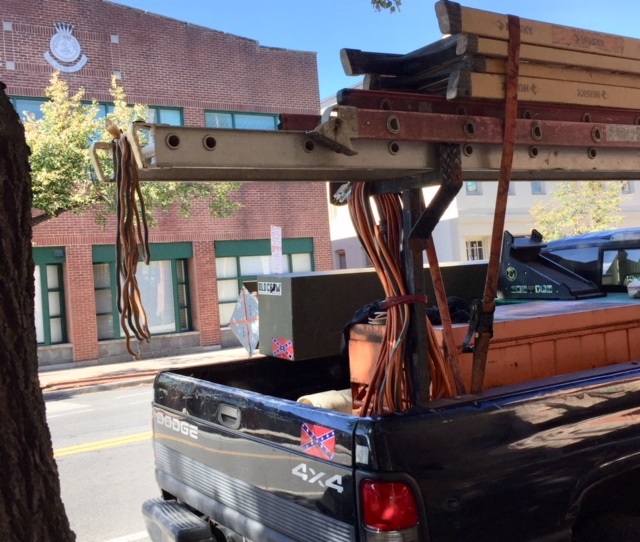
On the second day of Community Organizing Training, Renovation Guy was just arriving and I saw – for the first time – that there were two Confederate flag stickers on his truck.  One sticker could possibly be an accident.  But there were two.  He really means it.

In the training that’s sacredly agitating us this week, we were asked if we have the stomach to do this work.  In particular, do we have the stomach to work with people whose opinions we find upsetting/repulsive/repugnant?  And if we cannot work with such folks, can we even pretend to love them?

Sometimes Jesus makes me crazy.

I remember meeting a new church member years ago and asked him to tell me about himself:  “I don’t like Democrats or artists,” he said without blinking.  This was a 20-something guy who was interesting and fun, but then he had to go make it difficult.

He wasn’t kidding either.  He didn’t like Democrats or artists.  Could I love this new member?  Of course I could, because . . . Jesus.

But the Confederate flag guy is another story.  And yet . . . Jesus.

If it takes partnering with people with whom we disagree and/or have offensive opinions to change the world for good in the name of Jesus Christ, do we have the stomach to do it?  What differences in opinions/life styles/habits make people difficult for us to love.  It’s a good question for us to ask ourselves so that we might be better prepared when we meet these folks.

I don’t want my new spiritual discipline to involve loving people who attach Confederate flag stickers to their trucks.  But maybe that’s today’s theological challenge.  Befriending those with whom I disagree might be the only thing that will begin to change the culture of our country.  Loving our enemies is never easy.  Errr.

Image of RG’s truck.


Who Taught You How to Be a Leader?

Where does your average person learn how to be a leader these days?

Yes, there are still Boy Scout and Girl Scout troops.  There’s Student Government and other organizations in high school and college. Choral groups and sports offer opportunities to lead.  We have bosses in our jobs and pastors in our churches.  Who taught you how to lead?

The Rev. Andrew Foster-Connors is one of the trainers of the intensive NEXT Church Community Organizing Training this week in Baltimore and he asked this question last night:  Where does the average person learn how to be a leader?

Sometimes people “become leaders” because they are the most popular kids or the richest adults or the first person to volunteer.  But our culture is awash in people in leadership roles who have no idea how to . . .

  • Moderate a meeting
  • Build a team
  • Bolster community relationships
  • Identify, mentor, equip, and evaluate future leaders
  • Organize people
  • Organize money
  • Address conflict
  • Listen to constituents
  • Cast a vision

In the Church we preachers often lift up The World As It Should Be when we actually need to live in The World As It Is (with our eyes on The World As It Should Be.)  It’s not enough – if we take following Jesus seriously – to look at injustice in the world and say, “Well that’s just the way it is.

But we need to know how to do more than preach (or listen to) a pithy sermon.  We need to know more than how to make (or listen to) a crisp statement about The World As It Should Be.

We need to know how to lead so that change actually happens.  This is community organizing. And it’s some of what I learned yesterday.

I’d love to hear what you are doing to become a better leader.  For the world to be as it should be, we need you.


Image is Follow the Leader by W. Stanley Proctor, a public art installation in Tallahassee, Florida.


Continuing Education for a 21st Century Church

It used to be true that we pastors used our Continuing Education time (2 weeks required in my denomination) to chart out a year’s worth of sermons or bone up on preaching in general, and that’s still happening for some of us.  But considering the breadth of knowledge needed for 21st Century Ministry beyond Biblical exegesis and theology and practical resource-mining, it feels rejuvenating for us to broaden our skills for a changing church.

The pastor who baptized me many decades ago shared that the entirety of his ministry involved “only” preaching, moderating the boards, marrying, baptizing, and burying, emergency pastoral care, general visitation, and leading Bible studies.

Today – in addition to all the above – pastors regularly deal with people struggling with mental illness, addiction, PTSD, and homelessness.

Required “Good Boundary Training” sprang up in the past twenty years but in order to keep up as well-trained parish pastors, I appreciate seminaries and Mid-Councils who require  – or encourage –  training in the following:

  • Anti-Racism Training – Our overwhelmingly White denominations need to talk about race in new ways, especially in terms of understanding systemic racism and white supremacy.
  • Basic Mental Health First Aid Training – We who serve congregations could use help identifying, understanding, and responding to signs of mental illness and addiction as rates are up in a variety of mental health challenges.
  • Cultural Humility Training – We know that all Spanish-speaking people are not the same, right? That Immigrants from Nigeria and immigrants from Ghana are very different? Basic knowledge about cultural differences is good but cultural humility is better – digging deeper than cultural competence in order to better partner with our neighbors respectfully.
  • Community Organizing Training – As we consider my favorite question:  What breaks God’s heart in your neighborhood? we increasingly need skills for speaking truth to power, including how to build group-centered leadership and how to bolster one-on-one relationships for the sake of shifting power structures for the sake of justice.

What training – beyond the usual seminary Continuing Education courses – have you found to be especially enriching for 21st Century Ministry?   And maybe it’s a seminary that’s introduced a new skill you didn’t know you could use for professional ministry?

I’d love to hear what kinds of classes your Presbytery, Association, Conference, Diocese, or Congregation are offering these days for equipping leaders.  Improv?  Trauma Informed Care? Entrepreneurship?  Non-Profit Management? Juggling?  Please share.


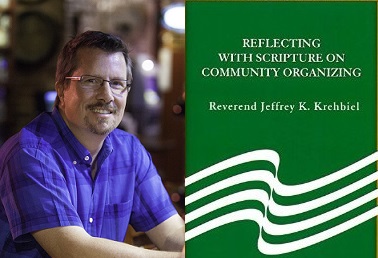
Image of my friend Jeff Kreibiel who passed away last April and the book he wrote that we used in Chicago a few years ago.  I am taking Community Organizating Training this week because it would have made Jeff so happy.  His book can be purchased here.

Using Our Power for Good

CHICAGO, IL – OCTOBER 19 : Teen Vogue Editor-in-Chief Elaine Welteroth, Uber Chief Brand Officer Bozoma Saint John, Emmy Award–winning writer Lena Waithe and singer Jamila Woods before the 2017 Chicago Ideas Week event “A Seat at the Table: Finding an Equal Footing through Storytelling.” (Photo by Tim Klein/Chicago Ideas)

“Power is the ability to change the rules.”  Rashad Robinson, Executive Director, Color of Change

I am looking for a new call, as my current employer knows, and it’s a fascinating exercise in self-reflection and calling.  Whatever God calls me to do next, I hope to have some power.

Yep.  I openly wrote that.

Power makes it possible for me to make the way clear for uniquely gifted pastors to follow their calling.  Power makes it possible to open avenues for creative new ministries.  Power is not about me (although it’s fun to wield it and share the joy.)

Rashad Robinson of Color of Change has used his power to successfully convince PayPal to stop processing the funds of hate groups and Fox to cancel The O’Reilly Factor.

Lena Waite, who spoke in Chicago last week with the editor of Teen Vogue and the Chief Brand Officer of Uber could not have inspired the audience more if she had been standing behind a pulpit.  She uses her celebrity to advance the careers of other writers, clothing designers, and actors.  She spreads the joy and the opportunities.

This is my calling too and it’s really fun.  We all need mentors and mentees. What can we teach another person and what can they teach us?

As leaders, we are only successful if our followers are being prepared to take over.  If there are any senior pastors out there, consider how you can give your associate pastors experiences that will prepare them to be senior pastors.

We’ve been hearing terrible stories in the past weeks about a Hollywood guy who used his power to assault and threaten people.  This is the day we put in a more concerted effort to use our power for uplifting and inspiring people.

Think – right now – about someone you can professionally lift up.  Let’s do it.


Image from Chicago Ideas Week.  It’s ends today but it’s back next year.  Become a member here.

This post is written in honor of ZR’s ordination to the Ministry of Word and Sacrament today in Chicago.