“What If” Wednesday: What If We Felt Safe?

hugThere’s a scene in the most recent U.S. episode of Downton Abbey when Tom Branson tells his sister-in-law, Lady Mary that he can’t tell her what’s troubling him because she would “hate him” if he did.  Actually, she could relate.

We have got to get past being the kind of church that is not safe.  Remember that we gather in sanctuaries.  And yet these sanctuaries are often cold and scary.

This post resonated with me – not because I have ever felt unsafe among followers of Jesus but – because many of my friends have.  I have a friend who was asked to leave her young adult Bible study because she and her husband were seeing a marriage counselor.  I have a friend who was too terrified to object when his church friends (or “friends”) insisted that he get electric shock treatment for being gay.  I have a friend who was removed from her church for leaving her abusive husband.

God have mercy upon us.

It’s hard enough to confess our shame.  But imagine trying to share our shame among people who ostensibly live in the image of the One who unconditionally loves, only to find themselves shunned.

What if we felt safe in church?

Many of us do not feel safe among family and friends, even when we know they love us.  We are too ashamed to share that we are addicted, we are the mothers of children given away at birth – or before birth, we are abused, we are abusive.

But what if – in spite of it all – we felt safe in church?

Image source here.

I Take The Bible Too Seriously To Interpret It Literally

zealot_reza_aslanYears ago, I was preaching a sermon series on the parables of Jesus when I mentioned that – because the writers of the gospels themselves identified the stories as parables – the story of the Good Samaritan never literally happened.  Jesus was a rabbi and this is what rabbis do:  they tell stories to explain things.

This disturbed a couple of people.  Did I mean that I didn’t take the Bible literally? (yes)  Did I mean that we couldn’t trust the Bible?  (no)  Did I mean that the Bible wasn’t true?  (no)

In a meeting of pastors who self-identify as conservative a few months ago, one of my colleagues said, “Liberals don’t take the Bible very seriously.”    Not only do I disagree, but I disagree vehemently.  Some of the same thinking – in terms of taking the Bible seriously – is explored in this book.

Most of us who self-identify as Christian do not study scripture as rigorously as Reza Aslan.  Although I don’t agree with everything in Zealot, I am unafraid of the way Aslan delves deeply into scriptural criticism.

It’s easier to read Scripture at face value, without considering the deeper meaning found via textual, source, form, historical, and canonical criticism.  Some of our brothers and sisters believe this kind of criticism is unfaithful.  But I really want to know what was going on historically, etc. in Jesus’ world.  This kind of comment by Reza Aslan doesn’t worry me:

“The readers of Luke’s gospel, like most people in the ancient world, did not make a sharp distinction between myth and reality.  That is to say they were less interested in what actually happened than in what it meant.” (p. 31)

I am most interested in what the Bible means about who God is and who we are.  My faith is not based on whether or not Jesus was born in Bethlehem or Nazareth.  It’s not based on whether or not Mary was a virgin, although I believe that Jesus was born in Bethlehem and with God, nothing is impossible.  But it’s deeper than that.

The Bible is comprised of stories, poetry, laws, lists, and some history.  But it’s not a history book, nor a science book.  It’s a book of faith.  The parable of Jonah teaches us to what extent God will go to reach us.  The parable of the Prodigal Son tells a similar story.  We were created by a God who loves us beyond measure.  Scripture speaks to this truth.

Imagine – we who try to follow Jesus – reading Scripture through the lens of a Hebrew culture rather than through the lens of western theologians and even through Paul.  Jesus was a Jewish rabbi and it’s fascinating to delve into the texts many of us consider unique and holy with an eye on all the layers.

This is what makes Scripture timeless.  And this is why I take it too seriously to interpret it literally.

What Makes a Church Integrated & Multicultural?

MLKIt’s Statistical Report time in my denomination and those stats include racial/ethnic diversity.  (I wonder if there will ever be a time when we are asked to document the sexual orientation of members.)

For the record, I am white.  In fact, for my 40th birthday, I did one of those cheek-swab kits to find out my mitochondrial DNA and learned that I am Really White.

Of the two churches I’ve served as pastor, one was 100% white and of European descent.  The other included members who were white, black and brown with members born in Europe, Asia, Africa, North and South America and Australia.  But that church was still predominantly white and of European descent.

So was my second church integrated and multicultural?  I would say no.

I currently live in a suburb that’s approximately 50% Caucasian American and 50% African American and yet one race or the other dominates most of the churches in my suburb and throughout Chicagoland.  It’s interesting how we self-identify in multicultural terms.  For example:

  • If I’m white and a member of a mostly white church, except for a handful of African-American or Asian or Latino members, I probably see my church as multicultural.
  • If I am one of those African-American or Asian or Latino members, I probably see my church as white.

What makes a congregation integrated and multicultural?  Is it possible not to have one race or ethnicity dominate?

Several years ago, a new church plant was established in my then Presbytery that was intentionally planned as an African-American church.  This is not to say that non-African Americans were unwelcome, but the preaching, music, leadership, and outreach was going to focus on the immediate neighborhood which happened to be African-American.  The church has thrived.

There was some controversy about so overtly planting a church for a particular racial demographic, and maybe that was a choice that the next generation of church planters will not make.  But when I see multicultural churches encouraged, there is almost always a dominant race in terms of leadership, styles, etc.

So here are some questions to ponder:

  • Is a church considered integrated and multicultural if the pastor is one race and the rest of the congregation is another race?
  • Is it essential that the leadership – particularly the pastors – reflect the racial/ethnic demographic of the congregation?
  • Is it spiritually and socially healthy for any one race or ethnicity to dominate a particular group in a congregation (e.g. the choir is all black, the elders are all white, etc.)

Power issues come into play, of course, and integrating a congregation seems best when it happens organically.  But the bottom line is that God’s Realm includes everybody of every color and ethnicity (and age, gift, education level, economic situation and place on the gender/sexuality spectrum.)  And don’t we ultimately aspire to be a church that looks like the Realm of God in every way?


Image of Martin Luther King, Jr. who moved to Chicago in January 1966 and preached among several Chicago congregations, including First Presbyterian Church on Kimbark.


The Problem with Talented Pastors

popart tennantIt used to be true that the pastor was the best educated person in town. We Presbyterians were all about that – historically – and our educational requirements for ordination reflected the desire to academically prepare pastors well. We were known for exegeting scripture, understanding church history, and teaching theology. One of us signed the Declaration of Independence. Another founded Princeton.

I remember one of my childhood pastors telling me – after I myself became a pastor – how hard it was to serve my home church in Chapel Hill, NC – a university town. Yes, the pastors were always very bright. But so were the parishioners. “An elder might be the head of the botany department and he assumed that he was an authority on everything,” I was told. These kinds of elders were sometimes a pain in the neck to work alongside, I was told.

But what if we – as pastors – appreciated the experts among us? Imagine if we turned to the construction workers, the bankers, the chefs, the librarians in our congregations, and then we partnered with them to serve our people and others. What it we pastors acknowledged that we cannot possibly do it all or know it all? What if we considered our parishioners to be colleagues in ministry. Imagine.

When I was a parish pastor, working with a computer science wizard, he often identified me to others as his boss. And then I would add that he was also my boss. He added immeasurably to the ministry happening in our congregation.

About once a month, we would have a tech day when he would share with me all the cool things he’d learned in the past month about social media or office machinery. And I might teach him how to do a Hebrew word study online.

This is the future of ministry. We are all in this together. The bakers in our community have much to contribute to the community. The barristas, the lawyers, the pediatricians, the anthropology professors, the middle school Spanish teachers – all have a ministry in the realm of God.

Here’s a special word to the small church pastors who Do Everything: Stop it. There are people in your congregation who can school you on all kinds of things. Let that happen.

The 21st Century Church realizes that we are connectional in terms of sharing gifts as well as nurturing relationships. And . . . the pastor can’t be the smartest person in the room.

Warholized image of William Tennant, Presbyterian Pastor and one of the founders of Princeton University.

The Pastor is the Last Person Who Gets to Be An @*#0!%

love-one-another-1-644x320It’s a naive person who believes that working in a church is all fluffy clouds and puppies.  I once worked with a church secretary who left “a stressful job” to work in our church office, imagining it would be all-peace-all-the-time.

She imagined wrong.

One of the phenomena of working in an institutional church is that some people believe they can be utterly crankitudinous human beings  – or worse – and everyone else believes we have to put up with it in the name of holy peacekeeping.

Occasionally pastors are the target of gossip, misinformation, and slander.  People yell at us or leave nasty notes.  I once had a hymnal thrown at me after an Ash Wednesday service.

But we pastors must be grown ups.

I’m not saying that pastors have to be doormats.  But we are charged with being spiritual leaders and training others to be spiritual leaders.  We are the last people who get to be @*#0!%s in our churches.  Even if we don’t like our people, we are expected to love them.  It’s not easy.

A friendly reminder to my pastor friends dealing mean people this week.

Get Me Rewrite!

life is beautifulAn article about a  ten year old lecture by Walter Brueggemann has gone semi-viral this week and it’s worth a second . . . and even a twentieth look.

We are pegged early and often as individuals with certain characteristics (clumsy, funny, shy, loud, cheap, ‘the smart one,’ ‘the screw up’) and it’s tough to shake the scripts.  Churches also live by narratives that we’ve told themselves or that others have passed down through the years.  Most of those scripts are either negative or false:

“We’ve never had any money.”

“Everybody wears mink.”  (Seriously, I heard this one recently.)

“We are a neighborhood church.”

“We do so much mission work!”

After a day-long gathering of the Commission on Preparation for Ministry yesterday – which, for you non-Presbyterians out there, is the group that oversees those in the process of becoming  professional ministers – it occurs to me that scripts play a huge role in both those who are discerning their life’s calling and those of us who serve as gatekeepers/cheerleaders in that process.  Often the scripts feed off each other:

Seminarian: “I have always been good with people.”  + CPM: “You need to work on your bedside manner” = Seminarian: “CPM is making me jump through unnecessary hoops.”

See what I mean?

It could also go like this:

Seminarian:  “I’m not a good public speaker.” + CPM:  “You have become a really good preacher.” = Seminarian:  “Whoa, maybe God really has called me to do this.”

Our hope is that the latter is the more prevalent script, but sadly that’s not how it goes.  And then the script/gossip is perpetuated:  “The CPM process is basically ecclesiastical hazing.”

How are scripts changed?

Both for individuals and for institutions, it requires authentic and compassionate analysis which is not always easy (e.g. “I really am kind of a jerk.”)  And yet, the cool thing about God and redemption and all that is the possibility that things can change.  This is my hope.


There’s a Church for That

20140109-204022.jpg

I don’t understand how cool phone apps work, especially the ones that can locate wall studs behind sheet rock and turn off the stove. But I know how cool churches work.

By cool churches, I’m not talking about screens and drums and coffee shops. I’m talking about churches that make a difference in the context in which they live:

– the churches that escort kids from school to the after school program in their building’s basement in a dangerous neighborhood

– the churches that welcome the homeless for breakfast every morning

– the churches that offer free legal clinics for the poor a couple morning’s a week

– the churches that host elder day care for local residents.

Imagine if, for every spiritual, social, physical, and emotional issue there was a church for that. So many of our congregations have lost our purpose and we can’t remember why we exist. Too few of our churches have a clear grasp of what breaks God’s heart in our communities. But it doesn’t have to be this way.

If we are willing, we can be this church- or at least something a little closer to it.

The Problem With Speaking for a Generation, Gender, Orientation, Race, Religion . . .

Lena DunhamAs a young twenty-something single pastor, I was asked to head up the Singles Ministry in the Presbytery because . . . I was single.  Was I interested in Singles Ministry?  Not particularly.  But “being one,” I must know “what they like.”

I honestly count on gay friends to be my go-to people for gay-centric questions.  I ask Muslim friends fundamental questions about Islam as if they all believe the same thing.

Here’s the problem:  expecting individual people to be the voice of their generation, race, orientation, etc. presumes there is actually a single perspective/culture for each.

While enjoying my All Church All The Time Lifestyle, I recently asked twenty-something TBC her perspective on what it would take to shift the church in such a way that Millennials would find meaningful community.  She recoiled at the question.

“I can only speak for myself, really,” she wisely responded.

I have heard and read for years that Millennials, for example, are entitled and uncommitted, but – frankly – the Millennials I know are hardworking and willing to make sacrifices to reach their goals.  It also bugs me when people of a certain generation/gender/orientation/race/religion speak for their own demographic as if they have cornered the market on the characteristics and aspirations of everyone in their cohort, whether they are real or fictional characters.

The answer to connecting with each other seems to be more about authenticity (being who we really happen to be while allowing others to be who they really happen to be) than about creating programs  “that singles will like” or planting a church “that GBLTQ people will like” or  reaching out to “young families” by making assumptions about what “they all want.”

What if we honestly connected with people by asking them about their lives, their stories, their fears?  Before we started programs, before we planted churches, before we redeveloped establish churches, what if we simply connected with people we already know and people we meet in our daily living?  What if we stopped making assumptions about each other based on age, race, religion, etc. and simply connected as individuals?

Fun exercise: read through the Gospels and list all the demographics that Jesus encountered.

Church As Warming Center

If a brother or sister is naked and lacks daily food, and one of you says to them, ‘Go in peace; keep warm and eat your fill’, and yet you do not supply their bodily needs, what is the good of that?  (James 2:15-16)

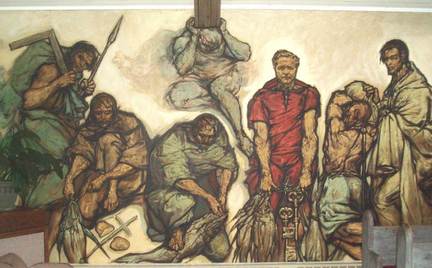
Calderon mural ProvidenceThey’re calling Chicago Chiberia and Antarcditka as I write this, with record-breaking temperatures out here:  15 below zero, not counting wind chill yesterday.

What makes me happy and cozy (snow outside, warmth inside) means stress and humiliation for others (no heat + burst water pipes + power outages = moving everyone to a warming center) not to mention what it means for people are not paid on “snow days” when their offices and businesses are closed.

I’m struck by the fact that 100% of the PADS sites*  in my South Suburban Chicago area are church buildings.  This means that Every Night of the Week, houses of worship are open to welcome homeless men, women, and children for meals and a safe, warm place to sleep.  Some of these church buildings have laundry rooms and showers.

This, my friends, is why churches have buildings.  They are tools for ministry.

While many castigate the efficacy of Institutional Church and/or Mainline Denominations, the congregations that offer their space in our area include two Evangelical Lutheran congregations, three Community Churches, two Presbyterian Church (USA) congregations, a Mennonite congregation, an Episcopal congregation, five Roman Catholic congregations, and a United Methodist congregation.   Those who stay overnight are considered and treated as favored guests.

Imagine a world in which everyone who – not only steps foot in a church space but encounters a follower of Jesus (thus creating Church Space)  – experiences “warming.”  Physical bodies are warmed  – but also spirits are warmed, cold hearts experience a little heat, compassion is ignited, a fire is lit under the indifferent.

Imagine the church being a warming center beyond setting up coffee pots and cots.  Sweet.

*PADS = Public Action to Deliver is a shelter program

Image source here.  Interesting story.

The God Who Smells Good

Oil-1-2As I prepared to preach about the magi yesterday, I found a little bottle of frankincense and myrrh in my robe pocket, left there since Epiphany 2013.  It smells heavenly.

Reza Aslan reminds us that the priests in the Temple slit the throats of animals while sweet-smelling incense smoldered, in hopes of masking the stench.  In the background common men could catch the whiff of  roasting lamb that the priests would enjoy later, on God’s behalf.

I get the sense that God not only likes sweet smells but I imagine that God  – being God – also smells quite good.  The sour smell of death is beyond God.  The stink of rot is beneath God.

One person’s hardwood mulch is another’s Chanel No. 5. What smells wonderful to a carpenter perhaps smells musty to a ballerina.

But there is something holy about certain smells that still have the power to take us someplace lofty and lovely:  angel food cake takes me to Grandmother Ethel’s kitchen, a new can of Play-Doh takes me to our children’s preschool years, sawdust takes me to the NC State Fair.

I believe in a God who smells good.  Like frankincense and myrrh.  Like baby’s skin.  Like freshly cut grass.   But God has entered a world that often stinks.  And our job is to enter that stinky world too:

“For we are the aroma of Christ to God among those who are being saved and among those who are perishing.”   2 Corinthians 2:15

Happy Epiphany.