We’re Back. What Will Be Different?

Now that most of us are back to work, how many New Year’s Resolutions have already gone out the window? Frankly I appreciate what Bernice King tweeted about resolutions:

Don’t make New Year’s resolutions. Determine what kind of everyday human you want to be. And decide if that human will be for goodness, justice, peace, and love. And envision if that human has dreams that will lift humanity. Then the moments, years, and minutes will matter.

Yes, I want to make selfless determinations and compassionate decisions, and I want to envision being the kind of human who dreams noble dreams.

AND I hope to stop eating so much sugar.  This article by Tara Parker-Pope inspires me: Make 2020 the Year of Less Sugar.  AND – not only do I know that milk, bread, and salad dressing all have sugar in them, but the Church will try to feed me such things as soon as today – my first day of Let’s-Eat-Less-Sugar.

There will be candy in the staff kitchen and sandwiches at the long meeting and cookies at every church supper.  There will be wine at dinner parties (even church dinner parties, my teetotaling friends.) There will be cake at staff birthday celebrations.  There might even be sugar on the vegetables for those of us living in the South.

How can the Church help?

It makes me queasy to consider Church to be a self-help organization. It’s true that Church can help us find forgiveness and peace and purpose.  Church can entertain us.  Church can support us through grief and addiction.  Church can open up connections in the community.  Church can even hook us up with childcare.

But the fundamental purpose of Church is not to support the members – although sometimes our call to serve means serving each other within the walls of the Church building.  The Constitution of my denomination says that the mission of the Church is one and the same with God’s mission:

“to announce the nearness of God’s kingdom, bringing good news to all who are impoverished, sight to all who are blind, freedom to all who are oppressed, and proclaiming the Lord’s favor upon all creation.”

The purpose of the Church is to fulfill God’s purposes and – yes – God wants us to live our best lives and not ruin our teeth or livers or brains by consuming too much delicious God-given sugar.  We are missing the point, though, if we think this is the only purpose of the Church: to serve, entertain, support, and delight us.

Recovery Churches exist to help those living with addiction so that they can support others.

Yoga Churches exist to help center those seeking focus and awareness so that they can focus on and become more aware of others.

Craft Churches exist to value the art of making things for the sake of sharing those creations with others.

Or something like that.

If we are healthy and have more energy, we can serve others better than if we are sick and listless.  Church World can help with this or Church World can sabotage this.  Questions to ask in your spiritual community:

  • Does our hospitality invite healthier living? (Resolution #1: More fruit and veggies and less fat and sugar at eating events.)
  • Does our culture encourage people to make confession, ask for help, accept brokenness?  (Resolution #2: More acceptance of imperfection and less shaming about messy lives.)
  • Do we reward staff, volunteers, and members who work “all the time”?  (Resolution #3: Not just more Sabbath time but any Sabbath time.)

I’ll be working on my sugar intake.  I pray our congregations will be working on healthier hospitality, broader acceptance, and remembering that even God took time to rest. Happy New Year!

Image of some of my favorite sugar sources. 

Trends That Will Determine Life and Death in the 2020s

Alan Murray – the President and CEO of Forbes Magazine – asked “some of the smartest people we know” their ideas about their predictions for the 2020s and you can read about that here and here. For the record, Alan Murray is also one of the best & brightest.

Among the ideas of Forbes’ best and brightest* include:

  • Cell-Based Meat (i.e. Plant-Based Meat 2.0)
  • More Tech Tools for Farmers
  • Increasingly “Morally Load-Bearing” Businesses in order to save capitalism.  It can’t just be about profits.
  • More Partnerships Between Business and Government
  • Less Emphasis on Academic Resumes and More Emphasis on Actual Competencies
  • Crispr Changing Our Medical Care Forever
  • Data Privacy as a Civil Right
  • Prioritization of Face to Face Contact
  • Ensuring that every Supply Chain is Inclusive and Efficient

[*Note: These are the “Best and Brightest” in terms of business and economics but Forbes didn’t ask the “Best and Brightest” in the non-profit/spiritual community world.]

Here’s my shot at Trends That Will Determine Life and Death in the 2020s – with all due respect to Alan and Forbes.

  1. Our fundamental health will be determined by what we feed ourselves everyday: the food we eat, the media we consume, the emotional environments in which we live, and the spiritual grounding we cultivate.
  2. Farmers will need more than tech tools.  They’ll also need fair compensation, and clean water and soil.
  3. Capitalism without justice for “the least of these” will result in global catastrophe and war.  Business leaders with souls will be in high demand.
  4. Partnerships between business and government, business and educational institutions, government and communities of faith, non-profit organizations and business, government and educational institutions will be the norm. We won’t excel without each other.
  5. Competencies will determine staffing more than degrees.  The minister of visitation will be the one gifted in pastoral care whether she has an MDiv or not.  That fancy degree will impress your Mom, but your inherent and developed gifts will be what gets you the job/call/vocation/position.
  6. Crispr is cool, but God will still be God.  To quote Ethel Johnston Edmiston, “It’s amazing what the LORD has let us learn.
  7. Our privacy will continue to be breached but there will always be parts of us that only God knows. Our deepest prayers will always be our own no matter who knows our geo-location or playlist.
  8. Being there for each other – face to face and live and in color – will be everything. Knowing how to create and find authentic community will be THE must-have life skill.
  9. Designing the supply chain – whether we are talking about the pipeline to call new spiritual leaders or the pipeline to recruit rural health care providers will need to ask at every step:  who is not at the table? We have got to include everyone because everyone is served best when everyone is included.  Please read this book.
  10. We will continually need to ask ourselves: Why?  Why am I pursuing this goal?  Why do I expect this outcome?  Why do we continue to do it this way? Why am I telling this story? Why does this feel right?  Why am I spending my time this way?

The 2020s are full of possibilities.  Even if you read what The Pew Research Center has to say at the close of 2019 and are bummed out about #2  (i.e. The decline of Christianity is continuing at a rapid pace in the U.S.) there is great hope and incentive to change the way we are the Church.  Happy New Year!


Is This About Me? Or Something Bigger Than Me?

I was attending a clergy ordination once and there was a Moment for Children during which the children of the church came down front to sit with the soon-to-be-ordained person for a story.

Candidate for Ordination:  Does anyone know why we are here in church this afternoon?  We were just here together this morning.

Child: Because we can worship God anytime?

CFO: No.  We are here because this afternoon because I get to be a pastor today.  This afternoon is about me.

Yikes. This person apparently never read The Purpose Driven Life much less Calvin’s Institutes.

Ministry is not about us.  It’s not about:

  • Being in charge of something.
  • Standing in front of the congregation.
  • Showing people how gifted we are.
  • Running a popular program.
  • Telling people what to do and how to do it.
  • Drawing attention to ourselves.

This is true whether we are church leaders or politicians or PTA presidents.  The questions we need to ask ourselves with every important action:

  • Is this about fear or faithfulness?
  • Is this about what’s good for me or about what’s right for the whole?
  • Is this about perpetuating my power or is it about sharing power with others?
  • Is this about myself or is it about my country, my community, my God?

We are in the throes of difficult days and 2020 will almost certainly be filled with anxiety and division. I get that many of us are in survival mode.  But we have to trust in something bigger whether – for you – it’s God or Country or Cosmic Justice.  We are called to a higher purpose.

May God bless our nation as our nation is divided and our institutions are no longer as trusted as they once were.

Although I don’t agree with everything Rick Warren or John Calvin have written, I do believe that life is not about me.  And it’s not about you.  The future of our world depends on understanding this.

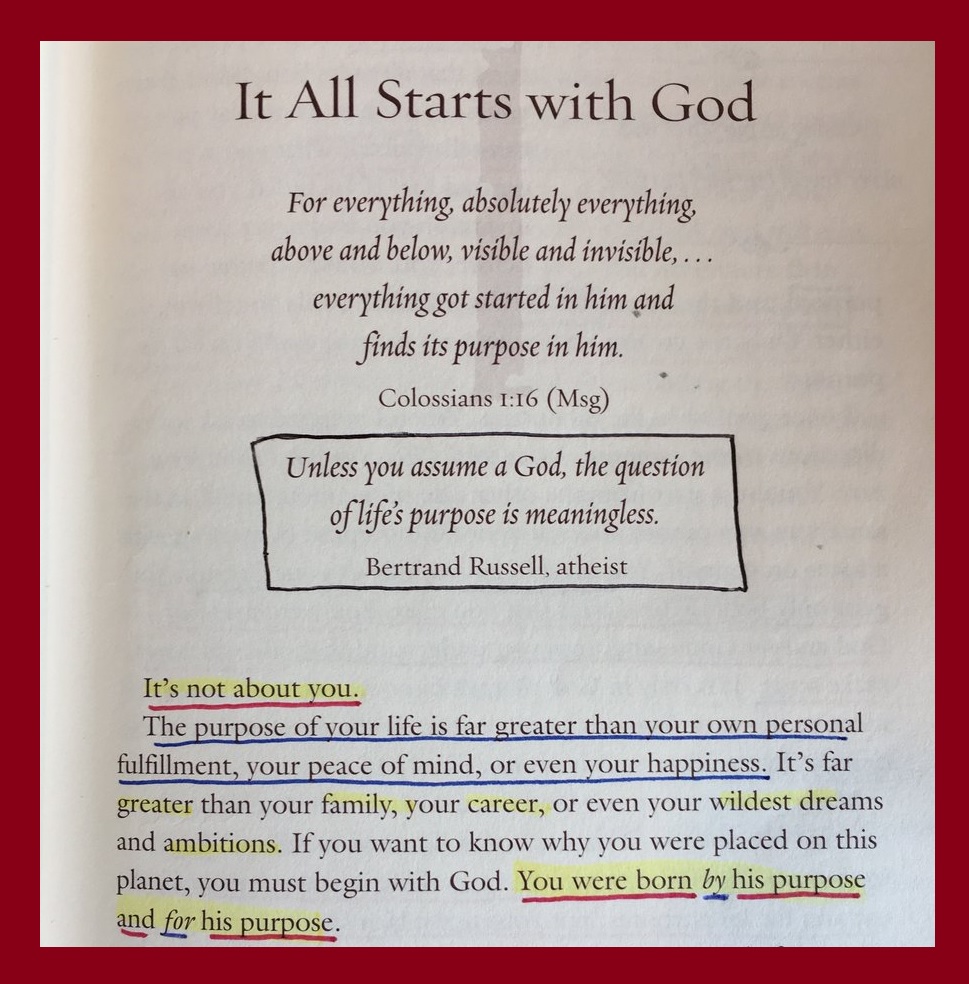
Image is the first page of Rick Warren’s book A Purpose Driven Life.

Church Mergers – And That Time God Merged with Us

‘The Holy Spirit will come upon you, and the power of the Most High will overshadow you; therefore the child to be born will be holy;‘ Luke 1:35

I preached last weekend among a congregation celebrating the 50th Anniversary of the merger that created them.  Two churches came together on December 14, 1096 and became a new church with a new name.  They used the building that one of the two churches had historically owned.  These days their congregation is small and currently without a regular pastor.  Would we say that this was a “successful” merger or not?

Congregations merge together for a variety of reasons.  Some merge for the sake of survival.  Perhaps if they merge and “become one” they will not only survive, but they will thrive with more people and more capacity to serve others.

Some merged congregations “become one” in name only. All too often one church is absorbed by the other and it’s painful when a congregation loses their identity.  Many mergers ultimately fail.

Please read this recent article in Christianity Today about church mergers.  New ways of merging congregations might be our call for the 21st C. Church.

In this season, we remember that God merged with humanity in a particularly intimate way.  Did that merger “work”?  Yes and no.

Although Jesus modeled what an life obedient to God looks like, few of us live our lives in Jesus’ image.  And how do we know that we are living in Jesus’ image?  Jesus explains it this way:

“The blind receive their sight, the lame walk, the lepers are cleansed, the deaf hear, the dead are raised, and the poor have good news brought to them.” Matthew 11:4-5

Church mergers that “work” are the ones during which congregations seek to become one with God.  The fruits of these mergers including healing and hope in the neighborhood.  People who have been blinded by anger and bitterness regain their sight.  Those who cannot walk alone find support until they can steady themselves. Today’s “lepers” are welcomed.  Resurrection is a daily occurrence.  And the poor don’t have to look for good news; it’s brought to them wherever they are.

100% of our thriving congregations understand that God is With Them as surely as God was with Mary.  She joyfully welcomed that mysterious news that the Holy Spirit would come over her.

How many of our congregations are excited about the Holy Spirit coming over us in the new year?  This is the kind of merger that makes all other mergers – with other congregations, with other organizations, with the neighbors – possible.  We who serve in the image of Christ – or try to – can expect amazing things to happen.

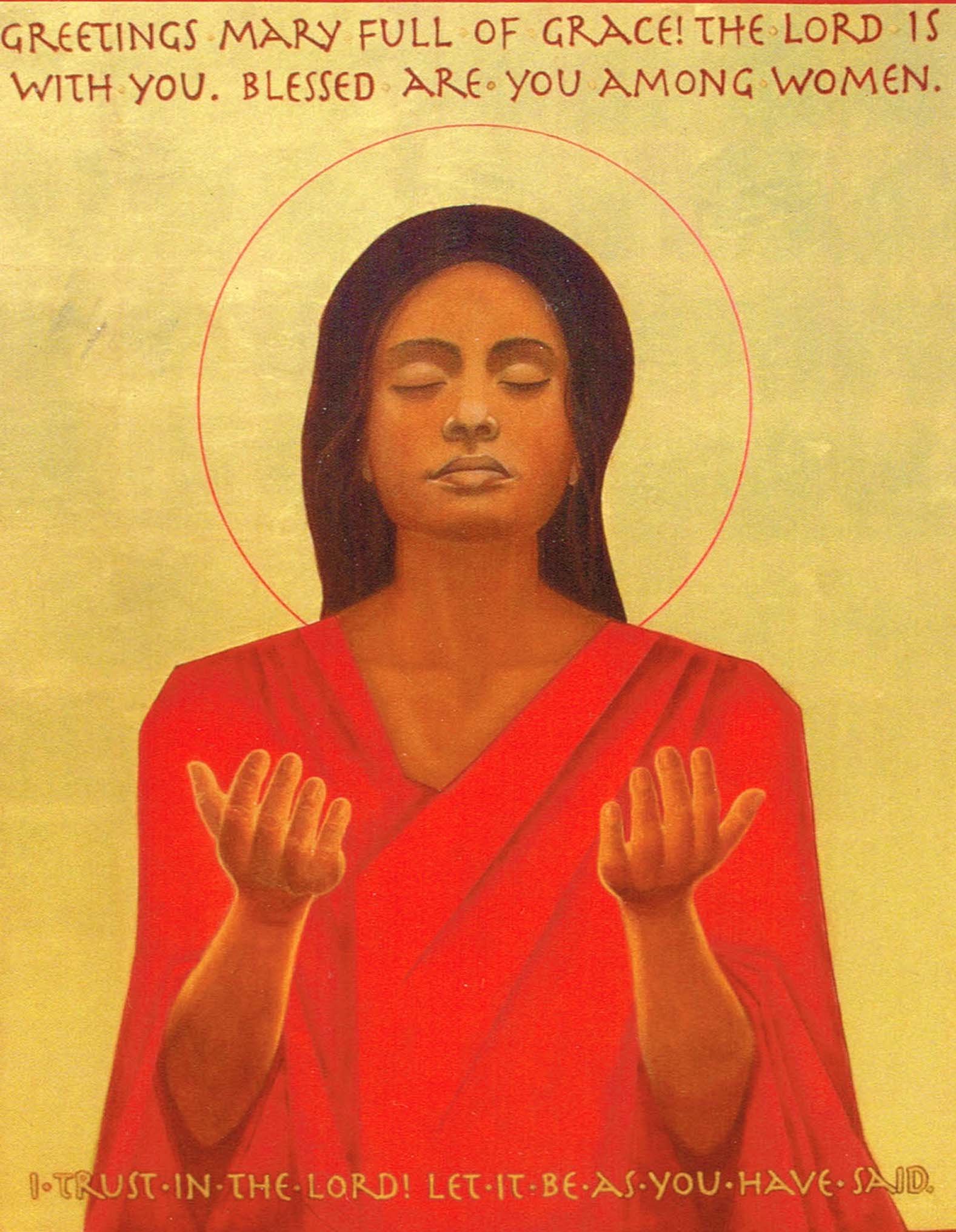
Image source here.

Do We All Need a PJ Day?

My family wears pajamas all day every Christmas.  As a double-pastor family, we found that it was the single day of the year that no one from church called – unless there was a catastrophic emergency.

We hang out. We drink coffee and cocoa. We watch movies.  We nap.  We play board games.  It’s like heaven.

This article asked the question last week:

What if, in 2020, the change voters want is actually a pause — not for the long expanse of 8 years but for 4, time to recover from the craziness of life . . .?

As the article suggests, my teeth hurt from all the crazy, the backbiting, the brokenness.  I am not promoting any particular candidate (although the WaPo article is), but I’m loving the idea of a national PJ Day when we hang out with people who agree with us and people who disagree with us.  Let’s drink coffee and cocoa together.  Let’s watch movies and nap and play board games.

We need a little time to reset our priorities and temper our tempers.  The alternative will only continue to rip our nation apart.

Can we do this? Take a political breather?

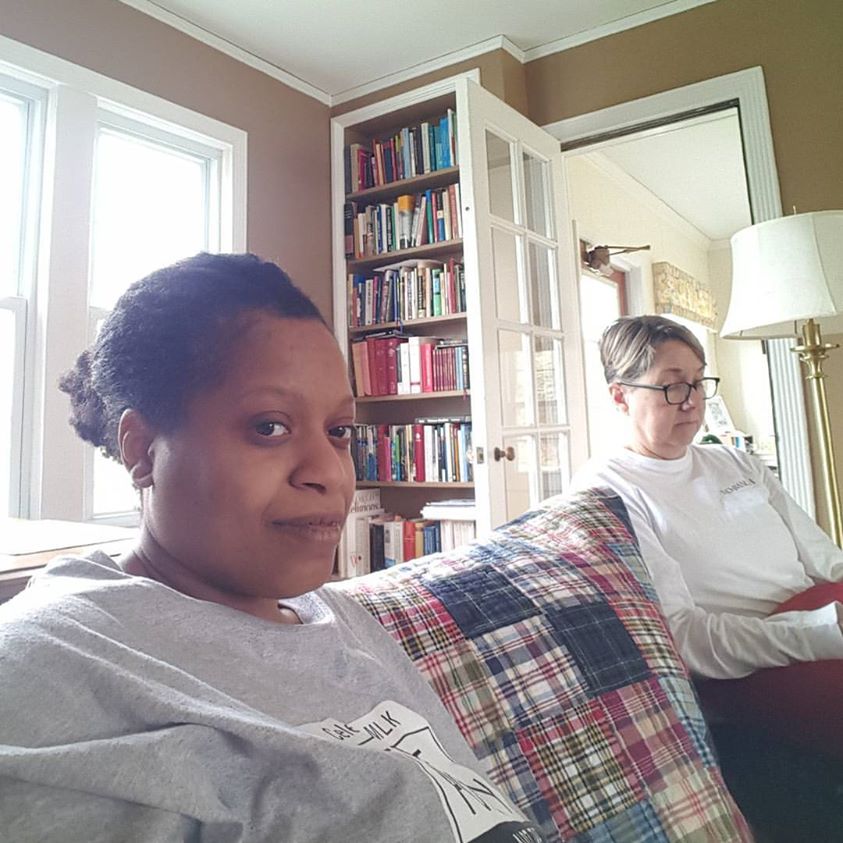
Image of the Co-Moderators of the 222nd General Assembly of the Presbyterian Church USA that time they took a PJ Day in 2017.

When Was the Last Time You Had a Friend Murdered?

This video is about 7 minutes long, but it’s worth it.

Brooks Sandwich House from Southern Foodways on Vimeo.

Scott Brooks (the one in the red shirt in the video) was murdered a week ago today while opening his sandwich shop in the NoDa neighborhood of Charlotte.  The loss to the neighborhood and beyond is immeasurable.

The next day, in the Charlotte City Council Meeting, Councilman Braxton Winston was interrupted while sharing a story about Mr. Brooks. The story was ostensibly going on too long. (Winston has been speaking for four minutes.)

Shocked by the interruption, Braxton Winston asked this question:

When was the last time you had a friend murdered?

The sudden loss of a loved one is always shocking. Accidents.  Heart attacks, Suicide, Embolism.  It’s an unbelievable jolt to our deepest parts.

I can only imagine the sudden loss of a loved one from murder.  I have – personally – never had a friend murdered.  The father of a friend – yes.  The friends of friends – yes.  But I’ve never lost a personal loved one to murder – yet.

The City of Charlotte noted it’s 103rd gun murder with Scott Brooks’ murder last week.  It’s a every day occurrence now to hear about a school shooting, the shooting of a police officer, the shooting of local business leaders, the shooting of people while they pray, the shooting of people on military bases.

It’s just a matter of time before each of us know of someone who has been murdered by guns. 

If we don’t do these things:

  • teach empathy,
  • learn that each person is a child of God,
  • correct gun purchase loop holes,
  • ban military grade weapons for civilians, and
  • bolster mental health care . . .

. . . then knowing someone who was murdered will become as common as knowing someone who died from cancer.  We all know someone who has died of cancer and I pray that one day, that won’t be the case either.

I also pray that the things that lead to gun violence will be corrected.  But it will take more than prayer, my friends.  We have the power to step up and do something in accordance with what God has commanded.

This article about Scott and David Brooks and their father C.T. is well worth the read – especially the part about their donation of property to build affordable housing in Sharon Forest, Charlotte.  In life and in death, we belong to God.

What’s Beautiful About the World Today?

I’ve been lifting up some heavy topics lately and it might give you the idea that I’m no fun.  Actually I have a lot of hope.  I especially have hope for the Church.

Among the most beautiful sights I’ve beheld lately:

  • A newborn surrounded by tired parents who clearly love her with all their being.
  • A photograph of two young people so in love I can feel the electricity from here.
  • A family gathered around a Thanksgiving table holding each other close, in spite of a tough year.
  • A Christmas card featuring ten month old twins so happy that I had to hang the card where I can see it while I cook.

I’ve also seen evidence that many of the blind are receiving their sight, the lame are walking, the lepers are being cleansed, the deaf can hear, the dead are being raised up, and the poor are having good news brought to them.  There are beautiful things happening in this world.  And we can be the ones who notice those beautiful things and tell others – in spite of the world’s darkness.

Have a lovely Friday.

Telling the Truth Could Get You in Trouble

My parents always told us that if we told the truth – even if we did something wrong – we would never get into trouble.  Telling the truth would keep us safe.

When I was a young child, my three siblings and I “trimmed” Mrs. Green’s rose bushes/wrecked havoc on Mrs. Green’s garden and left evidence behind which convicted us: a hedge trimmer labeled “Edmiston” in red.  With evidence in hand, Mrs. Green marched over to our yard and told our parents about The Great Rose Bush Destruction of 1964.

Our parents lined us up and asked each of us individually:

Dad:  Jan, did you “trim” Mrs. Green’s roses?

Me: Yes sir.

And then Dad went down the line to my first brother, my second brother, and my little sister and after he asked each of them “Did you trim Mrs. Green’s roses?” they individually responded “No sir.”

They lied.

Two other things happened that day:

  1. I got a spanking (and my siblings did not.)
  2. I learned that telling the truth would not keep me safe.

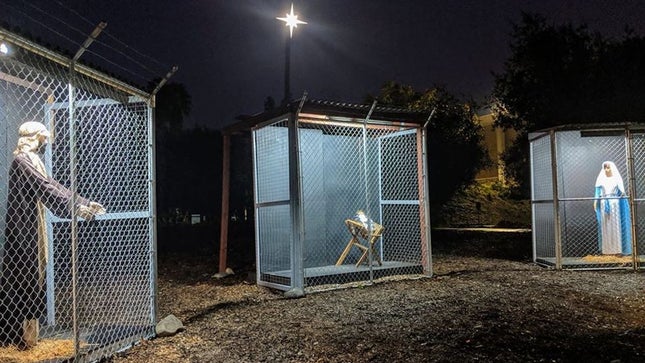
The nativity scene on the grounds of Claremont United Methodist Church in Claremont, California has attracted a great deal of attention including angry responses because they have tried to tell the truth this Advent.  The truth is that:

  1. Jesus was born in a cave used to shelter animals.
  2. Jesus was a refugee in Egypt along with his parents.
  3. Jesus was a minority in the Roman empire.
  4. We who believe what the Bible says: that the way we treat “the least of these” is the way we are treating Jesus are aggrieved about the separation of families at the southern border.

The detainment camps. The Mylar blankets. The cages. The lack of vaccinations and health care those who have fled violence and poverty.

This looks nothing like the hospitality God requires.

So here’s the thing: Sometimes we get into trouble when we tell the truth.  My parents got it wrong many decades ago (and we have laughed about the fact that my siblings got away with something.) But we have got to tell the truth about what our nation is doing in the world – even if it gets us in trouble.

I love our country.  I love the good we have done, the peace we have promoted, the industry we have developed.

But what we are doing on the border is wrong.  And that is the truth.

The story of Christmas is so much more than welcoming gentle Jesus, meek and mild.  It’s the story of God showing us what perfect loves looks like.  And that very truth got Jesus executed.

People might get angry when we tell the truth.

Image from The New York Times story on Claremont United Methodist Church.  May God bless their pastoral staff and congregation.

It Started with Jokes About “Triggering” (Is Your White Child Being Groomed by White Nationalists?)

[Thank you MA for inspiring this post.] 

My heart breaks for the parents of the terrorist in the November 29 London Bridge attack. I refuse to include his name here.

His parents are not radicals.  They do not condone violence.  And yet their son perpetrated a terrible crime in a public place resulting in the death of two people and the trauma of hundreds.

What radicalizes people who grew up in moderate and “good” homes?  A local mosque in Charlotte holds classes for parents to help them notice signs that their sons are becoming radicalized.  They are trying to inoculate their children from those who would twist authentic Muslim principles.

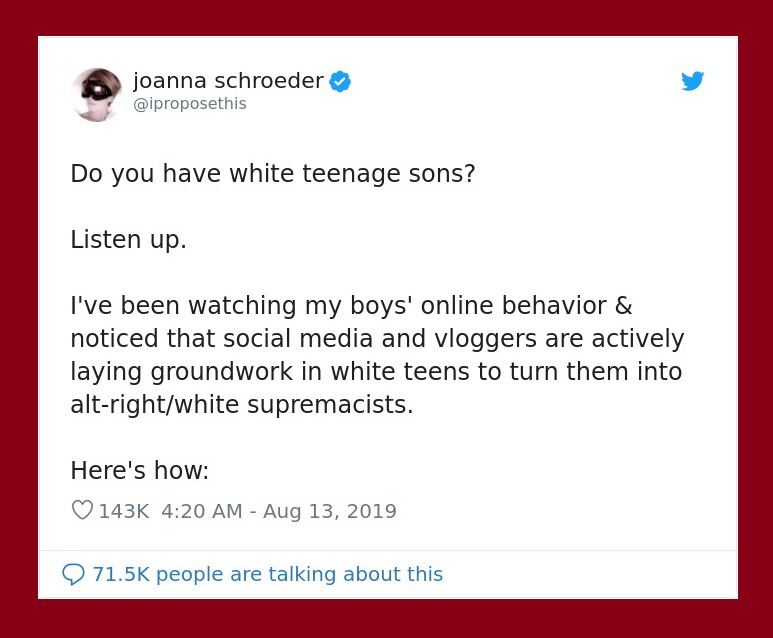
White Parents: please pay attention.  We also need to be trained in identifying signs that our children are being groomed by white supremacists/white nationalists.  It’s increasingly common in the suburbs, in small towns, everywhere.

Joanna Schroeder is Twitter-famous for tweeting the message above about her white teenage sons.  (You can read the whole stream here.) And since that tweet Ms. Schroeder has been featured in The Washington Post, The New York Times, and on NPR regarding the subtle radicalization of white boys and men.

“I’m not stupid enough to like a Hitler meme on purpose, Mom,” he said. “And anyway, I’m sure my friend shared it to be ironic.”

I know at least one young white men who dons a MAGA hat at his high school because “it makes people mad and that’s funny,” he told me last summer.  But I suspect that he wears it for reasons other than self-entertainment.

From Ms. Schroeder’s opinion piece in The New York Times:

According to Jackson Katz, author of “The Macho Paradox: Why Some Men Hurt Women and How All Men Can Help,” it’s not necessarily the ideology behind white nationalism, anti-feminism or the alt-right that initially appeals to young white men and boys as much as it is the sense of being part of a “heroic struggle.”  Participating in the alt-right community online “offers the seductive feeling of being part of a brotherhood, which in turn validates their manhood,”

Parents of white children: it’s not enough to model kindness and respect.  We need to talk in depth with our children about what happened in Charlottesville and El Paso and Pittsburgh and San Diego and New Zealand when angry white men lashed out at Jews and Muslims and any human beings who can be “otherized.”  White nationalism can be subtle or it can be blatant.  Some of the more blatant white nationalism comes out of the mouths of our elected officials.

I don’t intend for this to be a politically partisan post.  I intend for it to be a spiritual post.

  • We have got to teach our children that all human beings are created in the image of God.
  • We have got to teach our children that every major religion teaches that we were created to love our neighbors as ourselves.
  • We have got to talk to our kids and not allow social media to teach them how to think.

Short of inviting Joanna Schroeder to come to Charlotte, N.C. to teach parents here how to identify when our children are becoming radicalized, do you have ideas about others who could address this issue with parents?

Any former white nationalists out there who want to share past grooming secrets for the sake of squelching white supremacy?  (This is a serious question.)

PS Here’s the link to a free PDF resource called Confronting White Nationalism in Schools: A Toolkit.  It could be a valuable tool for churches.

Lower image from story about California high school party during which the teenagers made a swastika and saluted Hitler. (March 2019)


Tarheel Born. Tarheel Dread.

With lux, libertas — light and liberty — as its founding principles, the University has charted a bold course of leading change to improve society and to help solve the world’s greatest problems. 

(From the Mission and Values Statement Approved by the UNC Board of Governors, November 2009 and February 2014.)

When Silent Sam –  a Confederate monument – was dedicated on the grounds of the University of North Carolina in 1913, the University Band played “Dixie” and Julian Carr, a UNC graduate, Trustee and Civil War veteran spoke these words:

One hundred yards from where we stand, less than ninety days perhaps after my return from Appomattox, I horse-whipped a negro wench until her skirts hung in shreds, because upon the streets of this quiet village she had publicly insulted and maligned a Southern lady, and then rushed for protection to these University buildings where was stationed a garrison of 100 Federal soldiers. I performed the pleasing duty in the immediate presence of the entire garrison, and for thirty nights afterwards slept with a double-barrel shot gun under my head.

Lord have mercy.  Christ have mercy. Lord have mercy.

It was the United Daughters of the Confederacy who first proposed the monument in 1907 and most of the funds raised to design, build, and erect the monument came from the same Julian Carr who “horse-whipped a negro wench.”

Yes, there were students who died in the Civil War along with brothers and fathers and friends.  But it was a treasonous war.  It was a war about heritage alright – but it was the heritage of owning black and brown human beings.  It was about states’ rights for sure – but they were the rights of states to legalize the buying and selling of human chattel.

They/we lost the war.  (My great, great grandfather died at Antietam fighting for the Confederates.)  This was a war to perpetuate the sin of slavery.  It was a war about white supremacy.

I was born and raised in Chapel Hill.  I graduated from the University of North Carolina.  I have sung about being Tarheel born and Tarheel bred (and when I die I’ll be Tarheel dead) all my life.

Today I am sick about my UNC heritage because of this.

Regarding the Confederate Statues in the southern states as well as the statues of slaveholders in the northeast states (looking at you Peter Stuyvesant)  – I understand that we do not want to cover up our nation’s history even when that history is shameful.  Some people say that – instead of removing statues of George Washington and Thomas Jefferson and Peter Stuyvesant -historians should add plaques that remind us that each of these famous men were among the largest slaveholders in our young nation.

A plaque probably wouldn’t have worked in the case of Silent Sam. For decades and decades many UNC faculty members and students tried to remove him until he was finally pulled to the ground on August 20, 2018. A plaque wouldn’t have kept students from pulling him off his pedestal.

And then this happened last week:  The UNC Board of Governors not only gave Silent Sam to the North Carolina Division of the Sons of Confederate Veterans.  They also gave the the Sons of Confederate Veterans $2.5 million.  

The Board of Governors of my alma mater gave $2.5 millions dollars to an organization who – on their own web page – identifies its purpose to be:

Preserving the history and legacy of these (Confederate) heroes so that future generations can understand the motives that animated the Southern Cause. 

Slavery is what animated the Southern Cause.  Slavery.  It was slavery.  It was the heritage of slavery.  It was the right to own slaves.

And preserving that heritage today perpetuates white supremacy.  The Sons of Confederate Veterans is a white supremacist organization.  [Friendly reminder:  we don’t have to wear klan robes or march with tiki torches to be white supremacists.]

The year Silent Sam was dedicated was also the year that Joe McNeely was lynched in my current hometown of Charlotte, NC on the ground where the Panthers play football.  White supremacy was the law of the land in those days.

And we are kidding ourselves if we don’t believe that white supremacy is still in the air we breathe.  Giving an organization whose existence is a tribute to white supremacy 2.5 million dollars is no way to bring light and liberty.

The “bold course” would have been for SOMEBODY on the Board of Governors to acknowledge that – if we indeed want to be an institution of higher learning known for  “leading change to improve society and to help solve the world’s greatest problems”  we would have put this monument in a museum and offered anti-racism training to people of all ages.  For the love of God, you don’t encourage the ones who still believe that white people are superior to non-white people by paying them millions of endowment dollars.

I am so ashamed of this Board of Governors.  This is not who I hoped we were.  But the Board of Governors has declared loudly that – yes – this is indeed who we are.