Yes, It’s a Call – And . . .

I’m grateful for the heartfelt comments about yesterday’s post.  Some comments were basically about call.

The thought that professional ministry is now a “job” rather than a “call” is painful because it presumes that issues like “climbing the professional ladder” and “seeking a church that can pay more” would be expected.   Actually, by God’s Spirit, some pastors are called to small congregations who can barely pay a minimum salary.  Some are called to larger churches in poor communities.  They will never earn the salary of a rich Big Steeple church pastor.  And this is not fair.

It’s also true that when the congregation expects their pastor to sacrifice family time it’s painful.  As I wrote in a Facebook comment yesterday:

My biggest regrets in parish ministry have been those times when I chose my congregation over my family.

  • The church treasurer’s daughter was scheduled to get married on Saturday and on the Wednesday before, my mother’s skeleton basically collapsed as a result of the breast cancer that had spread to her bones.  I flew home to be with her Wednesday night, but my clergy spouse stayed behind to officiate – which was a blessing to the bride and groom.  But my husband didn’t get to say good-bye to my mom or be with me in those holy hours.  Mom died on Friday. HH officiated the wedding on Saturday.
  • A beloved church member’s daughter wanted to get married on May 5th which is great except that May 5th also our TBC’s birthday.  TBC was hoping for a Friday night slumber party (but I would have a wedding rehearsal that night and all the wedding events the next day.)  I worked it out and did it all: the rehearsal, the wedding (but no reception), and the slumber party. And I learned that I would never be available for weddings on my children’s birthdays again.
  • I missed Senior Night for FBC’s last lacrosse game in high school because I had a Session Meeting.  Yep.  I was that mom who missed my child’s event because of a meeting.

Our calls are indeed “work.”  And it’s good to balance church expectations with family expectations.  The more children the pastors have, the more parenting events they will either 1) miss or 2) attend at the risk of hearing punishing comments from parishioners about “taking too much time off.”

It’s not called Tug of War for nothing.

Someone asked yesterday how to change this culture, and it’s basically about love and respect.  If I love my people as their pastor, my hope is that they will respect my need to spend time with my family.  (Note: for single pastors, you too need to spend time with your family of origin/chosen family.)

So – yes, professional ministers* are called and not merely hired for a job.  And also I ask you who are church members:

What family event would you be willing to miss for your job?  

And can we be the kind of church family that encourages our pastoral leaders to take at least one day off a week, all their vacation time, and all their study leave time?

Healthy Pastors = Healthy Congregations.


* I use “professional minister” not to emphasize professionalism but to distinguish between Ministers of the Word and Sacrament and ministers who are The Baptized, called to the priesthood of all believers.

A Post for Congregations Seeking New Pastors (And a Trend I’ve Noticed)

Age is just a number, and yet many pastors slow down after serving in professional ministry for 30+ years.  We are tired . . . unless we find these 21st Century ministry shifts to be exciting and gratifying, and we are committed to un-learning much of what we learned in seminary back in the 1970s -1990s.

Even a 30 year old pastor can offer tired leadership and a 60+ year old pastor can offer energized leadership.  It just depends. I’m talking about generalities here.

I wrote this post five years ago and unfortunately it hurt the feelings of some of my 60-something colleagues.  Some called it an example of age-ism.

As you read today’s post you might accuse me of being unfair to pastors under 40.  But here goes . . .

As I talk with leaders all over the country – mostly in my own denomination – I’m seeing an interesting trend: some congregations who have called “young pastors” have regretted it.

[Please note:  This doesn’t mean that all young pastors are ineffective.  It doesn’t mean that all churches you’ve called young pastor are dissatisfied. It means that congregations and the youngest generation of pastors often have different expectations for ministerial leadership.]

Over the past 10 years or so, most of the congregations I’ve worked with have sought out pastors in their 30s or early forties to be their solo pastor/senior pastor in hopes that a young leader will attract other young people with young kids.  Here is what they have found (and again, these are generalizations):

  • Parenting has changed just as much as congregations have changed.  Younger generations of parents are less willing to sacrifice their families for their careers.  They are seeking a little more balance, and this often conflicts with congregations who expect their pastors to be available every weekend and most nights.
  • Younger pastors want to Get Things Done in a way that makes some congregations feel uncomfortable.  Most denominational congregations have entrenched cultures that makes change difficult.  It takes a long time – sometimes a decade –  to build trust and relationships before the culture can be identified and shifted even an inch.

Although members of Gen X and Gen Y have been patiently waiting for Baby Boomers to retire, I’m seeing Pastor Nominating Committees look for seasoned pastors who know how to shift the culture of traditional churches.  Those pastors look like the older generation of members, and yet they have 21st Century Ministry chops.

I believe that the most effective professional ministers of any age have these things:

  1. The tools to shift a congregation from a mid-20th Century culture to a 21st Century culture for the sake of the Gospel.  They ask the “why?” questions.  They model relationships over regulations.  They remind everybody that the church is not a club; it’s a community that exists to be Christ in the world.
  2. Good boundaries.  No pastor should be working every day and every night.  A healthy pastor has friends outside the congregation. A healthy pastor equips others to do ministry rather than doing it all themselves.
  3. Emotional intelligence.  Being able to interact with a wide variety of human beings is essential.  Healthy pastors are not moody, egotistical, bullying or controlling. On most days.

Especially for those churches whose pastors are now retiring at the age of 70-something after serving for multiple decades, it might seem tempting to call a 32 year old pastor next.  Chances are, though, that the resulting jolt might too dramatic for that pastor to be successful – no matter how gifted they are.

I suggest that after a long term pastorate with a retiring pastor, some congregations seek out seasoned pastors with energy who know how to lead the church into 21st Century ministry.  Maybe those leaders are 40-something and maybe they are 60-something.  It totally depends on who that pastor is.

Interesting enough, I’ve heard of several congregations over the past year who have called and installed 65 year old pastors, ostensibly five years from retirement.  Hmm.  That could work for several reasons . . . and it could be a longish buffer between the old way of being the church and a new way of being the church which will prime the congregation for calling a 30 or 40-something pastor in five years.

Would love your comments, even if this post makes you angry.

Image source here.

Is Church Helping You Make Real Friends?

A parishioner once told me that she didn’t need to make friends in church.  She already had friends.  There was her church life (worship, Bible study, meetings) and there was her friend life (job, dinner parties, margaritas.)

That was 30 years ago and I wonder if the same is true today.  We have divided lives and what happens on Sunday doesn’t necessarily impact what happens the rest of the week.

This article: Why You Never See Your Friends Anymore is not about church.  And yet it teaches us about 21st Century Church World.

In a nutshell:

  • Digital access makes it possible for us to work all the time.  A friend mentioned to me yesterday that he got a Committee on Ministry call while on vacation in Idaho recently.
  • Most people do not work a 9 to 5 schedule Monday – Friday.
  • 80% of those working for hourly wages have a fluctuating schedule which means they cannot count on having the last Friday of the month off to meet a friend. “Forty percent of hourly employees get no more than seven days’ notice about their upcoming schedules; 28 percent get three days or fewer.”
  • In a gig economy with multiple jobs, it’s hard to schedule down time.
  • Those with salaries are often expected to be available particularly long hours – and weekends.

All this translates into less time with both families and friends.  Some of us lsee the people we live with, but just barely.  Judith Shulevitz writes

I’m nostalgic for that atmosphere of repose—the extended family dinners, the spontaneous outings, the neighborly visits. 

There is less time it seems for “shared hours” between people who want to be together. And while some people want to be with their spiritual communities to the point of making it an intentional event in their lives, more people increasingly do not have the need to have an intentional spiritual community – much less hang out with them on a weekly basis.

The ramifications for Church are obvious:  fewer people are free to gather for Sunday services, fewer people want to gather for Sunday services, and Sunday services that perpetuate the busy-ness are missing the point of Sabbath.

And so how about we who lead congregations ask ourselves two questions:

  1. What about our system stresses an already stressed out people?  Do we make it easy to participate?  Do we shame people into volunteering or participating in activities?
  2. Are we authentic with each other?  I will indeed divide my relationships into “friend groups” and “church groups” if I cannot tell the truth about my own imperfections.  (Yes, I drink a little.  Yes, I see a therapist.  No, my children are not going to win Nobel Prizes.)

Just two questions.

Deep relationships are what God intends for us for the purpose of community-making and support.  If you had a crisis, who would you call after 911?  Maybe it depends on the crisis.  But I hope that whomever we call also commits to praying with and for us.  And bringing us soup.

Image of M2M worshiping community in Charlotte.  Interesting idea: There’s a church in Florida that offers an occasional Wine Study and Bible Tasting.

Indigenous

Chances are you’ve never heard of the Saponi Tribe.

They are the indigenous people of Western Virginia and the Piedmont area of North Carolina, related to the Catawba. The first settlers from Europe met the Saponi in 1670, and my ancestors from Ulster colonized the same area about 65 years later. According to the Rowan County North Carolina History Project:

The Saponi and Catawba were the first Native Americans to reside in present-day Rowan County.  German and Scotch-Irish settlers from the northern colonies of Pennsylvania and Virginia, traveled the Great Wagon Road to Rowan. Farmers took advantage of the fertile soil in Rowan and the county grew throughout the 1740s and 1750s.  

By 1837 all the indigenous people had either succumbed to disease, died in war, or been driven out of the area.  My family has lived there since the mid-1700s.

To be indigenous means that you were the original occupants of the land.  It means that your ancestors did not take the land by invasion.  The Saponi were – as far as anyone knows – the original occupants of Rowan County, North Carolina and they are long gone.  But I still have family there today.

This is information I need to know as a human being.  And today – Indigenous People’s Day – is a good day for all of us to do a little research.

Who lived at your current address before you lived there?  And who lived there before them? And before them?  And before them?  Once long ago there were original occupants of the the land where we currently live.  It’s important that we know what became of them and their descendants.

  • Were they killed in battle?
  • Were they forced to resettle?
  • Were they exposed to disease brought in by colonizers?

It’s important to know because – at least in my own understanding of theology – the sins of the world are corporate sins.  Although I didn’t personally displace any Native Americans, I have benefited from the actions of those who did.  It’s something to remember when we congratulate ourselves for “being blessed” with success and prosperity.

I am indeed blessed.  I would also call it white privilege. I enjoy the enormous privilege of having pale skin and European ancestry.

This is the day we remember the original occupants of the United States of America.  This is the day we ask God to help us be better human beings than we’ve been in the past.

Image from the June 2019 Saponi Nation Pow Wow in Burlington, North Carolina.

What We Don’t Need

Worshiper after hearing Diane Moffett preach:  That was a good sermon.

Diane MoffettWe’ll see.

How many of these activities have a real impact in the community?

I love this story from the Rev. Dr. Diane Moffett because she encapsulates the importance of impact in the 21st Century Church.  If we are not making an impact that brings authentic change, “a good sermon” is merely an interesting talk.

This is also true regarding so many activities of the Church:  the book study, the Bible study, the dinner, the fundraiser.  Our congregational calendars are full of activities that show how busy/successful we are when the reality is that we are merely enriching our own minds and social networks without holy impact.

These kinds of activities are killing the Church.  It feels like we are doing something.  And yet if what we are doing doesn’t change our own hearts and minds, much less our communities we need to stop.

What we don’t need are:

  • Task Forces that finish a task (or not) and yet their work has zero influence regarding who we are as a Church.
  • Film Series that entertain us but fail to inspire community action.
  • Speaker Series that make us smarter but nothing changes in our behavior or spiritual practices.
  • Youth Programs that delight the kids but do not deepen relationships with other kids or adults or God.
  • Bible Studies that we find inspiring but our behaviors remain the same.
  • Fundraisers that cover the general budget but the neighbors are still hungry.
  • Branding plans that make our congregation/denomination seem more impactful than we really are.

If we are serious about gutting systems of racism and sexism, if we truly hope to uproot injustice that hurts the poor, the uneducated, the sick, “the least of these” then we have hard work to do.  A book study won’t cut it.  A speaker from the local college won’t make much of a difference.

Those things are helpful in preparing us for the task at hand.  But they are not – in and of themselves – the task God created us to do.

We have to speak up and act out – in the image of Christ.  Please remember — my friends who complain when the pastor is “too political” — that Jesus confronted the political powers for the sake of setting the oppressed free.  You can look it up.

Yes Jesus comforted the afflicted but his healing miracles were controversial.  He dared to heal a bleeding woman and lepers.  He dared to touch the dead.  He told outrageous stories (parables) that have become so tame in our hearing that we forget how they infuriated First Century hearers.  His sermons would offend the Purple Church.

And so let’s honestly ask ourselves:

  • Was it a good sermon?
  • Was it a good program?
  • Was it a good meeting?

We’ll see.  We’ll see if the fruits of those events make a difference in our broken world.

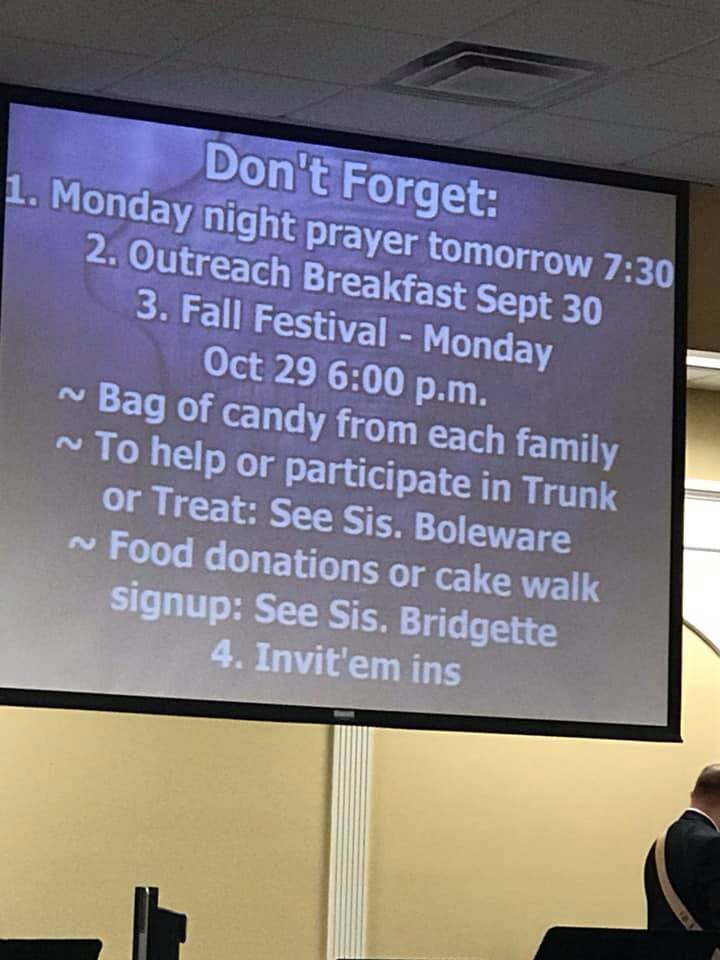
Screen with a list of church announcements that make me tired.


Gutted

There are four times in my life when I’ve felt gutted.  I’ve felt desperately empty and lost and alone in the world – except for God.  I’m grateful that I also felt God’s presence during those times of utter brokenness.

Consider other things that are “gutted”:

  • Fish (gutted of their insides)
  • Organizations (gutted of their staffs for financial or political reasons)
  • A home being remodeled (gutted of its walls)

This week at the CoInspire Conference (the name comes from “conspiring” and “inspiring“) the idea is to Liberate Imagination and Eviscerate Racism.  Liberating imagination sounds lovely and creative.  Eviscerating racism sounds violent and scary.

During one of the talks yesterday with three scholars on a panel (the gifted Jen Harvey, Raj Nadella, and Lisa Dellinger) one of them noted that . . .

(When trying to be anti-racist) there’s a difference between welcoming and including people who don’t look like we do and eviscerating what we hate.

We tend to address the symptoms of racism rather than destroying the root causes of racism, mostly because we don’t want to make people feel uncomfortable. (See yesterday’s post.)  But what’s needed is a total gutting of racist systems.  And that’s probably not going to feel lovely and creative.  It sounds violent and scary.

The uncomfortable truth is that countless People of Color have indeed been eviscerated throughout our nation’s history.  Lisa Dellinger who is Chicksaw and Mexican American shared that she was six years old when she realized that – as a Native American female – she had a “killable body.”  At age six she was already aware of Native American women whose bodies had been so brutally violated that she was afraid for her mother and later for herself.

If we read eye witness accounts of Native American massacres like Sand Creek it’s clear that the troops literally eviscerated the Cheyenne and Arapaho people – even taking their body parts as souvenirs.

On slave ships, in plantation homes, on lynching trees African and African-American people were bodily destroyed.  Especially if we read accounts of enslaved people who tried to run away or Jim Crow era Black and Brown people many were tortured and hanged and mutilated as if God had not created them.

The white supremacy that continues today will not be eliminated without total evisceration of racist systems.  And many White people aren’t even aware that there’s a problem.  But our nation’s housing, health care, and education issues are all a result of the white supremacy that is in our roots.

We need to eviscerate the roots.

This might sound like a scary/radical post coming from a nice White Church Lady.  But we who consider ourselves to be Jesus Followers are not actually following Jesus if we aren’t willing to – at least – talk about racial injustice in our communities.

As Dr. Nadella said yesterday, “If we only point to Charlottesville and El Paso, we are setting a high bar for what qualifies as racism. The microaggressions happening in our own communities and in our own homes and in our own offices are what perpetuate racism.”

I close with one example of a microaggression:

My friend A and I were having dinner together last month in a restaurant.  I arrived early to read my book and order a glass of wine and I told the restaurant’s host that my friend A would be joining me.  I texted her to tell her I already got a table.

When A arrived she told the host that she was meeting her friend, and the host said, “There’s nobody here waiting for you.”  She said that she knew I was waiting for her because I had texted her that I already had a table.  He insisted that “Nope.  There is nobody here waiting for you.”  And then she said, “I’ll just check for myself.”  And of course, I was right there in the dining room waiting for her.  A is Black and I am White, and apparently the host couldn’t imagine that we would be eating dinner together.

I have hundreds of examples of microaggressions like this.  My friends who are People of Color have thousands of examples.

We need to gut racism.  And now that we know this, what will we do about it? The least we can do is talk about it.

Image of a gutted fish.

What Makes You Uncomfortable?


  • You are a white person who realizes that everyone else in the restaurant is black?
  • Your white child has been assigned to a black teacher?
  • You read that white people will become the majority minority in the next five years?

Why do these things make us uncomfortable – if they do?

I write this from the CoInSpire Conference at Montreat, NC and the hope this week is that we will be uncomfortable together talking about race.

It’s not everybody’s thing.

Most people spend time seeking comfort: a good mattress, a home-cooked meal, a cozy home, a relaxing vacation.  This conference is not like that.  A large group of humans have paid good money to have our souls disrupted.

What makes you uncomfortable and why?

I was once asked if we (in the Presbytery Office) could put a letter “B” beside African-Americans on the supply preacher list because “we accidentally invited a black woman to preach when our pastor was on vacation and she was very uncomfortable being the only black person in worship.”  (Right.  The preacher was uncomfortable.)

[Note:  We have not added “B”s to the supply preacher list.]

The uncomfortable truth about our nation is that white people enslaved black people for almost 250 years.  Those enslaved people from Africa built everything from The White House to the fortunes of many white families throughout the southern states and beyond.  The uncomfortable truth is that 4743 human beings were lynched between 1882-1968 in the United States of American.  The uncomfortable truth is that brown and black people are disproportionately more likely to be incarcerated in this country than white people.  The uncomfortable truth is that – when many Americans picture criminals in their minds – they picture brown and black people.  The truth is that our current government privileges white immigrants over brown and black immigrants.

Talking about racism makes us uncomfortable and we often change the subject to relieve ourselves of that discomfort.  This week a large group of us are staying on topic even if it’s uncomfortable for the sake of the Gospel of Jesus.

Traci Blackmon is our preacher for the week and she has warned us.  It’s a conversation that every church needs to have if we are serious about faithfully following Jesus. But it’s not an easy conversation.

Image from a 2014 CNN article by John Blake: When You’re the Only White Person in the Room.

More of This Please

We can respond to the current state of the world in countless ways: Twitter Screams, Media Sabbaths, etc.

It occurs to me at the end of a joyous wedding weekend and at the cusp of a much-anticipated conference, that the best way to respond to the current state of the world is to include more events that we know will become anchoring memories.

The wedding was between a young man who is like a son to me and his beloved whom he met at another family wedding.  They are the perfect example of lives restored and redeemed and resurrected into something lovelier than what any of us could have planned.

The conference I’m attending this week includes Traci Blackmon.  That’s all I need to say about that.

And every once in a while, we get a bonus Reason to Live that comes out of nowhere.

We can also be instruments of restorations, redemption, and resurrection this week.  Let’s do more of that.

Image from Driftwood, Texas on Saturday morning.

Did Jesus Die for This?

Congregations often spend valuable time creating Mission Statements. My hunch is that – if you asked members to recite the Mission Statement of your church – 99% of them could not do it.  Most likely your mission is unclear to those who are supposed to be living by it.

On this lovely Friday, I propose that we toss our Mission Statements and have  – instead – a Mission Question.  My favorite is:

Did Jesus die for this?

This question changes everything – at least in terms of our business meetings -because Jesus didn’t die for most of the things we talk about: policies, programs, paint colors.

Jesus did die for: opioid addicts, the migrants at our southern border, the homeless people living under a nearby bridge, the lonely retirees who can’t get to worship anymore, the terrified kid who realizes they are trans, the unemployed banker who is too ashamed to come to church anymore, the couple trying to adopt a child, the depressed college student, the single parent, the refugee family, you, me.

A Mission Question clarifies why we exist as a church.  Some Mission Questions might in fact be:

  • How can we get new members?
  • How can we bolster our denomination?
  • How can we perpetuate our heritage?
  • How can we put a new roof on the building?

Actually though, Jesus didn’t die for any of these things: membership, denominations, heritage, buildings.  And yet, we spend most of our efforts on such things.

The thriving congregations I know are aware that Jesus died for people and so people are their focus.

Jesus doesn’t care whether we serve donuts or bagels at the elder breakfast but I’ve been to meetings where this question has been debated for more than five minutes.  Jesus doesn’t care if we allow coffee in the sanctuary or not although I’ve know parishioners who left a church over this issue..

Jesus doesn’t care if we tie back the curtains in the parlor or not.  Jesus doesn’t care if we paint the fellowship hall yellow or blue.  Jesus doesn’t care what size windows we install in the kitchen.

Jesus does care that we use our buildings as tools for ministry to serve the people God loves.

Jesus does care that we welcome all those whom God created.

Jesus does care that we grapple with issues of justice and compassion.

If you could identify the question that determines all decisions your church makes, what would that question be?

Image artist unknown

Do We Get Credit for That?

I am grateful to be part of a denomination that encourages leadership from everyone whom God has called to serve in a particular way – including women, People of Color, and LGBTQA+ human beings.  Nevertheless, many of our congregations find comfort in calling the usual candidates: straight white men.

For the umpteenth time, I’m a fan of straight white men, so please do not misunderstand me. We can support straight white men while also opening up opportunities for those millions of people who are not straight white men.  And The Church has a responsibility to do this for the sake of the Gospel.

I am finding that many of us want credit for opening up opportunities for women, People of Color, and LGBTQA+ individuals.  (And we want triple credit for calling a Brown, Queer woman, for example.)  We want points for:

  • Inviting an African American woman to speak at our Women’s Retreat (of White Women.)
  • Calling a female Associate Pastor.
  • Adding two People of Color to our Pastor Nominating Committee in a predominantly White congregation.
  • Electing a Lesbian to the School Board.
  • Choosing a Gay Asian man for tenure at our predominantly white high school.
  • Finding a White Police Officer guilty of murdering a Black man in his own home.

We did that once, so we’re good.”

Nope.

Changing a culture is not a one-and-done activity.  Changing a culture involves shifting who we picture in our heads when we imagine The Pastor, The School Board Member, The Mayor, The Doctor, The President of the United States.

I thank Dr. O for treating me to lunch last weekend and sharing this book about a true story of justice in Union County, NC in 1920.  A wealthy White woman and her sister decided to leave their 800 acre farm to a Black man and his daughter who had worked on the farm and “were like family.”  After Miss Maggie died (having outlived her sister) White relatives contested the will. 

What White people would leave their money and property to a Black family in the Jim Crow South?  Maggie and Sally Ross would.  And they did.

To their credit, the Union County jury voted in favor of the Black family who indeed inherited the property.  This is a story of unusual justice in the Jim Crow South.

Yay.

But it doesn’t mean that racism went away.  Yes, somebody deserves credit for doing the right thing?  Or do they?

Before we congratulate ourselves for hiring the Brown woman or calling the Gay Pastor or electing the former refugee from Somalia, we need to remind ourselves that this is a long time coming. At this moment my own Presbytery has an African America female Moderator, an African American female Vice-Moderator, an African American Moderator of Presbytery Council, an African American Moderator of our Ministry Resources Committee.  This makes me feel proud . . . until I remember that for 300 years, the Presbyterians have been led – almost exclusively – by straight White men.  We have some catching up to do in terms of including all the people God includes.

Do we get credit for doing the right thing?  To a point.  But it’s a little embarrassing to pat ourselves on the back for more than a minute for doing what God has always done.

Image of Inherit the Land: Jim Crow Meets Miss Maggie’s Will by Gene Stowe (2006).