Raise Your Hand If You Have a Personal Gun Violence Story

I remember being asked during a worship service to “Raise your hand if you or  someone you love has ever had cancer.”  Of course everybody raised their hands. It’s very normal to have a loved one with cancer.  It’s normal to have cancer. There are so many kinds and it’s almost the exception if cancer has never touched your life.

We are reaching a point when this will also be true in regards to gun violence. 

There are many kinds of gun violence.  But I want gun violence to be the exception, not the rule.

No one in my family or close circle has ever been shot by a gun. I have never lost loved ones who have been shot. I have never had a loved one die by suicide using a gun. I have never known someone who has been threatened with a gun – either by a stranger or a friend – at least that I’m aware of.

But it’s just a matter of time.

College students in a California dance bar. Worshipers in their own shul in Pennsylvania. A high school student before First Period Class in North Carolina. Two people in a grocery store in Kentucky.

All those tragedies happened over the past two weeks.  And it’s an incomplete list.

We fight cancer through research and treatment and educational awareness.  Fighting gun violence through research and (mental health) treatment and educational awareness is often stifled by pro-gun organizations.  But gun violence is a public health issue as surely as cancer is a public health issue.

I don’t want to be nonplussed if/when the day comes that someone shoots up one of my neighborhood restaurants or one of our congregations or my local grocery store.  I don’t want my local Target to become a target.  But it could happen in any of those places or in all those places.

People shoot children, teenagers, young adults, middle-aged adults, and older adults.  Victims and shooters alike have been black, brown, golden, and white in skin color.  I don’t want this to become so normal that everyone raises their hands when someone asks, “Who has personally experienced gun violence?”

What will it take to make gun violence rare?  Especially, if you happen to be a gun person, what’s your take on this?

Image from a Hands Up, Don’t Shoot event on a college campus in 2014.

What Kind of Leaders Do You Admire? And Why?

I have a clear memory of talking with my Mom about Barbara Jordan.  I was months away from voting for the first time and Barbara Jordan had delivered a powerful speech to the U.S. House of Representatives Judiciary Committee regarding the impeachment of President Nixon.

My mother told me that she wished she could vote for Barbara Jordan for President.  This is especially interesting considering the fact that it would take another 40+ years for a woman to be nominated by a major political party as their candidate for President.  But Representative Jordan was extraordinary:  brilliant academically and a person of elegance and enormous integrity.

This opinion piece by Senator Jeff Flake yesterday made me think about Leaders We Admire.  For Senator Flake, President Reagan was among those leaders “who awakened my civic imagination and inspired me to want to be an active part of the American experiment.”  Who are those political leaders for you?

Imagine electing candidates who make us proud.  Some of us did this on Tuesday.  And some of us chose lesser evils or a people whose names were familiar or candidates with whom we share some but not all political opinions.

Even if we disagree with each other, there is comfort and hope in electing leaders we respect.  I would love to hear what leaders you admire and why.  Any party.  Any time period.  Any country.

Anybody? (Thanks.)

Image of Barbara Jordan (1936-1996) – U.S. Representative from Texas and recipient of the Presidential Medal of Freedom.  This stamp was first printed in 2011.

Now What?

I’m intentionally writing this on election day before I see any election results.  It matters who won and yet there are certain things faithful and hopeful people must do next  – regardless of who was elected.

Following Christ is bigger than following elections.  We know that, right?

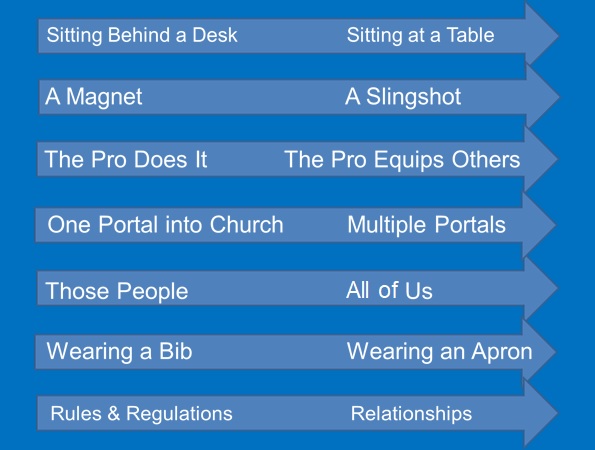
I’ve been writing about 21st Century cultural shifts for a long time but today more than ever I hope we will:

  • Get out there.  (Don’t hide behind your desk.)
  • Be deployed to serve in the world.  (Jesus said, “Go out.”)
  • Teach others how to serve. (Don’t try to do it all ourselves.)
  • Recognize that people connect with God and each other in different ways. (My way is not the only way.)
  • Stop otherizing people.  (We are all in this together.)
  • Stop expecting other people to serve us.  (It’s time to serve others.)
  • Remember that rules exist for the sake of relationships.  (See earlier post.)

Whether you are celebrating or mourning today, there’s work to do. Let’s get out there.

Image from a slide I use when talking about necessary church shifts.

Please Don’t Lie to Me

Even in professional ministry, people lie to me.  Sometimes those lies are bold-faced, bald-faced, or bare-faced. Sometimes the liars are parishioners and sometimes they are pastors.

Lying kills trust by definition. Lying is the opposite of truth-telling.

Yes, sometimes the truth hurts or it’s embarrassing.  But we cannot be a healthy organization without Truth.  Remember when Pilate asked Jesus, “What it truth?”  Best question ever.  Especially on Election Day.

Some say it’s true to call even peaceful protesters a “mob.”  Some say it’s true to call a caravan of poor migrants an “invasion.”  Some say it’s true to call the migrants themselves “diseased” or “criminal.”

Some say it’s true to call Republicans “racists.”  Some say it’s true to call conservative people “deplorables.”  Some say it’s true to call President Trump a white nationalist (although he self-identified as a nationalist a couple times and he is white.)

What is true?  Sometimes it depends on who’s talking.  Sometimes it depends on context. By this definition, many media personalities have told many lies.

And sometimes facts are facts.  Places of birth, dates of legal actions, and most checked statistics are facts.  By this definition, our President has told many lies.

Only a conniving person would say something like “it depends what the meaning of ‘is’ is”  when asked “Is there an improper relationship here?”  There are liars of every political persuasion.

I would love to live in a world where everyday truth was clearer.  But in the meantime, I pray that noble people are elected today and that we – in the Church – would always tell the truth for the sake of the Gospel.  Healthy organizations speak the truth in love.  We’ve known this for over 2000 years.

Sometimes I feel like channeling Tommy Lee Jones in The Fugitive.  Look out Dr. Nichols.

Rules Are For Relationships

I was told at a young age that Good Manners were invented to make other people feel comfortable. We don’t consult Emily Post in order to highlight our own personal poise and good breeding.  We practice good manners for the sake of other people:

  • Thank You Notes make people feel appreciated.
  • Multiple forks mean there’s an extra if needed for salad and dessert.
  • Seating charts help people feel included . . .

. . . in a perfect, gracious world.

The same is true for Church World Rules and Regulations.  And yet many a person has has felt estranged from The Church because of rules.

The rules in church bylaws and in my own denomination’s Constitution are supposed to be about protecting, honoring, and serving people within the realm of being followers of Jesus.  (If they aren’t, I would question why there are included.)

We have rules about who can be ordained as a pastor in hopes of preparing people as well as possible for the multi-faceted work of professional ministry – which is good for parishioners and the person leading them.

We have rules about discipline in order to protect a congregation and specific individuals from hurtful behavior.

We have rules about overseeing financial statements and meeting minutes to ensure that congregations and pastors are safe from nefarious situations.

We have rules about voting on church business so that everyone is heard.

We don’t have rules about drinking coffee in worship or bringing dogs to church meetings or dressing a certain way or making elders advertise how much money they contribute annually or any number of things – unless we do have those rules and that would be about something besides making disciples.

Jesus didn’t die for rules about whether or not someone can wear flip flops to meetings or whether or not you must call a pastor who is male or whether or not there has to be a Sunday morning Bible study in the church parlor or whether or not there is a screen in the sanctuary.

Jesus did die for the inclusion of rejected people, the forgiveness of broken people, the salvation of lost people, and the freedom of enslaved people.

Next time we grapple with the rules and regulations of our particular church, ask this question:

What about this rule helps/serves/welcomes/protects someone?

If there is no good answer – maybe we need to rethink that particular rule. My denomination rewrote our Form of Government in 2006.  We did this to be more permission-giving and adaptive.  We did this because what “must” be a rule in one context need not be a rule in another context.

Yes, certain rules are “shalls” in our manuals.  Next time you come across one, ask how that “shall” serves the people in God’s name.  The rules are all about relationships.

Image of the trash room in my apartment building.  I’m guessing this rule exists because it’s extra work for the person paid to pick up the trash.  Clearly we need to be more considerate neighbors.

What Divides Us? Interpretation

I heard on a radio talk show yesterday that what divides our nation is hate.  Yes, we are divided.  And yes, there is hate.

But I believe we are actually divided by interpretation.

How do you interpret Leviticus 20:13?

  • Red Team: This clearly states that homosexuality is a sin.
  • Blue Team: This is part of the Holiness Code which was culturally binding in ancient Israel but not for us.  The Holiness Code also says we cannot eat shellfish, plant a field with two different kinds of seed or wear two kinds of cloth at the same time.  

So do you pick and choose what to believe according to what you already believe?

  • Red Team:  No.  We take the Bible seriously, if not literally.
  • Blue Team:  Jesus taught us not to store up treasures on earth so does that mean we should not have a savings account or a 401k? We take the Bible seriously too – seriously enough to do textual, source, historical, and form criticism.  (It’s amazing what the LORD has let us learn.)

What about the Confederate Statues?

  • Red Team:  They are symbols of Southern heritage in America dating back to the late 19th Century after the U.S. Civil War to honor Southern history. 
  • Blue Team: They are symbols of white supremacy erected primarily in the early 20th Century and as late as the 1950s during the Jim Crow era, to honor (white) Southern history and to intimidate non-white Southerners.

What about immigrants and The Caravan?

  • Red Team:  They’re illegal. They take our jobs. They are changing our way of life.  And some of them are criminals.
  • Blue Team: Many are fleeing violence and you can’t apply for asylum without crossing the U.S. border first.  And immigrants enhance our way of life. They gave us Google and eBay and blue jeans and Chobani.

We see things differently.  I might see a person and think “criminal” while you might see a person and think “family.”  And it’s possible that several things can be true at the same time. I believe that Black Lives Matter but I also support police officers.  I believe that guns should be legal but I don’t believe that military weapons should be available to non-military people.

Nuance is good.

This has been an especially rough week – between the rampant violence and the barrage of political ads with Halloween voices trying to scare us before the election.

How can we bridge the division in our country?

We can try to see things from someone else’s point of view.  If you love Donald Trump, make friends with a DACA kid and hear her story.  If you hate Donald Trump, makes friends with a #HimToo victim and hear his story.  Maybe we’ll continue to disagree.  But it’s harder to hate people if you know their story.

Is it a duck or a rabbit?  It depends on how you see it.

This is What It Looks Like to Stand Together in the Face of Evil

Even though you intended to do harm to me, God intended it for good, in order to preserve a numerous people, as he is doing today. Genesis 50:20

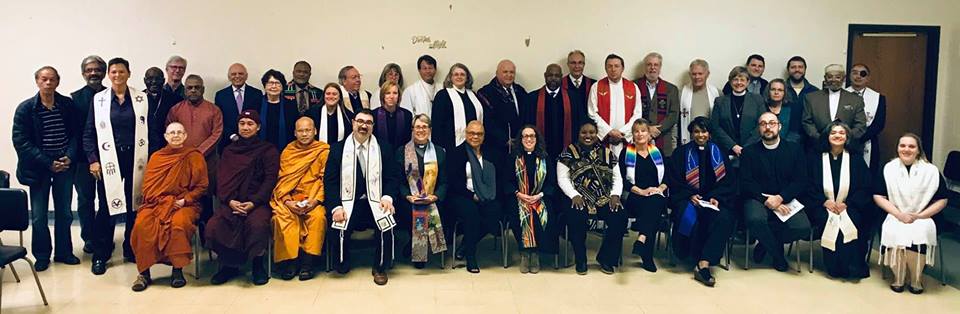
Words don’t do justice to what hundreds of us experienced last night in a Baptist Church sanctuary in Charlotte.  Jewish, Muslim, Hindu, Buddhist, and Christian leaders led a packed crowd of human beings who gathered to sing, pray, and remember the eleven Tree of Life congregants who died during Shabbat services last weekend.

How does one measure profound beauty displayed in perfect anthems and clearly declared proclamations of solidarity.  There were women in hijabs and rabbis wrapped in prayer shawls, monks in orange robes and cantors draped in white, Christians wearing collars and crosses.  There was laughter and tears and applause.  At least for one hour, we worshiped side by side and prayed for peace.

But just as offering “thoughts and prayers” can be empty gestures, gathering for worship together makes a minimal impact if we stop there.  Standing with those in pain involves taking action.  Voting is just the beginning.

What definitive step will each of us take to use this tragedy for good?  What’s really scary is letting our sorrows be wasted.

Image from the Interfaith Vigil held at First Baptist-West Church in Charlotte, NC on 10-30-18.

Pivot Points

It’s not that bad choices are irredeemable.  But life is so much easier when we make good/healthy/wise choices.

My friend JV was in town yesterday and he talked about pivot points – those moments in an institution’s life when we have a perfect opportunity to choose a new direction for the sake of growing and thriving in the future.  Churches face these on a regular basis:

  • When it’s time to call a new pastor
  • When there is a dramatic economic shift (e.g. factories close, new business ventures open)
  • When there’s a natural disaster (e.g. a flood/tornado/hurricane destroy the building)
  • When there’s an accidental disaster (e.g. a fire)

Many congregations do the safe thing:

  • They call a pastor who seems to be like their last pastor or a pastor who seems to be like their historically favorite pastor or a pastor who is the opposite of a disliked pastor (i.e. a reaction rather than a proaction.)
  • They rebuild with a focus on sentimental rather than missional factors.
  • They rebuild on the cheap, hire leaders on the cheap, cast a vision on the cheap – when they actually have the resources to stretch a little.

More congregations do what they’ve always done rather than pivot.  (These are the moments I wish Presbyterians had bishops.)

What I love in this ministry are congregations willing to take a leap of faith for the Kingdom of God.*  What I love in this ministry are congregations who have more faith in God than fear of the future.  What I love in this ministry are followers of Jesus who take The Great Commission seriously.

I also love those congregations that don’t want to change a thing.  But it’s a little heartbreaking to watch them die.  (Just a little because –  Resurrection.)

If you are reading this and your church is at a pivot point, please pray that your choices are informed by the Living God – and not weighed down by anxiety and fear.

Your partners in ministry will thank you.

*Kingdom is the usual word but it’s a limiting word for many.  God’s reign is what we are seeking.

Good Radicals

Ladies like me were not raised to be radical.  But it’s not too late to learn.

By definition, radicals are extreme while “moderation in everything” is a favorite shibboleth in our culture.

The two men charged with killing worshipers in Pittsburgh and threatening to kill members of the Democratic party from all over have been called “radicals” and the media has spent hours and hours pondering when they became “radicalized.”  What made them shift from talking about sports on Twitter to talking about destroying people?

We often hear of “Middle Eastern terrorists” who became radicalized and therefore profoundly dangerous. We hear less about domestic terrorists who have become radicalized.  The truth is that terrorists can be found of every skin color and from every land, and being radicalized is what makes them a threat.

What if – in response to the onslaught of terrorism in our world – we aspired to be good radicals?  What if we decided to love each other radically?  What would that look like?

  • What if we lavishly gave some of our income to ensure that a school on the other side of town was at least as good as the school where we send our own children?
  • What if we didn’t move into a bigger, better house until we helped provide shelter for a homeless family?
  • What if we sacrificed our vacation plans next summer to provide camp experiences for children who’ve never been to camp?

Most of the world would consider such actions foolish.  Most of the world does not consider strangers to be part of their human family.

The God I believe in showed us how to love radically.

I fail at this on a regular basis and yet I find that I can offer moments of radical love in my life.  There are perfect moments for each of us out there when we can offer radical love.

Even during a heartbreaking weekend, we caught glimpses of what radical love looks like:  police officers running towards the gunfire, first responders from neighboring suburbs stepping in to assist exhausted first responders in the Squirrel Hill neighborhood of Pittsburgh, strangers comforting strangers.

I for one need to become more radical – in terms of how I express my faith out in the world.  Anybody up for trying out radical love?

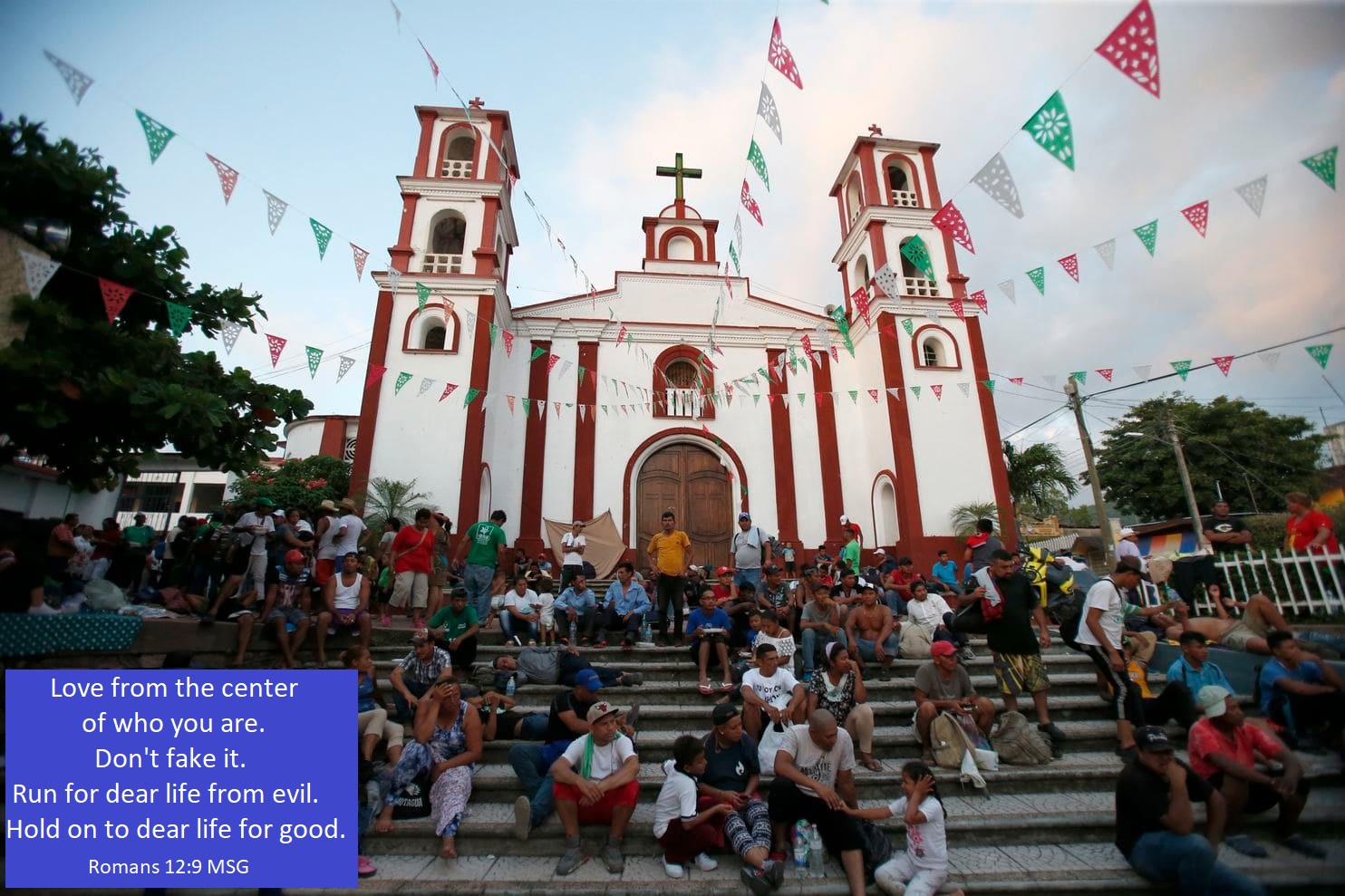
Image source here.  Mexican citizens in Pijijiapan outside a Catholic church building offering aid to migrants traveling from Honduras in “the caravan.” The quote is Romans 12:9 from Eugene Peterson‘s The Message.

It’s Impossible to Erase God’s Children

I remember a Presbytery meeting during my first years as a rural pastor decades ago when – at the end of the meeting during “new business” – a woman stood and said, “I make a motion against the existence of homosexuality.”

Before the Moderator could respond, another person – a pastor who happened to be sitting next to me – stood up and said, “I make a motion against the existence of night.

Both were ruled out of order and we ended the meeting with a prayer.

As much as someone might try, we cannot erase God’s children no matter who they are just because we wish they didn’t exist  anymore than we can erase the night.

The podcast Pantsuit Politics is one of my favorites. Sarah (“from the left”) and Beth (“from the right“) discuss the news of the day with “no shouting, no insults, and plenty of nuance.”  Thanks be to God.

On Tuesday, they were discussing the issue of “the caravan” of thousands of people from Honduras, El Salvador, and Guatemala hiking across Mexico and headed north to the Texas border.  They agreed that our government cannot pretend like these human beings are going away anytime soon.  I don’t remember whether it was Sarah or Beth who said it, but one of our nuanced podcasters said: “We cannot stop desperate people.  Give it up.

Both agreed that if our government acts as if this immigration issue will solve itself when we threaten people with military violence, they will still come.  Desperate people will not be deterred.

They compared it to an oncoming tornado.

Imagine if a huge tornado was barreling towards Texas and our response was to say, “That tornado should not come.  Tell it to go away.”  Obviously the tornado would not turn back.

Nor will these at-risk human beings turn back.  Nor will transgender human beings turn back.

Sarah and Beth said this: “What if we said to Mexico,How can our two countries work together to safely transition people?  How can we work together to address the security needs of our country, the security needs of these human beings, the basic needs of these human beings, and everyone’s economic interests in this process?'”

Simply deciding that people will go away is not only ridiculous; it’s unholy.  And if violence befalls this “caravan” of thousands of humans, there will only be more people in more caravans who will continue to seek security in other countries.

The very first book of holy scripture says that people are created in God’s image.  God will not be erased.  And even if there are human efforts to erase those created in God’s image, those efforts will ultimately fail.  We can fight God on this or we can address the needs of the vulnerable and treat people as we would treat the angels.

Church:  what are we doing to love the people God loves?

Image source.