What Does It Mean that White People “Have Work to Do”?

We white people have so much work to do. If you talk more about race now than before, that’s good, but the work continues and it’s the responsibility of white people to educate ourselves about systemic racism and our own participation in white supremacy.  From 6-16-18 Opening sermon at the 223 General Assembly of the Presbyterian Church USA

Hard work is highly valued in this country and many of us would say that we worked hard to get where we are. Some of us worked our way through college or started at the bottom of our place of employment.  Some of us didn’t have wealthy parents or even middle class parents who could help provide some of the extras in life: music lessons, vacations, braces.

There is a deep truth that some of us miss, however. The undeniable truth is that it has been intrinsically harder for some people than for other people in this country.  Those of us with Caucasian roots – no matter how hard we have worked – started ahead of the pack because of the color of our skin.

White skin has offered an advantage even in the poorest, hardest working parts of our nation.  The work that we with white skin have work to do involves understanding what this has historically meant in the past and what it means today.

But we are really busy.  As Yuval Noah Harari wrote:

Most of us can’t afford the luxury of investigating because we have more pressings things to do:  we have to go to work, take care of the kids, or look after elderly parents.  Unfortunately history does not give discounts.  If the future of humanity is decided in your absence, because you are too busy feeding and clothing your kids, you and they will not be exempt from the consequences.  This is unfair, but who said history was fair?

So what does it mean that “we White People have work to do” if we don’t have the time or energy to be historians or sociologists?

  • It means we need to listen to People of Color – without needing to refute and argue what they share about their experiences.  Just listen and try to understand.
  • It means we need to be more curious about our own history and theirs.  What do we know about the Jim Crow laws?  What do we know about Civil Rights History in this country?  Part of being good citizens is to be fluent in our own history.
  • It means telling the truth and allowing others to tell the truth even when the truth is upsetting and unsettling.

While this might sound heavy for a Monday morning, the Spirit spoke to me this weekend so I need to say something about my own need to do the work.  Good morning.

Image source.

Not Every Straight White Man

Sometimes I say – and not in whispered tones – “I hope they don’t pick another straight white man” when I’m referring to pastor nominating committees or political races.  As the mother of two SWM, the sister of two SWM, the spouse of one SWM and the friend of many SWM, it’s not that I dislike or distrust all SWM.  It’s just that sometimes SWM are not the leaders we need for a given situation or time.

If organizations and communities want to change, sometimes a SWM is not the one to do it – except when they are the only one who can do it.

The truth is that not every straight white man believes that girls and women were created to be at their disposal.  The truth is that not all single white men drunkenly assaulted women in high school or college. The truth is that not every straight white man believes that they are entitled to everything they want.  The truth is that many of our institutions are comprised of people who are not straight white men and yet those people are the ones perpetuating the selection of straight white men as the only ones who can lead them.

I treasure congregations who take a chance on calling leaders who don’t look like them, think like them, sound like them.  This is the future, my friends, for many of our congregations if they want to thrive.

This weekend, a predominantly white congregation in my Presbytery installs a man of color to be their pastor because their neighborhood is changing and the world is changing around and beyond them.  They didn’t intentionally seek a person of color but they listened when God pointed them to this pastor.  They trust God and take their role as disciples more seriously than they trust the way they’ve always done things.  And this call is so real that you can feel the energy in the congregation.

The straight white men of that congregation helped make that happen.  Not all straight white men are racist nationalists.

Image from the play by Young Jean Lee. (2014)

Long Live The Thirsty Beaver

My neighborhood is changing.  Actually it’s been “my neighborhood” for less than six months and I don’t have much stake in the changes except to say that I like being able to walk to the grocery store and assorted restaurants.  I’m told that my apartment was built on the site of an unused warehouse  and so I don’t have Gentrification Guilt.  Nobody had to move when my apartment building was constructed.

And then we have The Thirsty Beaver.

It’s been described to me as “A Middle Finger to Gentrification” and that seems to be true.  If you look at the image, you notice that new construction had to be erected around this little bar.  I haven’t been inside yet because 1) I’m probably not cool enough and 2) it would probably be frowned upon for me to be seen in this establishment.  (Note:  I am game to visit for anthropological reasons if you happen to be in Charlotte and  want to join me there.  For anthropological reasons.)

Bars are excellent evangelism venues and just last night, as I was doing my post-exercise “cool down” I met C and K from Mississippi and then I met J and J from eastern NC at a different establishment where neighbors gather.  I feel blessed to live in a neighborhood where few people are “from here” and so introductions are easy and dogs are especially welcomed.

What would we do to hang on to community?  The owners of The Thirsty Beaver turned down serious cash to keep their gathering place which meant that the new construction had to go around them.  Sometimes new construction enhances community.  It’s not an either/or.  It’s a both/and.

How does your church, your non-profit, or your for-profit build community?  People are craving authentic connections, and I’m grateful to those who resist the temptation to give up authentic community gathering spaces for money.  BUT – before you assume I am always in favor of keeping old structures for the sake of sentimentality and history, let’s ask ourselves:

  • Is our community/church friendly to strangers and “new people”?
  • Is our community/church making a positive impact in the neighborhood?

If not, maybe something new could do a better job.  In the meantime, who wants to check out The Thirsty Beaver with me to study what happens there?

Image source.

Read This Book

I don’t do everything Bill Gates tells me to do. But when a fascinating person calls a book “fascinating” I pay attention.  Yuval Noah Harari’s new book 21 Lessons for the 21st Century is quite the idea sparker.

The subtitle of this book could be Algorithms R Us.  But don’t let that scare you.

I would love to read this book with a group of people – preferably over coffee and French Pastries* – and connect the spiritual dots with you.  Although like Bill Gates, I don’t agree with all the suggestions Yuval Noah Harari makes** in terms of where we are going as a society, his insights are fantastic regarding everything from work and community to religion and God (which get separate chapters.)

This book speaks volumes about where the Church is going – or needs to go- in the coming years and I am seriously craving Future Talk time.  With croissants.

Favorite insights so far:

  • “In a world deluged by irrelevant information, clarity is power.”  This makes me think that we preachers and teachers need to be much clearer.  I once heard a whole Easter sermon about “the theory that Jesus really rose on a Wednesday.”  (Save us Jesus.)
  • “The first step (to overcoming our disillusionment) is to tone down the prophecies of doom and switch from panic mode to bewilderment.  Panic is a form of hubris.  It comes from the smug feeling that one knows exactly where the world is heading: down. Bewilderment is more humble and therefore more clear-sighted.  Actually, I would say that we need to switch from panic to wonder.  (As in: I wonder where God is in this.)
  • “Personally I like the idea of descending not from brutal world conquerors but from insignificant people who seldom poked their noses into other people’s business.”  I love this from the Jewish Harari who notes that “Prior to 1800, the Jewish impact on science was limited.”  His point is the same as Rick Warren’s in the first line of The Purpose Driven Life:  We are not the center of the universe.

There are quite a few OUCH moments in this read – which sparks excellent conversation.  We in the Church must never be afraid of conflict if we hope to thrive in the 21st Century.

You can read more about this book here and order it here.  I hope you will and then let me know what you think.

*As I shared on FB, I just found out that the Amelie’s on North Davidson Street in Charlotte is open 24/7 – 365 days a year.  This is profoundly good news and I’m a little peeved that it took me almost six months in this city to discover this crucial piece of information.

**”Although like Bill Gates, I . . . ” is a hilarious thing to type.  Nobody confuses me with Bill Gates.


Be the Shelter, Not the Storm

It’s sort of like teaching the Institutional Church that we need to be more like slingshots than magnets.  It’s sort of like teaching Church people to wear more aprons and fewer bibs.

Be the Shelter, not the Storm.

In every congregation and in every community there are people who relish in creating storms.  And yet all of us find ourselves occasionally caught in scary, swirling storms and we need shelter that might literally save our lives.  Everybody needs shelter from life’s storms.  But most of the time, we can be the shelter in somebody else’s storm.

The Church is called to be that shelter one disciple at a time.  This is not merely about offering shelter in our church buildings for the homeless or feeding the hungry during hurricanes.

It’s about being the person who helps another person save face in the grocery store who’s $5 short.  It’s about being the one who sits with a grieving person whose life has just been obliterated.  It’s about noticing the child who is invisible to others.  It’s about inviting someone to join you at the table.  It’s about inviting a lonely neighbor into your life.

This is Church.  And this is what I’ve witnessed in the past several days while in the throes of a storm called Florence.

Image of Bob Dylan singing one of the greatest songs ever written.

Perennials

A Fall Foliage GardenI was speaking last night at a fundraiser for a fine organization that supports Senior Citizens and learned that “Seniors” are rebranding themselves.  (Note: Boomers continue to look out for ourselves, don’t we?)

One of the suggested new names for Old Boomers is “Perennials” – people who are resilient and continue to bloom season after season.  Rhymes with Millennials. 

It’s aspirational.  It’s upbeat.  It’s clever.

It also presumes that We Will Always Come Back year after year – even when you thought we were dead.  I am not officially a Senior Citizen yet (except at movie theaters) but I think – every day – about stepping away to let younger generations bloom.  Sometimes perennials take over the garden and need to be weeded out for new growth to happen.

At 62 I can’t afford to retire nor do I believe there isn’t a role I need to play in the Church.  At 62 I have the power to open doors for others.  At 62 my voice tends to be heard so I can speak up for and promote others.  I hope my legacy would be that I prepared the way for younger generations to bloom.

But what about the 72 year olds, the 82 year olds, the 92 year olds who still have the energy, intelligence, imagination and love – with special emphases on energy and imagination – to serve?  I’m already invisible in many circles.  Even in my apartment building, hipster neighbors assume I’m there visiting my young adult children.  I don’t look cool enough to live there.

I can see how ageism is offensive and that feeling of being cast out hurts.  When we have placed our identities solely on work, we are lost after work ends.  Who are with without being pastors/lawyers/teachers/business leaders?

We can drive for Lyft and Uber (pastors on the road) or we can volunteer in the public library or in local classrooms.  We can take up painting or knitting.  Or we can ask younger colleagues:  Is there anything I can help you with?  – And then allow ourselves to be directed.

If I retire in my sixties and have 20 or 30 years left to serve in some way, will there be a place for me?  This is the question I was asked last night.  Where can we bloom while getting out of the way?  Where can we bloom that doesn’t feel as if we are being infantilized? (“Here Sweetheart, why don’t you try working with clay?  It will be good for your arthritis.“)

A lot of our generational issues seem to be about money.  Boomers don’t have enough to retire. Generation Xers would like to be paid what Boomers have been getting paid.  Millennials need more to pay off educational debts.  I really don’t know what Generation Z needs but – God help them – the international debt levels are catastrophic.

I like the term “Perennials” but prefer to consider all of us perennials.  All of us go through seasons of resting and seasons of blooming.  All of us need to be fertilized and watered.  All of us need to be cut back a little (especially the older perennials.)  All of us need to connect and look out for each other.

Image of fall perennials.  And if you are looking for a place to donate time or money in the Charlotte area, this organization is worth your attention.


Ladylike

I grew up believing that ladies:

  • Respect our elders even if they are being foolish/mean/abusive.  (e.g. That time the older church pillar made racist statements at a Session meeting.)
  • Don’t cause a scene.  (e.g. That time the funeral director whispered something unspeakable into my ear regarding what he was going to do to me in the limo while we were standing together at Arlington National Cemetery.)
  • Didn’t speak up. (e.g. That time a supervisor was shredding the reputation of a colleague at a party.)

My favorite “Somebody-Should-Jump-Up-And-Say-Something” Moment was on Tuesday, March 17, 2015 at Fourth Presbyterian Church in Chicago when Diana Butler Bass was speaking at the national NEXT Church Conference.  Word was out via social media that the PCUSA denomination had just passed the same-sex marriage amendment.  There was a buzz throughout the packed sanctuary.  Diana was saying important things. And just as I was thinking that Somebody Needs to Stand Up and Make An Announcement, somebody did (thank you KS) and Diana stopped for a moment and we all cheered.  Ladies aren’t supposed to interrupt people – especially during a keynote address.  But it was the right thing to do that night.

Ladies are also not supposed to be loud or angry.  Ladies are not supposed to defend ourselves – even when we feel profoundly wronged.

But healthy communities teach children to speak up when they feel uncomfortable.  Healthy communities teach adults to speak up when we see injustice (or something’s on fire – literally or figuratively.)  Healthy communities allow for constructive criticism, require safe boundaries, and trust each other enough to speak the truth in love.

The Church of Jesus Christ cannot be healthy until ladies and gentlemen and everyone in between speak up the way Jesus spoke up.  (References: Matthew 22:16, Matthew 25:45, Mark 14:18, Matthew 20:16, Luke 19:46, Luke 6:27-31 – and there are hundreds of others.)

In faith and for the sake of the Gospel, God is calling us to speak up and step up.

Image of one of my favorite humans Erin Counihan who spoke at the NEXT Church National Conference in 2018 about her evolution as a Church Lady.  Source: Presbyterian Outlook.

Trauma

Traumatized people are all around us.  They are in all of our congregations, our places of work, our neighborhoods.  (And sometimes we are the ones walking around with the unseen wounds.)  On this particular day, there are . . .

  • Thousands of people for whom today brings heart-pounding memories.
  • Thousands of people evacuating their homes while Hurricane Florence threatens to pound the Atlantic Coast.
  • Parishioners who have experienced betrayal by their spouses.
  • Parents who have lost children.
  • Children who have witnessed domestic violence in their homes.
  • Homeless children who – unbeknownst to their teachers – live in the family car.

Today’s most effective physicians get to know their new patients by starting with: “Tell me about your childhood” – looking for Adverse Childhood Experiences (ACEs.)  You can read about ACEs  here.

Research shows that children who experience one or more Adverse Childhood Experiences before their 18th birthday have a higher incidence of mental and physical consequences as adults.  The ten most traumatic ACEs are:

  • physical abuse,
  • verbal abuse,
  • sexual abuse,
  • physical neglect,
  • emotional neglect,
  • a parent who’s an alcoholic,
  • a mother who’s a victim of domestic violence,
  • a family member in jail,
  • a family member diagnosed with a mental illness,
  • the disappearance of a parent through divorce, death or abandonment

According to this article “With an ACE score of 4 or more, things start getting serious. The likelihood of chronic pulmonary lung disease increases 390 percent; hepatitis, 240 percent; depression 460 percent; attempted suicide, 1,220 percent.”

A high incidence of childhood trauma doesn’t condemn someone to a miserable adulthood.  A high incidence of adult trauma doesn’t condemn someone to misery either.  But it’s good to know what we are dealing with.

Congregations are filled with traumatized people and seminaries generally do not teach pastors to wonder why people in our churches are the way they are in terms of their life stories.  One of the beautiful parts of Church, though, is that we have ample opportunities to share our stories with each other – the ugly, the difficult, the traumatic – along with the glorious and beautiful.  A healthy church is the one that makes it not only possible but okay to share our imperfect lives with each other.

To all those broken by terrorism and natural disasters and childhood traumas and adult traumas, today is a good day to be the Church with and for each other.

A Simple Practice to Start the Day

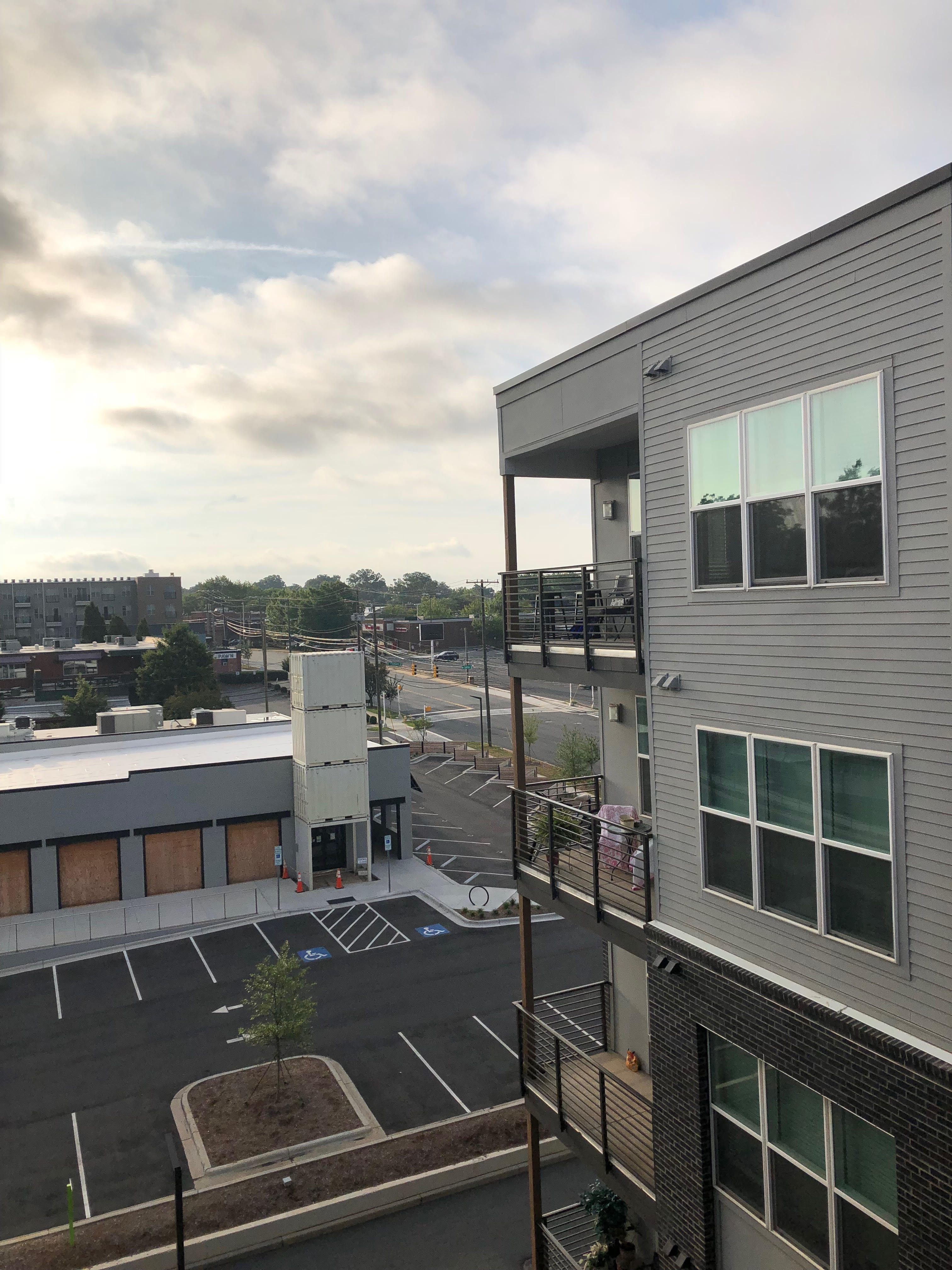
This is the view from my balcony in Charlotte.  While it might not strike you as beautiful or peaceful, I love it.  I drink my morning coffee out there most days and – having been inspired by a friend whose view is the Chicago skyline – I sit there and pray for strangers:

  • The people who sold their personal things at that – now closed – pawn shop because they needed the cash,
  • Those who drive through the CVS Pharmacy window without health insurance,
  • The people who will soon open their business in the space where the windows are now boarded up (as well as the owners/brewers of the new Pilot Brewing next door who seem like very nice people.)

My Chicago friends moved into a high rise in Streeterville upon retirement and told me that – in the evening as lights came on – they used those lights like prayer beads.  A light in the blue building would come on and they’d pray for whoever lives in that apartment.  A light in an office building would pop on and they’d pray for whomever was working late at their desks, for the late night cleaning crew, for the security guards in that skyscraper.

Whether the view from your porch or your window includes homes like yours or birds or a strip shopping center or a parking lot, there is someone or something to pray for.  And if you are as quiet-time challenged as I am, even five minutes works wonders.  It’s a calming way to start the day.

Happy Monday.

Although It Seemed Like a Good Idea . . .

In the ongoing quest to “grow” and “change,” congregations want to get there as quickly as possible and so they make the fastest, easiest choices instead of the best and most thoughtful choices.  Eventually we all pay for fast and easy.  For example:

  • Congregations in transition hire a retired Big Steeple Pastor (strong preaching, lots of experience) to be their Interim leader.  The sermons are comforting, the pastor is impressive but very little transitional work is done and – when the new pastor arrives – they still don’t know how to be a 21st Century Church.
  • Congregations between pastors spend that interim time getting ready for their next chapter by painting the front door, re-writing the Manual of Operations, and weeding the playground.  But they do not spend any time discerning who they are now or how their neighborhood’s needs have shifted or why they exist.
  • Congregations rush through the process to call a new pastor and they swiftly call someone who looks the part.  But it takes just a few months to notice that it’s not actually a good match after all.  (Wisdom from my sister:  It’s better to be alone than to wish you were.)

We seem to be addicted to quick and easy – even in discerning spiritual leadership.

Poor leadership is the #2 reason why congregations fail to thrive.  The #1 reason congregations fail to thrive is because the congregation doesn’t want to do the work.  Ouch. (But it’s often true.)

Let’s do the work of discernment.  Let’s let go of our fear and trust that God is in this.