I Don’t Understand How You Can Call Yourself a Christian and Vote That Way (And You Don’t Understand How I Can Call Myself a Christian and Vote This Way)


The ugly polarization between Blue and Red voters in the United States makes my stomach hurt.  I take it very personally when I hear that someone “thinks Trump is doing a good job” in light of what I consider to be his dehumanizing comments and abject cruelty towards people in need.

It’s so personal that it physically hurts.  A vote for Trump, in my mind, was a vote against my daughter in law who is brown, my family who are LGBTQ and my friends who have fled terrorism.  It doesn’t make sense to me – if you also love my daughter in law and the rest of my family, and my friends – that you would think someone who has castigated each of them or people like them is “doing a good job.”

But that’s me. And because I attach religious and moral ties to politics, it’s easy for me to be self-righteous.

So what’s the answer as I now serve in a Church Mid-Council with thousands of people on each side of the political divide who all call themselves disciples of Jesus Christ?  I pray for wisdom and I look for groups like this one.

We need to learn to talk with each other.

When I was a pastor in Northern Virginia concerned with what I considered to be the mean-spirited tone of this periodical, I contacted their editor and asked to be connected with one of their supporters in my geographic area so that we might become prayer partners and drink coffee together and try to understand each other.  The person on the phone told me that “I can’t think of anybody on our side who would want to talk with you.”  Ouch.

I appreciate the hard work of understanding our political foes.  Is there anybody out there who is willing to join me to trying to understand?

Video from the Better Angels website.  Thank you LK.

Random Church is the Best Church – Reprise

A cocaine dealer paid for my brunch yesterday.  

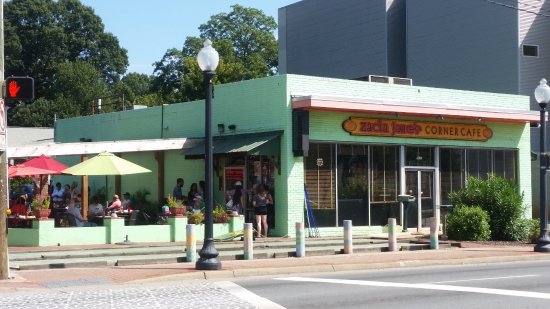
It had been a long day – a long week actually – and it was a good day to eat brunch out.  It’s fairly easy to get a seat at the bar even during the Sunday brunch rush at Zada Jane’s.

My lunch date had fallen through but I don’t mind eating alone. And when you go places alone people are more likely to talk to you.  Enter the coke dealer.

David (not his real name) was sitting beside me at the breakfast bar and he asked me to guess what he did for work.  He was a 30-something wearing a t-shirt and jeans and before I could guess, he blurted out that he was an investment banker.  His point was that we shouldn’t judge people by appearances which is also true for me.  (I made him guess what I do for a living and he thought I was an investment banker too.)

Actually, he was not an investment banker and neither am I.  Our server outed me as a Presbyterian pastor. (I am the resident chaplain at Zada Jane’s.)

David asked for prayer and girlfriend advice and he showed me photos of his kids.  I suggested he phone someone to help him get home and two guys soon came by. (David was drunk.) And then he said he wanted to pay for my brunch.

He pulled out a wad of cash “from last night’s party” and he told me that he’s actually a cocaine dealer “sometimes.”

And sometimes I find church in random places.

Image of the bar area of Zada Jane’s –  one of the best breakfasts in Charlotte. I previously wrote about Random Church here.

When Your Church Sign is a Tombstone

A church in my neighborhood has a tombstone for their church sign.  The congregation is named for a famous Bible verse which is also engraved on the tombstone.

I’ve heard of new church plants that meet in funeral homes and it could work. But people cry a lot in funeral homes and an effective church probably has a healthy crying to laughing ratio.  Church is for crying – yes – but not all the time.  Most people do not laugh in funeral homes. (Note: my siblings and I tend to laugh quite a bit in funeral homes but we have an unusual sense of humor.)

New church venues in theaters, schools, and bars seem to convey a more positive ambiance than funeral homes – the resurrection notwithstanding.

I personally like a nice grave stone. I appreciate the history they share and the stories they perpetuate.

One of my favorite cemeteries is the one behind Thyatira Presbyterian Church not far from where I now live. There are three very old pirate graves among those ancient plots. 

Legend has it that three men left their pirate lifestyle along the coast and settled in Rowan County, NC  but they were later – somehow – outed by pirate hunters. (!) They were subsequently hanged and buried in unmarked graves  – except for a skull and crossbones on each tombstone.

But I digress.

Here’s the thing about choosing a tombstone as your church sign:  it’s disturbingly and unintentionally indicative of your church’s culture.  Yes, it says sturdy and maintenance-free but the truth is that – while The Church is sturdy – the church must be flexible and wide open and changing to suit the ministry needs of the community.  And “maintenance free” church requires further discussion.

Yes, maintaining ministry space is important. But many of our congregations call pastors who only know how to do maintenance.

Instead, the 21st Century Church needs to call culture shifters who will love the people out of old models into a new way of following Jesus for these days.  We need visionaries and prophets and dreamers – along with those who know how to do enough management to keep the ministry thriving.

Following Jesus has very little to do with administrative management.  Again, God bless the managers.  But 21st Century Church Leadership actually has everything to do with training disciples who will proclaim the message of Jesus, offer community to God’s people, lead worship, speak the Truth, inspire people to work for justice, and show the neighbors what the love of God looks like out in the world.

When your church sign is a tombstone, resurrection is certainly possible.  But I can’t help but wonder if somebody is secretly expecting death with no resurrection, even in their wildest imagination.

Images are of 1) a church sign in my neighborhood and 2) the pirate graves at the Thyatira Church cemetery.  

Hello Death

At this time about 28 years ago, my father was dying of cancer and I remember asking my brother, “Do you think he’ll be alive at Christmas?” and my brother said, “I don’t think he’ll be alive in September.”  It kind of made me angry when he said that.

Dad died on August 24, 1990.

I remember this when I talk about the life cycles of congregations because I can make church people angry when I say things like, “I don’t think this church will be alive in September.”  Actually, I’ve never said that to church people but I’ve thought it.  What I have said is this: “if we don’t do ministry differently, this congregation will close in 3-5 years.

God never promised that individual congregations would live eternally.  We only know that there will always be The Church of Jesus Christ (with a capital C.)

St. Giles Church in Edinburgh – often called the Mother Church of my tradition (Presbyterianism) was established as a Roman Catholic church in the 12th Century.  It became a Presbyterian Church led by John Knox in 1559.  It was (briefly, sort of) Anglican in 1637.  Today – although there is still an active congregation – many worshipers are tourists and a gift shop on the premises sells key rings and book marks.  Things have changed over the past 900 years. Most congregations don’t get that much time.

It’s interesting that we Christians who claim resurrection of the dead are so uneasy speaking of the death that is required before there can be resurrection.  We not only mourn the death of loved ones; we mourn the death of the churches we’ve loved and served.  Perhaps the church of our childhood is still standing but it’s a shadow of its former self.  It’s breaks our hearts.  We wonder what’s going to happen to that cemetery with all our ancestors buried there.

The reality that our congregations will one day die is shocking.  We don’t want to hear it.  That diagnosis is for other churches – not for ours.

And when we hear that our particular congregation is dying, it feels like the work we’ve put into it is invalidated.  I know so many good pastors and other church leaders who’ve put untold hours and money into congregations which have fed them and loved them, only to see those churches dwindle in membership and prestige.

But here’s the thing:  it was never about membership and prestige.  It was always about sharing the message of Jesus.  How are we sharing the message of Jesus in a culture that will not cross the threshold of a church building?

Churches exist to change the world in Jesus’ name.  And there are churches everywhere doing just that: sheltering the lost, welcoming the broken, housing the homeless, comforting the sick.  The wonderful news – the shocking news – is that the message of Jesus continues to be shared even after the death of loved ones and after the death of congregations.

I, for one, look forward to witnessing lots of resurrection.

This post is written in memory of one who is shockingly gone although the message of Jesus she shared will continue to be proclaimed long after her funeral today.  We thank God for the extraordinary life of the Rev. Dr. Katie Geneva Cannon, Child of God and Minister of the Word and Sacrament.


Mental Health Expenses

I’ve been gone for two weeks:  one for vacation and one for study leave – although HH and I were leaders at that Continuing Education event.  Also we lost a car and a phone but that’s for another post.

I learned at the Clergy Couples Conference at Massanetta from financial advisor Brad Barnett that:

  • The average family of four spends $568-$650 a month on food (at least that’s the “thrifty plan.”)
  • Brad’s family of four spends $360 a month on food.  (Note:  Brad is probably not a foodie.)
  • The average monthly car payment is about $500.
  • If people starting at age 30 until age 67 save $5.50 a day instead of spending it at a coffee shop, they will have $700,000 by retirement.

Of the Big Three expenses that human beings have in this country, the average breakdown of one’s income goes like this:

  • Housing 33% of income
  • Transportation 17% of income
  • Food 13% of income

. . . which leaves 37% for sharing, saving, paying off debts, clothing, educational expenses, medical expenses, hobbies, vacation, pet expenses, gifts, and an occasional coffee out. In a perfect world.

Some of those things I’d call mental health expenses.  And I’m not just talking about what we pay the therapist.

Almost everybody – regardless of income level – spends money on items that bring us calm/sanity.  For some, it’s individual cigarettes. For others it’s weekly pedicures.  For a blessed few it’s an annual vacation to a sunny venue with tropical adult beverages.

[Note:  There’s a fine line between self-destructive behavior and self-care behavior.  One person’s Friday glass of wine is another person’s weekend binge.]

But what if eating out and/or buying coffee in a comforting cafe offers a slice of mental respite?  I have a sun roof in my car expressly because it feels like a little vacation every time I take the wheel.  And I consider an occasional bouquet of flowers to be good for my soul.

People with financial discipline are to be admired and emulated.  No dinners out = vacation money.  I get it and good for you if you don’t even drink coffee.  But there is deep joy and nourishment in using a little money for something that we can savor in a moment of peace whether it’s expensive cheese or a foot massage.

Clearly, this is not a post for those with absolutely no financial wiggle room.  College debts and lifelong poverty – among other things – makes much of this a fantasy.  Many clergy couples I know have both seminary debts and children, and their incomes hover just above the poverty line.  Most first call pastors make “the minimum” established by their Mid-Councils.  Or they earn less because they are “part-time” which is church talk for Full Time Ministry on the Cheap.

Talking about money is not my favorite thing.  HH and I returned home and looked over our own expenses and we can do better.  Not $360-a-month-for-food better, but better.

I learned so many things while away over the past two weeks.  One was that my soul needs flowers and an occasional cup of coffee out with friends.  What are you learning this summer?

Image of a $3.99 bouquet from Trader Joe’s.  

Some of Us Are Clergy Couples

Vacation was great and even though it rained all week at the beach and our car broke down and we had to leave it behind at a garage in Eastern North Carolina, I had lots of time to read this book recommended and loaned by the wise TW.  I have many things to write about it, but not this week.

Still radio silent-ish as HH and I spend time at Massanetta Springs with clergy couples. There might be a future post or three on this topic as well, but for now, I’m in conference mode.  In the meantime, my hope is that you too are relishing summer things.

Image of a creek in Rockingham County, VA near Massanetta Springs.

Vacation Week

It’s Beach Week and so I’m trying to be radio silent-ish until August 4.

I hope you have space to breathe deeply too.

The Happiest Pastor

One of our pastor colleagues recently declared:  “I’m the happiest pastor in the Presbytery.”  Deep trust in God has made this pastor “the happiest.

It reminds me of my favorite Bible verses:

Happy are those who trust in the Lord,
    who rely on the Lord.
They will be like trees planted by the streams,
    whose roots reach down to the water.
They won’t fear drought when it comes;
    their leaves will remain green.
They won’t be stressed in the time of drought
    or fail to bear fruit.  Jeremiah 17-7-8

Imagine trusting God even when half the congregation leaves over changes in the church.  Imagine trusting God even when the top three financial donors move to Florida.  Imagine trusting God even when young church members pass away.

It’s not that we aren’t disappointed or sad.  It’s just that we have hope in spite of some hard blows to the community.  These are among the everyday challenges that can threaten us.

My happy colleague reminds me that unbending trust in God brings peace even in difficult days.

The happiest pastor is not paid the most or preaching to the largest congregation.  The happiest pastor is the one who goes through each day trusting that God has already saved us and will continue to save us in unexpected ways.  This happy pastor leads one of the most refreshingly faithful congregations around.  And faithfulness has resulted in deep joy.

Imagine all our pastors vying for who is the happiest.  That would be amazing and it would turn the world around.

A Call or A Job?

I have a job that pays my life expenses, but it’s more than a job.  We in the Church say we have a calling from God.

Other vocations — Doctors, Educators, Social Workers, Bee Keepers, Etc. – often say they are called by something deep and holy to do what they do too.  I would love for everyone to have a sense of calling in their life’s work – although it’s not true.  Many people have jobs that don’t feed their souls – and I’m not just talking about menial labor.  I know housekeepers who feel called to clean and organize other people’s homes and I know pastors who consider their work to be the job they’re enduring until they can retire.

In my denomination, we neither guarantee that all pastors will be placed in a church nor do we assign pastors to churches and churches to pastors.  Pastors are not considered truly called unless three entities agree:  the Pastor, the Congregation, and the Presbytery.

The truth is that the Pastor, the Congregation, and the Presbytery can sometimes be cynical about this process.  In my professional ministry I’ve observed:

  • The ordination of a difficult person to be a temporary pastor in her home church so that her home pastor could then quickly “get rid of her.”  She was causing trouble and the only way she would move on was to get ordained and then go find a new position somewhere else.
  • The hiring of a pastor “so he would have a salary” (even though he had a history of being a dysfunctional leader) in a troubled congregation that was having a hard time finding a preacher.
  • Positive (but untrue) references from one Presbytery leader to another so that the first Presbytery leader could get an ineffective leader out of his own territory.

None of this has anything to do with God, and yet this is not to say that God won’t use even cynical arrangements.  But healthy congregations and Mid-Councils look for that spark revealing a true calling from the Holy.

Jesus calls us every day no matter what our vocation might be.  We are called to love our neighbors every day.  We are called to pray for our enemies every day.  We are called to offer hospitality to strangers every day.

This means all of us are ministers in a very real way.  Here’s to hearing a clear Voice.

Image Source.

Church Pathologist

When a Church is thriving it’s fun to discover why.  What’s their secret sauce?  Is there a gimmick?  A charismatic leader?  A financial benefactor?

Thriving congregations have common factors that you can read about here and here and here.  So much has to do with authenticity and spiritual curiosity and follow through.  But that’s not what this post is about.

I wouldn’t call it fun but it’s interesting to uncover why some congregations do not thrive.  Maybe they have struggled since the day they were established.  Maybe they were hit by the ecclesiastical equivalent of  an asteroid. Maybe the local economy collapsed or a deadly outbreak wiped out most of the population.

But more likely, the causes are quite ordinary.

Over the weekend, I spent a little time researching a church I love – obsessed with why they’ve struggled for so long.  Eventually, they might blame the Presbytery for “closing them” but the truth is that they have made choices to close themselves that – compounded over decades – proved to be fatal.

  1. They never asked members to make financial commitments.  There was never a “stewardship campaign.”  There were never conversations about the needs of the church or a push to make sacrificial giving.  Throughout their history, they collected “free will offerings” but never expected members to make financial pledges for the sake of budget planning.
  2. They had seven different pastors the first ten years of their existence.  I can’t figure out why this happened and the possibilities are endless.  Maybe they simply kept calling the wrong pastors – whatever that means.  Maybe they didn’t treat their pastors fairly.  Maybe they couldn’t consistently pay a pastor (See #1.)
  3. They loved each other but they didn’t love their neighbors.  They only reached out into the neighborhood in a cursory way and every time they were offered the opportunity to make a difference in the community (house a local ministry in their building, partner with another church to reach out) they said no.
  4. They had no relationship with the wider Church  Say what you will about the problem with denominations, but healthy denominational partners help with everything from emergency funding to leadership training to pastor vetting to mission building.  Their history indicated that they believed the Presbytery would one day want to close them.  Actually the Presbytery’s job is to help them thrive.  I wish they’d asked when they clearly needed it.
  5. A handful of members “ran everything.”  Although pillars of the Church are gifts in many ways, it’s also possible that they can drive other pillars away.  When they cling to offices for decades at a time, when they complain because new volunteers “don’t do it right” they inadvertently push new leaders out.  And they sometimes push new pastors out.

Do any of these factors ring true for your congregation?  If so, it’s not too late to make some changes.  But note that those changes will be very difficult.  We’re talking about editing a congregation’s DNA.  It can happen.  But we really need to want to do it.

I remember talking with a pathologist about why he preferred to work with dead bodies and he said that – as a younger doctor – he’d been an internist who advised his patients to eat vegetables and stop smoking and start exercising. But rarely did they listen.  Now – working with dead bodies – he was never disappointed.  The dead don’t need advice that they’ll ignore anyway.

I prefer to work with living, thriving congregations where:

  • giving is generous
  • pastors are fulfilled and appreciated
  • both strangers and friends are authentically loved as God’s children
  • congregational partnerships are sought out for the sake of ministry
  • leadership is rotated

Those congregations deserve most of our attention because they want to live and thrive.  But I also love those congregation who don’t want to die, while also making choices that will bring their undoing.  (I wish they’d listen before it’s too late.)