Talking About Slavery & Making People Uncomfortable

There are things we don’t like to talk about because they are unpleasant. Channeling my inner Scarlet O’Hara, I could easily think about other things and be done with it.
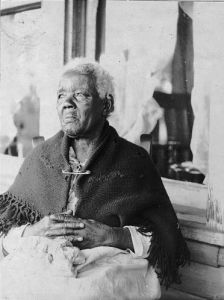
But I was among the white children taught that:

  • People were “good to their slaves.”
  • Masters brought eternal salvation to their slaves by teaching them Christianity.
  • Slaves possibly liked being enslaved.

Yes, I admit before you and God that I believed such things and wanted to believe such things.  But, in the ongoing project of educating myself about this sickest of sins in my ancestral and our national history, it strikes me as an unequivocal duty to learn all I can about those years when my country and my own ancestors thought it was okay to own other people. And my owning them, I mean:

  • Utterly taking away the agency of certain children of God by naming them, selling their children, keeping them from establishing families, deciding who will learn to read and who won’t, keeping them in sub-standard housing, chaining them, and punishing them for real or imagined infractions.
  • Perpetuating a system that chose money over humanity, fear over faith, and injust incarceration that continues to this day.

Sorry to be so heavy on a lovely Friday morning, but this is important if we are ever to understand how we got to the place in our beloved United States where African Americans are incarcerated at more than five times the rate of Whites and it’s necessary to have an organization called Black Lives Matter – as if somebody thinks that Black lives don’t matter.  Heads up:  Black lives do not matter for many people in the United States of America, or at least they don’t matter as much as White lives.

So, I’m trying to educate myself.

I’m planning my own personal slavery education tour and I consider it a necessary part of my spiritual journey.  I am trying to figure out impactful ways to lament, not so that I can tell anyone else to do it or how to do it, but so I can then step up and do something beside feel deeply sorry that something happened in the history of this great nation, and it continues to happen on my watch.  I have to do this.

Anybody out there want to talk with me about addressing slavery?

Image of Sarah Gudger who was a slave near Asheville, NC.  You can read her story here.  Also, I’m headed to Mississippi for this first time this weekend and look forward to spending time with many  people who are also grappling with this like here.  
Leading While Female

I’ve been supervised by both male and female supervisors.  I’ve supervised both male and female colleagues.  The success or failure of those experiences has had less to do with gender than with personalities.  But what is your experience?

The Atlantic Magazine – my very favorite periodical – seems to be on a Women-At-Work kick that is not necessarily helping The Cause – if the cause = thriving on the job regardless of gender.  In the past 16 months, they’ve featured:

So what’s your experience, my friends who identify as female?  Do you feel bullied?  Criticized? Awful? Unhelped?

Remember when Madeleine Albright said, “There’s a special place in hell for women who don’t help each other.” That didn’t go very well, did it?

Frankly,  there are some women who are difficult to work with and there are some men who are difficult to work with and there are non-binary people who are difficult to work with – but it’s not about gender or identity.

It’s about personality.  It’s about collegiality and expecting the best of each other. It’s about giving each other a break.  It’s about sharing the credit and taking the blame.  It’s about letting each other fail without shame.  It’s about sharing a common mission.  It’s about trust.

(Red Flag:  If your colleague’s mission is to promote herself/himself/themselves over the organization, look out.)

Women:  do you find it more or less difficult to work with other women?

Men:  do you prefer to work with one gender over another?

What’s the key to excellent collegial work lives?  Apparently The Atlantic is curious about this and so am I. Or maybe they are just trying to sell magazines.

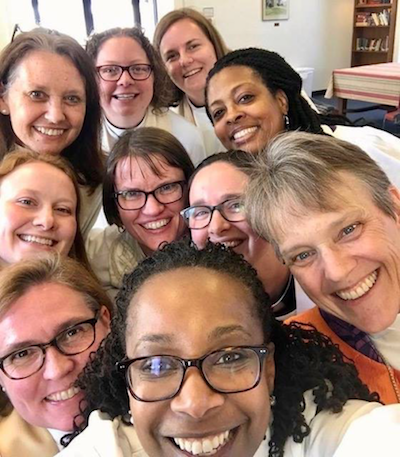
Image from The Young Clergywomen’s Project and specifically from a post by Sarah Weisiger.

Apparently There Was a Dragon

I don’t watch Game of Thrones for several reasons but apparently there was a dragon in a recent episode.  Or maybe there are always dragons.  All I know is that some people in different families – or maybe the same family – are all vying for a throne and it sounds like more than a game.  FBC suggests that I never watch Game of Thrones because it gets ugly in a Mom-Freaks-Out-Watching-Violent-Scenes kind of way.

Some things I don’t need to see although I trust that the story line is excellent. I’m glad you like it.  It’s not for me.

What do you do if everyone in your circle is watching Game of Thrones and you don’t know/care what’s going on?  The Washington Post addressed this on Monday and it’s suggested that those of us who don’t watch merely take joy in knowing that we are getting so much done as our friends are watching the show and then spending countless hours recapping it and making up dragon memes.

I’m probably not getting lots of extra work done (because I will talk with you all day about The Great British Baking Show.) But picking and choosing our diversions is important.  It settles us.

I don’t care who The Bachelorette chose.  I don’t care who won last night’s ball game (although maybe I’ll care if the Cubs make it to the Series again.)

We all need distractions from everyday stresses.  Sometimes they are educationally edifying and sometimes they simply help us tune out.  And sometimes they strengthen us spiritually.

I’m trying to take advantage of nature in my back yard as a diversion available only in these summer months.  Bunnies.  Coneflowers. Hummingbirds.  Even though it’s not always easy to stay focussed on beautiful things, it strikes me as a nice diversion that doubles as a sound spiritual discipline.

Image of a dragon in Game of Thrones.  I don’t know if it burned up something important or not.


Read This Book

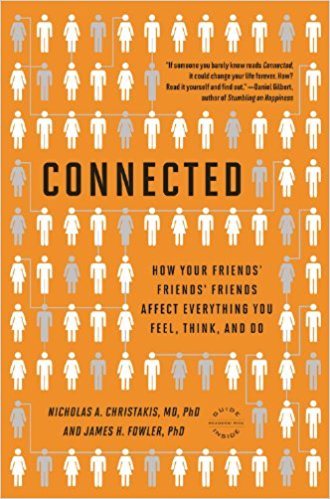
I can’t remember who suggested that I read Connected: The Surprising Power of Our Social Network and How They Shape Our Lives – How Your Friends’ Friends’ Friends Affect Everything You Feel, Think, and Do but thanks, if it was you.

I remember a parishioner once explaining to me why she and her husband would be sending their daughters to an expensive private school instead of the (very good) public school in their suburb.  “We want them to make the right connections because it will help them for the rest of their lives.”

Picture Buffy sitting beside Margaret in Italian 1 which leads to Buffy spending a semester in Rome during college with Trevor who went to summer camp with Margaret and through Trevor, Buffy meets George who marries Buffy’s cousin Addison.  

The more prosperous we are, the more this kind of thing happens mostly because privileged people have broader experiences (summer camp, trips abroad, college) and more opportunities to branch out.  Not true if you’ve spent your entire life in a single small town with the same people and nobody every moves in or out.

Connections-by-privilege happen to me too.  I was at a funeral reception in Chicagoland for a wonderful older man whose spouse had died the year before where I’d met her sister who grew up in my home state and – as it turns out – I went to high school with her niece and nephew.  And at the funeral reception I met her grandson who was best friends with my own nephew back in N.C.  And maybe we are all cousins.

Christakis and Fowler in Connections point out that our social networks can be dangerous (“75 percent of all homicides involve people who knew each other”) and social networks can save our lives (” I gave my right kidney to my best friend’s husband.”)

The great thing about the Church is that we have the opportunity to make connections with people we would not ordinarily know.  I was once the pastor of a congregation that included a member of President Reagan’s staff, a refugee from Vietnam, three Sufi Muslims from Turkey, several homeless men, an undocumented construction worker who didn’t speak English, and people who spent their days inventing secret things for DARPA.  These folks most likely would not be spending time together if they weren’t part of the same church.

It makes me wonder:

Do our social networks look like the Kingdom of God?  Are we connected to people who “can help us for the rest of our lives” as well as people of different races/religions/generations/socioeconomic groups/tribes?

  • Are we connected to any immigrants?
  • Are we connected to any refugees?
  • Are we connected to anyone who is homeless?
  • Are we connected to anyone who is mentally ill?
  • Are we connected to anyone who is unemployed?
  • Are we connected to anyone who speaks a different language?

By “connected” I don’t just mean that we met them once.  Have we invited a broad spectrum of people into our homes and into our lives?  Imagine how different the world would be if we made connections with people we privately disparage or judge or fear?

Our connections are everything.  They impact how and what we eat, how we spend our free time, and how we see the world.  Being honestly and deeply connected to God makes the biggest impact of all because God is the ultimate Connector.  Jesus was connected to all kinds of people – including those that nobody wanted in their network.

I believe that it’s a spiritual practice to notice people who are not in our social networks and to care about them.  Maybe we could even connect.

PS If your church is comprised of people just like you, there could be a problem in your definition of “outreach.”

Good People (Can Be Clueless)

“…most people the world over were good.  And my family?  We were definitely good.  Our parents impressed the importance of it on us all the time.”  Debby Irving from the chapter “My Good People” in Waking Up White

All that is necessary for evil to triumph is for good men to do nothing.”  Edmund Burke

Most of us think of ourselves as Good People.  We follow the rules (except when we don’t re: speed limits.)  We are honest (except when we aren’t re: lying to save face.)  We work hard (except some of us forget that we had some  advantages like white skin color.)

While vacationing in a place where Confederate flags were sometimes visible if not flaunted, I thought about Debby Irving’s chapter “My Good People” a lot. Vacations are supposed to be for relaxing and so discussing politics – for example – in a family with different political perspectives is frowned upon.  (Note: It was really hard the day Anthony Scaramucci was fired.)

Family conversations are opportunities for sharing stories and revealing opinions, and there is always that moment when I need to decide whether or not to speak up when a comment about Good People inadvertently reveals cluelessness.

Examples:

“We were good to our housekeeper.  She was like family.”  

What I wanted to say, but didn’t:  “She wasn’t like family.  She didn’t spend Christmas with us.  She didn’t go on vacation with us.  She didn’t even sit at the same table with us at meals.”


Maybe Sally Hemings and Thomas Jefferson really loved each other.”

What I wanted to say and did:  “She was 14 years old.  And enslaved.

Sometimes we keep our mouths shut when we should speak up.  We don’t want to cause conflict.  We don’t want to hurt someone’s feelings.  We don’t want to get “political.”  We want to think the best of people and we want to think the best of ourselves.

We are Good People.  But sometimes we are also clueless about the fact that we aren’t as Good as we think we are.

I believe in speaking up when we hear or see injustice or false narratives.  But sometimes I don’t speak up either.  Imagine how different the Church would be if we chose not only to speak up but to stand up.


Are We Having Fun Yet?

Every job has it’s not-so-fun parts.  I personally hate doing expense reports.

But if our daily work doesn’t also give us joy and life and moments of fun, I’m not sure we are in the right place.

I remember talking with a colleague about his new call – a complicated congregation with the reputation for serious crankitude – and when I asked how things were going, his face lit up and he said, “I’m having so much fun!”

This is why I believe in “call” – if we are truly called to do something, it’s because we have both the chops and the cosmic prompting to do it.  And it’s meant to be fun – at least occasionally.

Not only can ministry among challenging people be fun  – if the call to serve them is real –  but highway toll-taking, tax accounting, house painting, garden weeding, and tooth polishing can be fun if we enjoy it.  I enjoy none of those things.

But my neighbor asked me recently about my work in the Church and after I described it, he said, “That sounds awful.

Not to me.  It’s really fun.

Repairing Trust

It’s no secret that The Church is not considered a trustworthy institution by a majority of Americans.  According to a 2017 Gallup Poll:

  • 41% of those polled have “a great deal” or “quite a lot” of confidence in the Church or organized religion.
  • 40% of those polled have “a great deal” or “quite a lot” of confidence in The Supreme Court.
  • 36% of those polled have “a great deal” or “quite a lot” of confidence in public schools.
  • 28% of those polled have “a great deal” or “quite a lot” of confidence in organized labor.
  • 21% of those polled have “a great deal” or quite a lot” of confidence in big business.
  • 12% of those polled have “a great deal” or “quite a lot” of confidence in Congress.

Clearly, distrust of our institutions has become part of our American  – and perhaps global  – culture.  Everything from covering up sexual and financial misconduct to serving the institutions rather than God can be blamed, but we are all responsible.

Our institutions are facing a crisis of integrity and – especially in the Church – this is the antithesis of who we are and who we are called to be.

What diminishes trust in our congregations, Governing Boards, Mid-Councils, and National Denominations?  Here are my top six causes:

  1. Failure to adhere to established processes  – which gives the impression actions are being done hastily in order to limit time for objections to be considered.
  2. Secret meetings and secret information without appropriate transparency – which results in gossip, conjecture, and confusion.
  3. A different set of professional and spiritual expectations for some than for others – which results in a breakdown in relationships both personally and professionally.
  4. Lying.  In an anxious culture, anxious people tell themselves and others false narratives to make a case for their own jobs and their own agendas – which shifts the understanding of an organization’s mission from “what’s good for the team/organization” to “what’s good for me.”  (Also known as covering my own @**)
  5. Allowing legal and financial concerns to drive our decisions – which is perhaps “how the world does things” but don’t we as the Church want to be better than the world?
  6. Not standing up against bullies – which sends the message that we fear them more than we fear God.

How do we repair trust levels?  We must bend over backwards to share information which in and of itself allays anxiety.  [Check out this experiment about four groups of soldiers commanded to do a forced march (search “Israeli” and read on page 33 of Steinke’s Congregational Leadership in Anxious Times.)]

We must communicate clearly and often. We must expect the best of each other. We must refrain from gossip.  We must keep all leaders in the know.

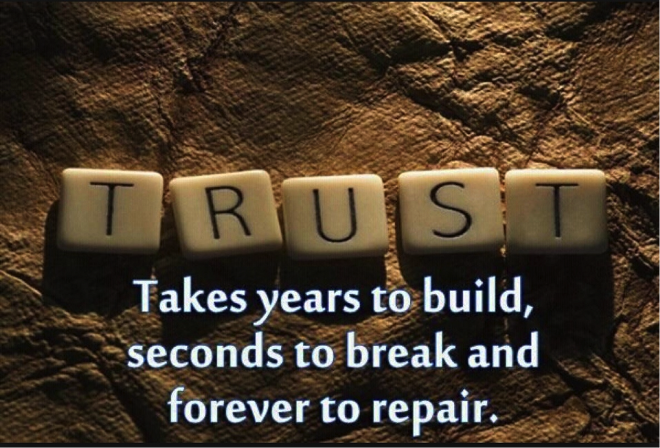
An institution that fails to engender trust is a failed institution.  And – especially in the case of Christ’s Church – we deserve to fail if we are untrustworthy.

Can we think of one trustworthy thing we  can do today in whatever leadership position we find ourselves?  Our sacred institutions are depending on us for the love of God.

Networks, Relationships, & Boundaries

Assuming the best about people is inherently a selfish act because the life you change first is your own.  Brene Brown.

In high school I dog sat for UNC’s Women’s Golf Coach.  She connected me to free basketball tickets which was awesome.  But she knew that I wasn’t taking care of Goldie for the tickets. She thought better of me than that.

I guess you could say that Dot was part of a network I cultivated to bring tangible benefits into my life.  It’s good practice for adult success, right?

But actually, Dot was my friend.  I loved her.  And I loved Goldie.

Networking relationships are not the same as personal relationships. Networking is transactional.  I connect with you so that you can help me climb the ladder.  I socialize with you because you can get me into that group/club/circle of influence.

Personal relationships can be transactional too, but the benefits are intangible. They nourish our souls and build our character.

The best professional relationships – I believe – can be personal relationships if we have good boundaries.  Let me say that again:

We can have authentic personal relationships with people in our professional lives if we have good boundaries.

I’m moved by this short Brene Brown talk about boundaries, compassion, and empathy.  We can work professionally with personal friends if our boundaries are strong.  I tend to say, in the course of establishing boundaries, something like, “I’m putting my supervisor hat on now.”  It clarifies that – although we are friendly (or even close friends) we need to make changes, for example, for the sake of professional growth and health.

Some people believe it’s dangerous/impossible to have personal relationships with our co-workers, subordinates, or bosses.  But I believe we can have deep and lifelong friendships with colleagues.  Call me crazy, but good boundaries = good relationships, including personal ones.

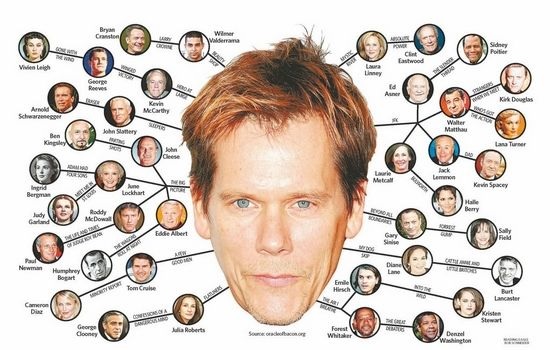
Image is called Happy 2000 by James Fowler, author of Connected: How Your Friends’ Friends’ Friends Affect Everything You Feel, Think, and Do

Dream Team

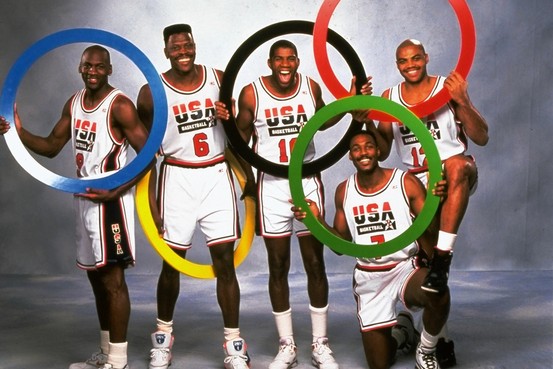
THE Dream Team included the best basketball players in the world and they delivered the Olympic Gold Medal to the United States in 1992.

But I have a Dream Team too.

My dream team includes family and friends who care what happens to me.  I could call many of them in the middle of the night and say, “I need you” and they’d be right over.  My dream team includes an excellent internist who asks me about stress at work, a dentist who knows what it’s like to be a woman in a man’s profession, a coach who knows Church World, a lawyer who doesn’t (but he’s just what I need), an accountant who’s a PK, and a therapist who kicks my butt.  I have an almost perfect dog.  My dream team includes a scheduler who sits at a desk three states away but she knows my every move, a car mechanic who knows the mysteries of Hondas, several barristas and quite a few pastors.

Everybody needs a dream team.

Everybody needs cheerleaders, fixers, and the human equivalent of a pillow.  We need people who stand up for us when we are too tired to stand up for ourselves. We need people who will bring us sweet tea and key lime pie (or whatever brings us comfort.)  We need people who pray for us and with us.  We need people who love us when we are unlovable.

Church People are given obvious and abundant opportunities to be on somebody’s Dream Team or to help people create their own.  I’ve watched countless examples of this: The Church stepping up when a person is living a nightmare with – seemingly –  no way out.

I believe that the world already has a Savior, so it’s not about being somebody’s Savior.  Nevertheless, God has called those of us with solid dream teams in our own lives to use our resources and our privileges to calm the nightmares of others.  Everybody deserves a Dream Team who will support and bless them.

Who is on your own Dream Team?  And subsequently, whose Dream Team are we on?  Do we need to consider sitting with someone in their nightmare?

Image of Michael Jordan, Patrick Ewing, Magic Johnson, Karl Malone, and Charles Barkley.  Be still my heart.

Storytelling is Not a Strategy

Brands are ready to embrace the power of storytelling. Kelly Wenzel

I have a love-hate relationship with branding.  

  • I like easy-to-identify fonts and colors so that when I see a green straw, I think “Starbucks.”  When I see this, I think PCUSA.
  • I don’t like pegging people as in “I know what Jan’s about and my narrative about her is set.”  It’s true that I’m associated with church, Church, and some parenting/cultural shifts/Southern things.  I’m white, married, and straight. But there’s more to me than that.

Contently offered this article last March about the importance of meaning-making but the author was talking about business profits.  It’s an old story that businesses try to tug on heartstrings to tell a story that will make us buy their product.  Think cotton commercials circa 1990s (The Fabric of Our Lives.)

But manipulation is a terrible idea, especially for the 21st Century Church. Millennials are notoriously excellent BS detectors and many others of us can smell when we’ve been targeted.

We tell stories because they make meaning, yes.  But it’s for spiritual nourishment rather than “winning.”  Stories build that armor of protection we’ll need in a cruel world.  Stories comfort us in terrible times.  In the world of faith and religion, stories remind us that we are not alone.

For Christians, it’s particularly meaningful that we have a God whose story includes betrayal and grief and humiliation.  We lesser humans have been there too.  It’s part of our story.

And when we share our stories, it’s not to manipulate or serve ourselves. Storytelling is not a strategy – the Contently people are right.  But a story’s purpose is to connect us to each other.

I wish the image said: “Feed Me. A Story.”  I love food stories and Jesus told lots of them.  Check these out.