Does Carolyn Bryant Donham Deserve Forgiveness?

Nope. 

Sometimes God’s grace is infuriating though.

I believe God’s grace is for Carolyn Bryant Donham too  – even after lying about her interaction with Emmett Till in Money, Mississippi over 60 years ago. He was 14 years old and black.  She was 21 and white.  She told authorities that young Emmett from Chicago – visiting cousins in Mississippi  – had flirted with her and then assaulted her in the store where she worked.

“According to recovered court transcripts released by the F.B.I. in 2007, he let out a “wolf whistle” as she exited the store to get a gun from her car. Bryant later informed her husband and his half brother, who proceeded to uphold a grim tradition: Till was abducted, beaten, shot in the head and thrown into the Tallahatchie River.  A 74-pound gin fan was tied to his neck with barbed wire, with the hope that he would never be found.”  (Source)

In an interview by Timothy Tyson for his 2017 book The Blood of Emmett Till, Carolyn Bryant Donham confessed she had lied.  It was all a lie. And her lie got Emmett Till lynched.

No. Carolyn Bryant Dunham doesn’t deserve forgiveness. She deserves to be punished.  And yet . . .

Last Sunday I stopped for coffee in a rural area on my way to church and was impressed with the cute coffee shop that roasted its own beans and baked its own scones.  It was very crowded for a Sunday morning.  There were sofas and booths for two.  And there was a large table with about 20 people sitting and standing around it.  I took a seat on one of the sofas to sip my coffee and look over my sermon when I overheard a man at the large table complain about “liberals.”

Someone ought to line ’em all up and then string ’em all up,” he said.  And others at the table laughed and agreed.  I admit before you and God that I literally thanked God at that moment for my white skin.  But I said nothing.

If you remember the parable of The Good Samaritan, I was more like the hypocritical priest headed to worship than the Good Samaritan who stopped to do the right thing without regard for his personal schedule.  Frankly, I was afraid.  There were 20 of them and one of me.  Even with my white skin in an establishment full of other white people, I was afraid.

My guess is that Carolyn Bryant Donham was afraid in 1955.  Her husband and brother in law were violent men and maybe they intimidated her to say things she didn’t want to say.  Or maybe she told a small lie that erupted into a huge lie.

Nevertheless, her lie killed a child.  And she doesn’t deserve grace. But God offers it anyway.

All of us have fallen short of God’s glory.  Every one of us.  And yet the God I believe in offers us grace anyway.

It’s maddening.  This means I have to forgive people too – which I rarely want to do.  I like to simmer in my own resentment and anger  – which of course does nothing but kill my soul.

There are no words to express my anger at the Carolyn Bryant Donhams of the world.  But while I’m boiling inside about what that woman did and then what she failed to do, the truth is that I am also in need of forgiveness and so are you.

The astounding thing is that God forgives us even when we cannot forgive ourselves.  But I confess, I have some wrestling to do with God.

Image of Emmett Till’s grave in Alsip, Illinois about ten miles from my and HH’s house in Flossmoor.

Vulnerable

There are reasons why pastors prefer funerals to weddings.

There are reasons why congregations that attract broken people can be more faithful than congregations that attract “young families.”  (In 2015 I wrote this.)

There are reasons why I’d prefer to serve a church that needs Jesus than serve a church that considers itself “successful and prosperous.”

It’s all about vulnerability.  When we are grieving, when we are broken, when we feel unsuccessful and insecure, God does God’s best work. 

But when was the last time we asked God to make us vulnerable so that our faith might grow? That’s a terrifying prayer request.

There was a time when I felt wholly alone in my ministry except for God and a handful of people.  I had been told that I was untrustworthy, manipulative, and disgusting.  I was told that everything would be better if I just went away.  There was a narrative about my leadership that people who didn’t know me believed and people who did know me didn’t refute.

gas·light ˈɡaslīt/
verb gerund or present participle: gaslighting
  1. manipulate (someone) by psychological means into questioning their own sanity.

It was not a good time.  And it made me trust God to save me.

We need Jesus most when we are vulnerable.  And the Church is at its best when we make it safe to be vulnerable – as opposed to perpetuating a culture of “I’m looking great on the outside but actually my life is a hot mess.”

Thriving congregations nurture authentic community based on the fact that each of us is broken in some way.  I certainly am.

I’m not saying that we all need to stand up and tell the world every flaw/heartbreak/weakness/sin/trauma that we carry today – although maybe this works for some people.

I’m saying that we all need at least one person – and possibly a community of people – with whom we can share our hot mess reality.  I’m saying that we all need a Savior who is not our parent, mentor, spouse, or BFF.  And we don’t really know the depth of our need until we experience those desperately vulnerable times.

Being vulnerable is not merely a Brene Brown aspiration.  It’s the reality of being a spiritual human.  And it’s the only way to meet or re-meet God.


ISO Spiritual Curiosity

I would rather be the pastor of 50 spiritually curious people than 500 who go through all the (church) motions most Sundays.

One of my colleagues and I were discussing this the other day and we agreed that looking out from a pulpit at listless people can flatten any sermon  – even those written with great inspiration. I can tell when wandering minds are pondering existential things as opposed to wandering minds who just want to get out of there.  Many churchgoers are just that: churchgoers.

In many places in the United States, there is still an expectation that Good People Go To Church.  Maybe it’s a self-imposed expectation, but it’s soul-killing either way.  The result has been that many people know how to be Church People but we don’t know how to be God’s People.

In other words, we know the lingo (pulpit, font, bulletin) and we know the particular congregational expectations (how to dress, what not to do in the sanctuary- i.e. bring a coffee cup, nurse a baby, talk about personal unpleasantries) and if we – Church People – fail to abide by these expectations, it becomes fodder for gossip or shunning.

Such things are not worth our time if we are spiritually curious.

I remember being asked by young adult parishioners in my former congregation if I would teach them to do Hebrew and Greek exegesis online so that their personal Bible study might be more in depth.  True story.  Maybe they wanted to grapple with life from a spiritual perspective because they had not grown up in the Church.  Their spiritual sensibilities had not been tainted by years of meetings about carpet colors and Guidelines for Arranging Sanctuary Flowers.

Maybe we are so beaten up by life that it’s simply easier to come and go without much spiritual effort.  It’s easier to focus on the unimportant stuff and so that’s what we do.  But imagine using those beaten-up-by-life moments to grapple with God.  Unfortunately, Church is not the community that some people think of when life is falling apart.  #KeepingUpAppearances #NotSafe

Can spiritual leaders be blamed when we are more excited about talking about Big Life Questions with spiritually curious people than serving among people who seem to have forgotten why we are here?  One of the exciting features of 21st Century Church is that there are still people out there who still wonder Why Are We Here?  What is God Doing?  How Can I Find Meaning in the Throes of Chaos?

I love those questions.  And I love the harder ones:  How Can I Possibly Be Friends With People Whose Politics I Find Abhorrent?  How Can I Forgive the One Who Tried to Destroy Me?  How Can I Live With ___?  How Can I Live Without ___?

Spiritually curious people are a joy to be Church with.  They are the ones who get that life is not ultimately about them.  They are the ones I’m seeking out.

What Do You See? I See a Resurrected Church

Every day in every city and tiny village throughout the United States, people pass by church buildings.  The buildings might be towering stone structures once the tallest edifice in town.  Or they might be look like the ecclesiastical version of a ranch style house.

What do you see when you pass them by?  Maybe you don’t notice them at all.  Most people don’t.

All my life I’ve noticed church buildings.  As a child, I could have told you where the Lutheran church building was in relation to the United Methodist church building.  I could tell you where the Latter Day Saints met and where the Roman Catholics worshiped.  I could even tell you were the Hillel Center was on the university campus in Chapel Hill  long before I went to high school.

And I see those buildings now.  I see them with eyes on the future.  

  • What’s happening around that building?
  • Does the space appear to be used daily?
  • Does it look abandoned?

As a Mid-Council leader, I get phone calls from real estate developers weekly asking about that Abandoned-Looking-Church-On-the Hill asking if they could buy that property.  The Charlotte area is booming and new condo construction is everywhere even in the rural areas in surrounding counties.

We are not selling church property to build new condos.  (I’m not a bishop, even if I sound like one here.)

The 21st Century Church looks different – even in the real estate we use for ministry.  Our worship spaces are different.  Our educational spaces are different.  Our mission spaces are different.  I can see it, even if it hasn’t happened yet.

When I pass by an abandoned looking church on the corner, I see affordable housing and free clinics and job training sites.  I see affordable day care and after school programs and clothing closets.  I see gathering spaces for LGBTQ+ youth and addicts and people in the depths of grief.  I see ministry.  Can you see it?

People will tell me that we can’t develop ministry without money and we can’t get money without selling to the highest bidder.  I understand how that works and yet I am optimistic about partnering with organizations willing to share their money while we share our property.

This is not about being landlords.  I’ve written about this before.

This is about being church.  Not lone ranger Church – but collaborative, selfless, it’s-all-about-Jesus Church.  Can you see it?

“Now That We Know, Doing Nothing is No Longer an Option.”

I just finished reading Austin Channing Brown’s Im Still Here: Black  Dignity in a World Made for Whiteness and I encourage everyone to read it. And while you might be tired of my comments that . . .

  1. We (white people) have a lot of work to do, and
  2. We (white people) need to wake up to the realities of white privilege and white supremacy . . .

I admit before you and God that I am one of those exhausting white people that Austin Channing Brown is talking about in Chapter One.  That’s all I’ll say about that for now.

As my eyes slowly open to some of the realities of human history that I was never taught in school or at home, I can no longer not act on that knowledge.  I can’t pretend that I don’t know that . . .

If you believe that this is fake news, I encourage you to do your own research and critically think through these reports.  Seek out trained journalists and researchers – not talking heads and lobbyists.

Churches have a special knack for sweeping unpleasant truths under the rug.  We tend to erase the stories about pillars of the faith who were slave holders or slum lords.  We want to believe that we come from good stock and that our forebears were benevolent community leaders.  Of course they were.

But as I open myself up to the possibilities/stark realities that “my people” might have been complicated human beings who were not always “good” and that my country has a long and disturbing history of separating children from their parents, I find that I must do something in accordance with my faith.

What we do depends on our personalities and our opportunities:

  • We can give money to ministries and other organizations working towards justice.
  • We can be the activists who write our members of Congress and march in the streets to draw attention to discrimination and/or run for office ourselves.
  • We can teach our children and others about the reality that “life, liberty, and the pursuit of happiness” was usually offered only to white people – which is a sin.  Plain and simple.
  • We can challenge those who are telling half-truths.
  • We can pull out our camera phones and record the next white person who calls 911 on a person who is simply living while black or brown.  And then put it on social media.

My own tradition – the Presbyterians – prides itself in being well-educated.  We have established schools of higher education from Princeton University in New Jersey to Daeyang University in Malawi to Universidade Presbiteriana Mackenzie in Brazil.  We have founded secondary schools throughout the world.

We attend Bible studies and book studies and lectures and discussions on international issues.  And then we go home smarter. But nothing changes.

After touring an exhibition on lynching with black and white students, Austin Channing Brown writes in her book that one white student stood on the tour bus and said – emotionally – “Now that we know all of this, doing nothing is no longer an option.” 

Doing nothing when we know that there are hungry people, homeless people, addicted people, terrorized people, lonely people, and broken people makes us complicit.

My friends, if we address these things in the name of Jesus, never again will we need to wonder if the Church is irrelevant or dying.  We will know deeply that it is neither.

ISO Intrapreneurial Pastors

Feeling simplistic this morning and so I’ll just come out and say that there are three kinds of pastors out there – and we need them all:

  1. Church Planters – for starting completely new congregations
  2. Church Chaplains – for helping congregations die with dignity
  3. Church Intrapreneurs – for rethinking and creating new ministries within established congregations

This article explains it right here.

We need pastors who see the future and to paraphrase Bill Aulet of the Martin Trust Center for MIT Entrepreneurship. we need leaders who can “create kingdom values with new ministries, new ways of running congregations, and do it both with assets that the  church controls and assets that the church doesn’t control like partnerships with secular partners. Entrepreneurs can exist (as Intrapreneurs) in congregations and congregations need them more and more.”

I’m talking about the church leaders who learn about the need for affordable housing and – even if all things are going well in ministry – they begin efforts to partner with other organizations to build affordable housing on that extra piece of property they own but are not using.

I’m talking about the church leaders who recognize the need for a jobs training program which would be perfect in unused Sunday School classrooms.

I’m talking about the church leaders who start a second worship gathering in the cafe near the high school on Sunday nights.

More coming later this week but for now – please – read the MIT article.

Image from Sweet Jesus Ice Cream, the Toronto-based company.  It is my undying dream to partner with them. Not kidding.  Especially not kidding if you are the Sweet Jesus people.  Please return my emails and phone calls.

Making New Friends As A Middle-Aged Adult

I once observed three preschoolers checking out the new kittens at the vet while their respective parents were talking about canine flu and dog meds with the doctors.  It was fascinating.

In a matter of minutes, the three children from three different families had exchanged their names and their dogs’ names.  They had each pointed out which grown up was their particular parent.  They had shared a couple of jokes.  They had discussed the possibilities of taking home one of those kittens.  And they were making arrangements to hang out together.  “Maybe you could come to my birthday party,” one little boy offered the other two.  Seriously.  They were making social plans less than ten minutes after meeting by the kitten kennel.

Last night I attended a one night hand lettering class offered through Skill Pop at the suggestion of a colleague thinking I’d learn a new skill and – if I was really lucky – I’d make a new friend who had nothing to do with church.

Two things to note:

1- I love my church friends.

2- Crafts are not my thing unless we’re talking about arranging a cheese board.

I indeed met some fun women at my table – a couple of twenty-something women who work together and brought wine.  There was another woman who looked like somebody I’d love to be friends with – creative, mom of three grown kids and two step-kids, native New Yorker, young grandmother, cool haircut and fun eyeglasses.  We chatted about everything from having babies to hormone-related acne.  (Like I said, we were all women at this table.)  I got some shopping tips.  The young women offered to share their prosecco.  But I left with my art work and no plans to meet my classmates for coffee.  No one invited me to her birthday party.

Actually, if one of those women had invited me to her birthday (or any) party, I probably would have felt awkward.  I mean we had just met.

Most of us meet new friends through work – which is great – but work-related friends have boundary implications.  Many of us have old friends from childhood or high school or college – which is also great – but with different work schedules and family schedules, it can be hard to get together.

I frankly like to be alone but it’s a new adjustment as I now live alone for the first time in many decades.  I’m grateful that HH is just a phone call away, but it’s weird not turning to him on the sofa to tell him something that happened today.  We’ll figure it out.

Figuring out how to make friends as an adult is trickier.  Nevertheless I’ll be taking more Skill Pop classes – mostly for the classes, but you never know.

Image from Skill Pop.

“That’s the Best Thing a Church Has Ever Done”

Okay – calm down.  It probably wasn’t the best thing the Church has ever done, but it was pretty great.  This video is 14 minutes long but if you don’t want to watch it, just keep reading . . .

I took a Lyft to the airport last Friday, leaving General Assembly early for a wedding in Philadelphia. It had been a great week for a long list of reasons and I was staring into space and relishing the memories when this conversation happened:

Lyft Driver Kevin:  Were you here for a conference?

Me:  Yes, the Presbyterian Church USA.  You might have seen us on the news Tuesday night.  We were on the local Fox channel.

LDK: Why were you on the news?

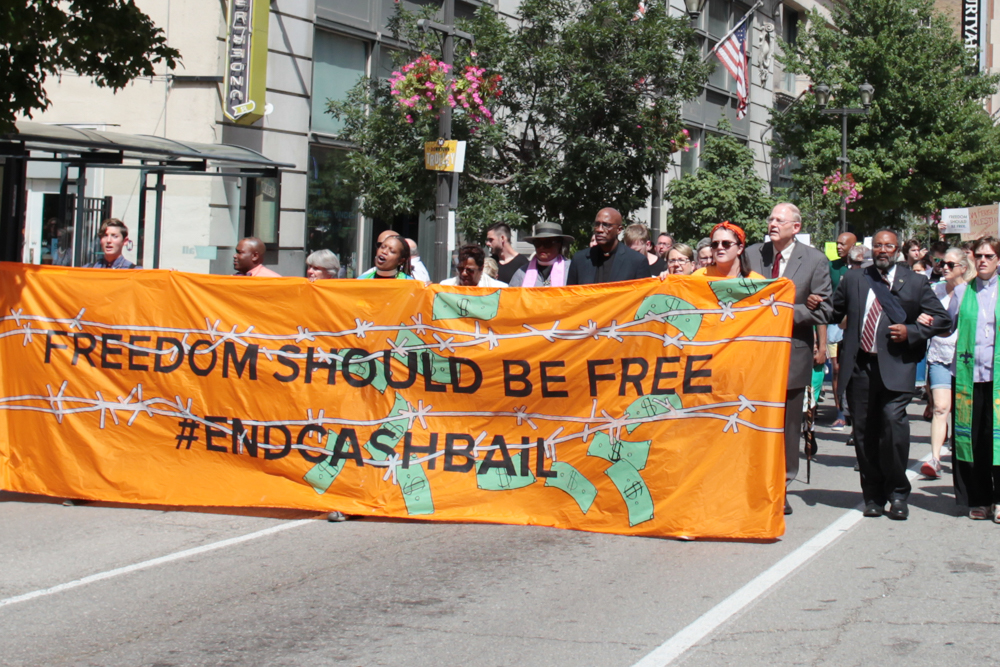
Me:  We marched from the Convention Center to the Courthouse with $47,000 to bail out some people who couldn’t pay their cash bail.  It was our worship offering from Saturday.

LDK:  Your church did that?

Me:  Well, it’s not just my church.  But yes, we did that.  We paid the bail to release about 3 dozen non-violent offenders.  It was pretty great.

We got to the airport, pulled over, and when we went to his trunk to retrieve my luggage, Kevin said, “I feel like I’ve met a friend today.  That’s the best thing the Church has ever done.”  And he hugged me good-bye.

This is what the world is looking for, my friends:  less talking, more concrete ministry that helps those in need here and now.  It wasn’t the very best thing the Church has ever done, but – like I said to Kevin – it was pretty great.

Image  by Danny Bolin from the march on June 19 march led by the Rev. Dr. J. Herbert Nelson, Stated Clerk of the Presbyterian Church USA.  You can still donate to this action here.

Sometimes We Get It Wrong

Yesterday’s Supreme Court ruling to affirm the ban on travelers from Iran, Libya, Syria, Yemen, Somalia, Venezuela and North Korea (five of those nations being predominantly Muslim) felt like an anti-American mistake to some of us.  Writing for the minority, Justice Sonia Sotomayor called the decision “gravely wrong.”  She compared it to the 1944 Supreme Court decision that allowed the detention of Japanese-Americans during World War II – a decision that has since been overruled.  Donald Trump called for a “Muslim ban” in 2015 and although he has tweaked that message as President, his travel bans still smack of sanctions against a particular religion. This is inconsistent with the principles of our democracy and with the message of Jesus.

Sometimes even our Supreme Court gets it wrong.

The same is true for Church councils and courts.  Sometimes we get it wrong.

Presbyterians believe that – in the context of an equal number of ruling elders and teaching elders (pastors) at the General Assembly every two years, the commissioners  – guided by advisory delegates and informed by the 170 Presbyteries  – are charged with “discerning and presenting with the guidance of the Holy Spirit, matters of truth and vision that may inspire, challenge, and educate both church and world” (Book of Order, G-3.0501c).

This is how the General Assembly makes decisions and in the case of constitutional changes, those decisions must be further approved by a majority of those 107 Presbyteries.  (Note:  For God so loved the world, God didn’t send a committee.)

This is how my denomination has discerned changes in everything from the ordination of women to the decision not to wholly divest from fossil fuels – and many, many things in between.

Some believe that last week’s decision to vote down divestment from all fossil fuel stocks in denominational investments was not the faithful decision.  Others believe it was the right decision for this time.

Sometimes we get it wrong and sometimes we get it right and truth (with a small “t”) is like that.  It changes.

My hope is that one day the Papal Head of the Roman Catholic Church will discern that it’s “right” to ordain women and allow priests to marry.

My hope is that one day my siblings in the other Presbyterian denominations will discern that it’s indeed “right” to recognize that God calls faithful LGBTQIA people into leadership.

My hope is that one day soon, fossil fuels will be replaced by alternatives that do not wreck the earth.  Especially for our faithful siblings whose livelihoods come from oil companies, know that your calling as Christians includes caring for this Earth that God gave us.

All of us need to do better in caring for the planet.

All of us need to educate ourselves about our Muslim neighbors.

This is how we get it right.

Images are The Four Justices by Nelson Shanks (2013) which hangs in the National Portrait Gallery in Washington, DC and from the 223rd General Assembly of the Presbyterian Church USA in the St. Louis Convention Center last week.  [Note:  Not all the Justices of the Supreme Court are women.]

Long Ago When I Used to Read The New Yorker Cover to Cover

I was a lonely pastor in my twenties.  I lived alone in a town of 400 and was the solo pastor of a lovely church with a very part-time organist and – until she died after tripping over the mimeo machine in her kitchen – a volunteer bulletin person.

It was the kind of place where people phoned me if they saw a light on in the manse at 3 am – concerned that I might be sick.  It was the kind of place where – if out of town guests were visiting – everyone commented on the out of state cars in the driveway.

It was the kind of place where I left town on my Sabbath – either taking the train to NYC for an overnight with ALC or driving the short distance to Manchester, VT for the day where I ate blueberry pancakes at a little place across the street from an independent book store.  And then I spent the rest of the day in that book store.  I read art books and poetry and it saved my life in terms of my loneliness.

I also read The New Yorker cover to cover every week because it was my escape.  I lived in far upstate rural New York and it connected me to the city.

Sometimes I wrote notes to Peter Cameron after reading one of his stories and sometimes he wrote back.  Once I attended a reading by May Sarton at the independent book store and I wrote her too.  She sent me a an autographed book of her poems.  I had time to do those things.  Living alone = more alone time.

Today, for the first time in a long time, I read The New Yorker cover to cover.  I read about construction issues at the 21 Club and about the sad Paisley Park museum where Prince used to live.  I read a cute story by Simon Rich and a book review for Famous Father Girl: A Memoir of Growing Up Bernstein by Leonard Bernstein’s oldest daughter.  I read some articles about politics in Mexico and looked at all the cartoons.  It was like eating dessert all day long.

Call me elitist/blessed/lucky.  Whatever you wish.  But what’s lovely today is that TDA and I are the former co-moderators of the General Assembly of the Presbyterian Church USA.  So I took Monday off.

Cover of The New Yorker on August 28, 1965.  (Mom’s 32nd birthday)