Putting Up With It (Or Not) Is About God

“You have to put up with things the way they are.”

  • What if the price for getting a good job in your community is pollution of the local water sources?
  • What if new industrial jobs require an upshot in cancer rates?
  • What if being married to a husband who can provide a nice home means putting up with his bad temper?
  • What if living in an area with minimal gun regulations results in increased levels of accidental gun deaths?

Again, I’m loving Strangers in Their Own Land by Arlie Russell Hochschild as I try to understand our nation’s political/religious divide.  (Note to Washington, DC people:  Dr. Hochschild will be at Kramer Books next week.)

Community Organizers are known for working towards a world as it should be, not the world as it is.  The Louisianans interviewed by Dr. Hochschild are suspicious of Community Organizers as a whole and the divide strikes me as a theological one.

There are Christians who believe that no matter what happens in this life – environmental disasters, cancer, domestic violence, gun violence – it’s okay because everything will be perfect in heaven.

And there are other Christians who believe that we are called to seek God’s will “on earth as it is in heaven.”  In other words, we will fight pollution, cancer, domestic abuse, and senseless gun deaths because we believe that God calls us to make this earth a little bit more like heaven here and now.

Throughout Arlie Hochschild’s book, those she interviews and befriends people who say, “That’s just the way it is.”  Racism, Sexism, Crime, Climate Change, Poverty?  That’s just the way it is.  Pollution is the price for capitalism.  Accidental deaths are the price for a the government minding its own business.

One acquaintance of Hochschild’s – in a dinner table debate with a neighbor arguing about a local pipeline leak – said, “You want everything to be perfect, for companies to make no mistakes, and we can’t live like that.”

I wonder if that’s a simplistic difference between conservatives and liberals:

  • Some of us believe “that’s just the way the world is” and we put up with unheavenly things because God will bring perfect justice in the next life.
  • And some of us believe “that we must work towards the world as it should be” choosing not to put up with unheavenly things because God calls us to seek justice on earth.  And perfect justice will happen in the next life.

Still grappling with understanding how my Christian siblings could vote for someone who seems like the anti-thesis of Jesus.  And perhaps they are still grappling with me.  It would be lovely to talk about these things with each other openly and respectfully.

Image source.  Again – thanks TW.

Cutting in Line: Church Version

Quick stats about clergy in my denomination and beyond:

I would like to think that most pastors are about seeking authentic calls instead of climbing ladders.  But the truth is that those called to small rural congregations will be compensated much less than those called to large suburban or urban congregations.  Sometimes we can’t afford to take even authentic calls when the salary will not cover our expenses.

I know fewer pastors who admit to climbing the ecclesiastical ladder these days although it probably still happens.  I have one clergy friend who has intentionally served successively smaller and smaller congregations because he was following the Spirit’s nudging.  He is a great leader and he has the financial security to be able to seek smaller and smaller church positions which pay less and less.

And then there are other pastors whose choices are limited and climbing the ladder is not an option.  For example:

  • Women of color have an especially difficult time being called to serve as pastors anywhere.  Neither congregations where everybody looks like them nor congregations where nobody looks like them are quick to give these talented pastors a chance.
  • Some clergy are tethered to a specific geographic area because of a spouse’s job.
  • LGBTQ pastors are often rejected because congregations “aren’t ready for this.”

And many 60-something (and often 70-something) pastors are delaying retirement.

Yesterday I wrote a post about resentment that happens when “undeserving people cut in line” in terms of job opportunities.  The same thing happens in churches.

As Baby Boomers are (finally) retiring, I hear congregations say they are looking for Millennial pastors – completely bypassing those in the generation between the two.

I know many qualified white straight male pastors who have stood in line for the opportunity to be called to their dream church only to find that the Pastor Nominating Committee is hoping to call a white female or a Person of Color. “It’s hard to be a white male pastor,” one clergy person said to me recently.  Actually, it’s not that hard.  It’s just that being a straight white male is not enough anymore.

My practice is to ask Pastor Nominating Committees to stop thinking “check list” when seeking a new leader.  Stop looking for a person of a specific generation, a specific gender, a specific skin-color, a specific number of years as a “head of staff,” a specific marital status, etc. etc. and discern a real person with an authentic call whom God has gifted for your congregation’s particular needs and hopes.  You might be surprised whom God is lifting up.

In spite of comments that “some people are cutting in line” in Church World,  I know too many women, too many LGBTQ leaders, too many People of Color who have graciously stood in line, waiting their turn to be noticed –  much less called to serve – for long years.

Those of us who have been fortunate enough to be called to something akin to our dream jobs have the responsibility to open doors for those still standing in line.  If possible, we need to make the way clear for our colleagues who seek their dream jobs too.  Especially for those of us who will be retiring sooner than later, we owe it to the generations after us to encourage congregations to seek the pastor with the right gifts rather than the pastor who seems to have the right look.  #NoMorePulpitCandy

Image from Garrett Evangelical Seminary graduation.

Cutting in Line Makes Adults Angry Too

To be the “Line Leader” in elementary school was a big deal for our kids. It gave them what felt like absolute power to – keep their classmates in line – literally. The pride on their faces while leading their friends to the library or to the gym was obvious.  If you were lucky, you got to be Line Leader for the whole week.

And because nobody has a sense of justice like a second or third grader, no one dared to cut in line on their watch.

When adults cut in line, the result could be a shrug or a punch, depending on the context.  There are some very angry people in the DMV line.  Not so much to board a Southwest flight unless you think you can jump into the A line with your sad C boarding pass.

According to a book I highly recommend –  Strangers in their Own Land by Arlie Russell Hochschild – there is a different kind of cutting in line with deep existential ramifications for our nation. (Thanks TW.)

Cutting in line – in terms of life opportunities – results in deep anger and mourning – especially for the American Right.  Hochschild – a San Francisco sociologist – spent five years in the Louisiana bayou befriending  “arch-conservative” residents, and she found that one person’s social movement to bring equality to minorities and women is another person’s experience of having “other people” cut in line.  Especially during the 1960s and 1970s a number of cultural shifts “shuffled the order.”

“During this era a long of parade of the underprivileged came forward to talk of their mistreatment – blacks who has fled a Jim Crow South, underpaid Latino field workers, Japanese internment camp victims, ill-treated Native Americans, immigrants from all over.  Then came the women’s movement.  Then gays and lesbians spoke out against their oppression.  Environmentalists argued the cause of forest animals without forests.  The endangered brown pelican, flapping its long, oily wings, had now taken its place in line.”

If you are a low to medium income white male who has worked hard all his life, you might feel like your place in line is being threatened by a long list of others – with “others” being the operative word.  (Note:  These days, several middle class and upper middle class men have told me they feel that their place in line is being threatened too.)

Our nation was created for white straight males.  But things are increasingly different now.  In the words of Arlie Russell Hochschild:

“All these social movements left one group standing in line: the older, white male, especially if such a man worked in a field that didn’t particularly help the planet.  He was – or was soon becoming – a minority too.”

It will be a while before white straight males indeed become a minority.  But it feels more imminent for our Tea Party neighbors, and it helps explain how we got to such a divided place.  The only way to bridge the divide is to do what Hochschild did:  intentionally connect with people who disagree with us.

Images of a 1950s school class of white boys in the front of the line (top) and the book by Arlie Russell Hochschild.  I liked this book better than Hillbilly Elegy.

Tomorrow:  Cutting in Line – Church Version.

Why This Pastor Sees a Therapist

When I made my first appointment to see a therapist in my new city, I was informed that – because of the location of the therapy offices – I might run into Presbyterian colleagues.  I replied that I not only welcomed that, but I’d be willing to put a bumper sticker on my car that said “I’m here to see a therapist.

Actually, I’m kidding about the bumper sticker, but I’m serious about normalizing therapy.  Why do I see a therapist?

  • It helps to process things that I can’t talk about with my colleagues (because boundaries.)
  • I want to discern my life patterns and figure them out with a wise person.
  • When I’m really busy, it’s easy to lose perspective.
  • Sometimes I’m overwhelmed.
  • I just started a new position in a new city away from family and old friends.  I should probably talk about that with a professional.

I have had a therapist everywhere I’ve lived since college – through deaths, break ups, births, and job shifts.  It makes me a healthier person.  And it’s different from coaching or spiritual direction – although I need those things too.

Whether we are clergy people, mail carriers, electricians, educators, senators or stay-at-home parents, life can be busy/crushing/soul-sucking/wonderful.  I, for one, need to process all that.  How about you?

Image of a t-shirt you can buy here.  

“Silent Sam” Was Actually Screaming at Some People

I was born, raised and educated in Chapel Hill, NC.  I walked by, sat by, and have taken photographs by “Silent Sam” countless times.  I knew the tale about this statue of a Confederate soldier with a rifle but no cartridges who only fired his gun “when a – presumably female – virgin walked by.”  Hilarious.

And I’m not a fan of destroying property.

But this “silent” statue was actually screaming White Supremacy.  Most of us just couldn’t hear it.

Imagine hearing – out loud – this speech on June 2, 1913 by the Davie Poplar in McCorkle place off Franklin Street, 48 years after the Civil War spoken by UNC trustee and Confederate Army veteran Julian Carr:

One hundred yards from where we stand, less than ninety days perhaps after my return from Appomattox, I horse-whipped a negro wench until her skirts hung in shreds, because upon the streets of this quiet village she had publicly insulted and maligned a Southern lady, and then rushed for protection to these University buildings where was stationed a garrison of 100 Federal soldiers. I performed the pleasing duty in the immediate presence of the entire garrison, and for thirty nights afterwards slept with a double-barrel shot gun under my head.

Lord have mercy.  Christ have mercy. Lord have mercy.

I didn’t know that history because I was never curious enough to find out.  In fact, I’m not even sure I was aware that “Silent Sam” depicted a Confederate States soldier.  I never noticed the details.  I never had to notice because it didn’t hurt me.

Today it hurts me.  I was stunned that – at the very least – there wasn’t an accompanying plaque explaining the vile history of this statue, but then, why in the world would anyone – except a current day white supremacist – allow such a statue to remain on the campus of a distinguished university if they knew about this dedication speech?  (The whole speech can be read here.)

A good book to read about Confederate statues is Mitch Landrieu’s In the Shadow of Statues: A White Southerner Confronts History.  It changed my heart about this issue.

White Supremacy is alive and well – in my own heart too.  I hate the destruction but I get it.  We can do better and it begins by White People doing our homework and listening for the screams.

Image of a toppled Silent Sam.

I Don’t Understand How You Can Call Yourself a Christian and Vote That Way (And You Don’t Understand How I Can Call Myself a Christian and Vote This Way)


The ugly polarization between Blue and Red voters in the United States makes my stomach hurt.  I take it very personally when I hear that someone “thinks Trump is doing a good job” in light of what I consider to be his dehumanizing comments and abject cruelty towards people in need.

It’s so personal that it physically hurts.  A vote for Trump, in my mind, was a vote against my daughter in law who is brown, my family who are LGBTQ and my friends who have fled terrorism.  It doesn’t make sense to me – if you also love my daughter in law and the rest of my family, and my friends – that you would think someone who has castigated each of them or people like them is “doing a good job.”

But that’s me. And because I attach religious and moral ties to politics, it’s easy for me to be self-righteous.

So what’s the answer as I now serve in a Church Mid-Council with thousands of people on each side of the political divide who all call themselves disciples of Jesus Christ?  I pray for wisdom and I look for groups like this one.

We need to learn to talk with each other.

When I was a pastor in Northern Virginia concerned with what I considered to be the mean-spirited tone of this periodical, I contacted their editor and asked to be connected with one of their supporters in my geographic area so that we might become prayer partners and drink coffee together and try to understand each other.  The person on the phone told me that “I can’t think of anybody on our side who would want to talk with you.”  Ouch.

I appreciate the hard work of understanding our political foes.  Is there anybody out there who is willing to join me to trying to understand?

Video from the Better Angels website.  Thank you LK.

Random Church is the Best Church – Reprise

A cocaine dealer paid for my brunch yesterday.  

It had been a long day – a long week actually – and it was a good day to eat brunch out.  It’s fairly easy to get a seat at the bar even during the Sunday brunch rush at Zada Jane’s.

My lunch date had fallen through but I don’t mind eating alone. And when you go places alone people are more likely to talk to you.  Enter the coke dealer.

David (not his real name) was sitting beside me at the breakfast bar and he asked me to guess what he did for work.  He was a 30-something wearing a t-shirt and jeans and before I could guess, he blurted out that he was an investment banker.  His point was that we shouldn’t judge people by appearances which is also true for me.  (I made him guess what I do for a living and he thought I was an investment banker too.)

Actually, he was not an investment banker and neither am I.  Our server outed me as a Presbyterian pastor. (I am the resident chaplain at Zada Jane’s.)

David asked for prayer and girlfriend advice and he showed me photos of his kids.  I suggested he phone someone to help him get home and two guys soon came by. (David was drunk.) And then he said he wanted to pay for my brunch.

He pulled out a wad of cash “from last night’s party” and he told me that he’s actually a cocaine dealer “sometimes.”

And sometimes I find church in random places.

Image of the bar area of Zada Jane’s –  one of the best breakfasts in Charlotte. I previously wrote about Random Church here.

When Your Church Sign is a Tombstone

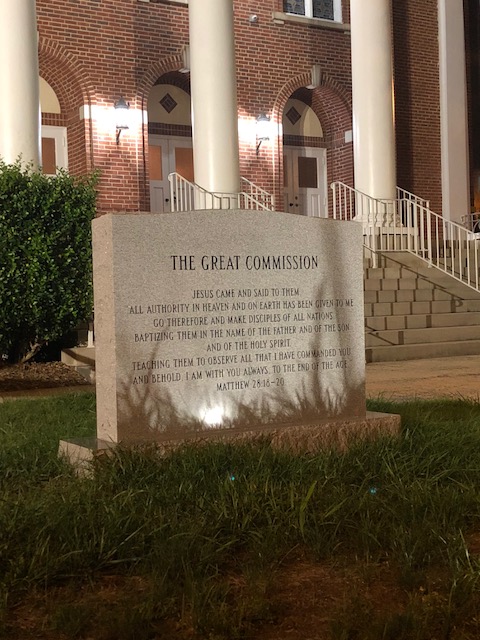
A church in my neighborhood has a tombstone for their church sign.  The congregation is named for a famous Bible verse which is also engraved on the tombstone.

I’ve heard of new church plants that meet in funeral homes and it could work. But people cry a lot in funeral homes and an effective church probably has a healthy crying to laughing ratio.  Church is for crying – yes – but not all the time.  Most people do not laugh in funeral homes. (Note: my siblings and I tend to laugh quite a bit in funeral homes but we have an unusual sense of humor.)

New church venues in theaters, schools, and bars seem to convey a more positive ambiance than funeral homes – the resurrection notwithstanding.

I personally like a nice grave stone. I appreciate the history they share and the stories they perpetuate.

One of my favorite cemeteries is the one behind Thyatira Presbyterian Church not far from where I now live. There are three very old pirate graves among those ancient plots. 

Legend has it that three men left their pirate lifestyle along the coast and settled in Rowan County, NC  but they were later – somehow – outed by pirate hunters. (!) They were subsequently hanged and buried in unmarked graves  – except for a skull and crossbones on each tombstone.

But I digress.

Here’s the thing about choosing a tombstone as your church sign:  it’s disturbingly and unintentionally indicative of your church’s culture.  Yes, it says sturdy and maintenance-free but the truth is that – while The Church is sturdy – the church must be flexible and wide open and changing to suit the ministry needs of the community.  And “maintenance free” church requires further discussion.

Yes, maintaining ministry space is important. But many of our congregations call pastors who only know how to do maintenance.

Instead, the 21st Century Church needs to call culture shifters who will love the people out of old models into a new way of following Jesus for these days.  We need visionaries and prophets and dreamers – along with those who know how to do enough management to keep the ministry thriving.

Following Jesus has very little to do with administrative management.  Again, God bless the managers.  But 21st Century Church Leadership actually has everything to do with training disciples who will proclaim the message of Jesus, offer community to God’s people, lead worship, speak the Truth, inspire people to work for justice, and show the neighbors what the love of God looks like out in the world.

When your church sign is a tombstone, resurrection is certainly possible.  But I can’t help but wonder if somebody is secretly expecting death with no resurrection, even in their wildest imagination.

Images are of 1) a church sign in my neighborhood and 2) the pirate graves at the Thyatira Church cemetery.  

Hello Death

At this time about 28 years ago, my father was dying of cancer and I remember asking my brother, “Do you think he’ll be alive at Christmas?” and my brother said, “I don’t think he’ll be alive in September.”  It kind of made me angry when he said that.

Dad died on August 24, 1990.

I remember this when I talk about the life cycles of congregations because I can make church people angry when I say things like, “I don’t think this church will be alive in September.”  Actually, I’ve never said that to church people but I’ve thought it.  What I have said is this: “if we don’t do ministry differently, this congregation will close in 3-5 years.

God never promised that individual congregations would live eternally.  We only know that there will always be The Church of Jesus Christ (with a capital C.)

St. Giles Church in Edinburgh – often called the Mother Church of my tradition (Presbyterianism) was established as a Roman Catholic church in the 12th Century.  It became a Presbyterian Church led by John Knox in 1559.  It was (briefly, sort of) Anglican in 1637.  Today – although there is still an active congregation – many worshipers are tourists and a gift shop on the premises sells key rings and book marks.  Things have changed over the past 900 years. Most congregations don’t get that much time.

It’s interesting that we Christians who claim resurrection of the dead are so uneasy speaking of the death that is required before there can be resurrection.  We not only mourn the death of loved ones; we mourn the death of the churches we’ve loved and served.  Perhaps the church of our childhood is still standing but it’s a shadow of its former self.  It’s breaks our hearts.  We wonder what’s going to happen to that cemetery with all our ancestors buried there.

The reality that our congregations will one day die is shocking.  We don’t want to hear it.  That diagnosis is for other churches – not for ours.

And when we hear that our particular congregation is dying, it feels like the work we’ve put into it is invalidated.  I know so many good pastors and other church leaders who’ve put untold hours and money into congregations which have fed them and loved them, only to see those churches dwindle in membership and prestige.

But here’s the thing:  it was never about membership and prestige.  It was always about sharing the message of Jesus.  How are we sharing the message of Jesus in a culture that will not cross the threshold of a church building?

Churches exist to change the world in Jesus’ name.  And there are churches everywhere doing just that: sheltering the lost, welcoming the broken, housing the homeless, comforting the sick.  The wonderful news – the shocking news – is that the message of Jesus continues to be shared even after the death of loved ones and after the death of congregations.

I, for one, look forward to witnessing lots of resurrection.

This post is written in memory of one who is shockingly gone although the message of Jesus she shared will continue to be proclaimed long after her funeral today.  We thank God for the extraordinary life of the Rev. Dr. Katie Geneva Cannon, Child of God and Minister of the Word and Sacrament.


Mental Health Expenses

I’ve been gone for two weeks:  one for vacation and one for study leave – although HH and I were leaders at that Continuing Education event.  Also we lost a car and a phone but that’s for another post.

I learned at the Clergy Couples Conference at Massanetta from financial advisor Brad Barnett that:

  • The average family of four spends $568-$650 a month on food (at least that’s the “thrifty plan.”)
  • Brad’s family of four spends $360 a month on food.  (Note:  Brad is probably not a foodie.)
  • The average monthly car payment is about $500.
  • If people starting at age 30 until age 67 save $5.50 a day instead of spending it at a coffee shop, they will have $700,000 by retirement.

Of the Big Three expenses that human beings have in this country, the average breakdown of one’s income goes like this:

  • Housing 33% of income
  • Transportation 17% of income
  • Food 13% of income

. . . which leaves 37% for sharing, saving, paying off debts, clothing, educational expenses, medical expenses, hobbies, vacation, pet expenses, gifts, and an occasional coffee out. In a perfect world.

Some of those things I’d call mental health expenses.  And I’m not just talking about what we pay the therapist.

Almost everybody – regardless of income level – spends money on items that bring us calm/sanity.  For some, it’s individual cigarettes. For others it’s weekly pedicures.  For a blessed few it’s an annual vacation to a sunny venue with tropical adult beverages.

[Note:  There’s a fine line between self-destructive behavior and self-care behavior.  One person’s Friday glass of wine is another person’s weekend binge.]

But what if eating out and/or buying coffee in a comforting cafe offers a slice of mental respite?  I have a sun roof in my car expressly because it feels like a little vacation every time I take the wheel.  And I consider an occasional bouquet of flowers to be good for my soul.

People with financial discipline are to be admired and emulated.  No dinners out = vacation money.  I get it and good for you if you don’t even drink coffee.  But there is deep joy and nourishment in using a little money for something that we can savor in a moment of peace whether it’s expensive cheese or a foot massage.

Clearly, this is not a post for those with absolutely no financial wiggle room.  College debts and lifelong poverty – among other things – makes much of this a fantasy.  Many clergy couples I know have both seminary debts and children, and their incomes hover just above the poverty line.  Most first call pastors make “the minimum” established by their Mid-Councils.  Or they earn less because they are “part-time” which is church talk for Full Time Ministry on the Cheap.

Talking about money is not my favorite thing.  HH and I returned home and looked over our own expenses and we can do better.  Not $360-a-month-for-food better, but better.

I learned so many things while away over the past two weeks.  One was that my soul needs flowers and an occasional cup of coffee out with friends.  What are you learning this summer?

Image of a $3.99 bouquet from Trader Joe’s.